
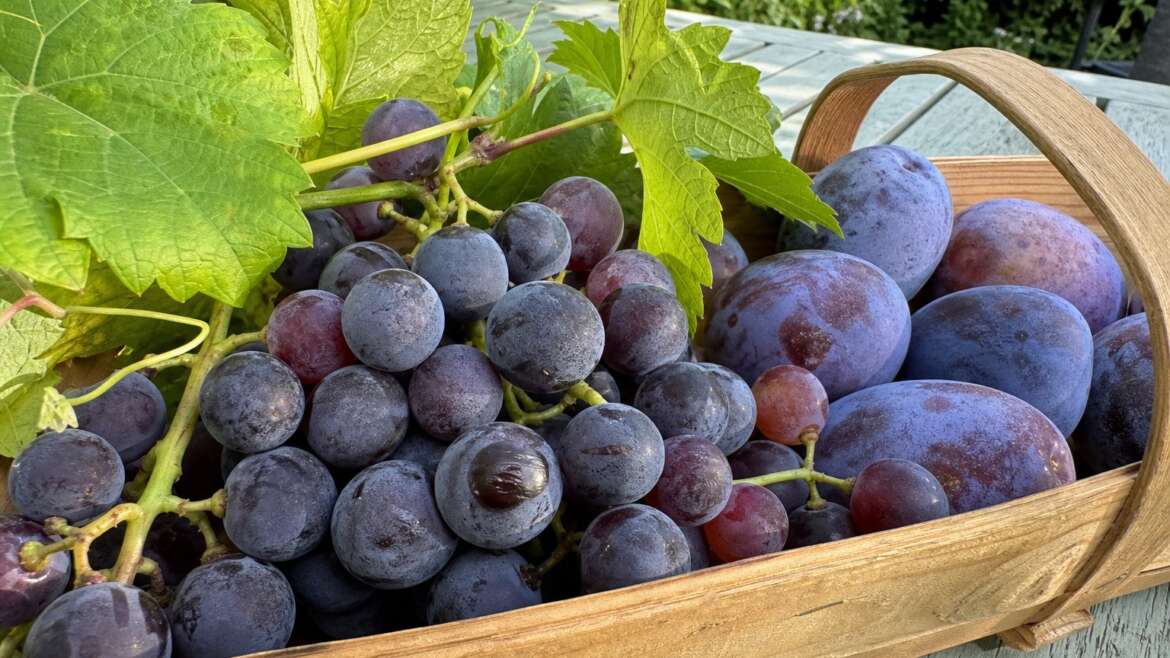
September fruit has a habit of looking more mysterious after you pick it. A cluster of grapes that seemed almost black on the vine turns blue-gray in the basket. A plum looks as if it has been dusted with flour. Touch either one and your fingertip leaves a dark, glossy mark, as though you have rubbed a small window through the haze.
It is easy to mistake that powdery film for trouble. Gardeners are trained to be suspicious of pale dust on plants, especially if they have already fought powdery mildew on squash, phlox, cucumbers, or grapes earlier in the season. But the soft bloom on sound grapes, plums, blueberries, damsons, and some other fruits is usually not disease at all. It is part of the fruit’s own skin, a waxy outer layer that the plant builds while the fruit is developing.
That bloom is delicate enough to smudge with a finger, but it is not cosmetic in the shallow sense. It is a working surface: part of the fruit’s boundary with the world. The wax helps govern water loss and wetting, changes the light reflected from the skin, and takes part in the fruit’s encounters with microbes, insects, and abrasion.
What the bloom actually is
The outside of a grape or plum is not just a thin bag of color. Like leaves and young stems, fruit is covered by a cuticle, a protective layer made largely of cutin and waxes. A review in Frontiers in Plant Science describes the plant cuticle as the outer barrier that helps prevent water loss and acts as a first defense against environmental stress, pests, and pathogens.1
On some fruits, part of that wax forms outside the cuticle as microscopic crystals. These are called epicuticular waxes. To the naked eye they read as bloom: pale, matte, powdery, and slightly blue or silver. Under magnification, the surface is less like flour and more like a tiny landscape of plates, ridges, flakes, and roughened wax architecture.
Grapes are especially good at showing this. Research on grape berries found that the glaucous, or bluish-white, covering comes from epicuticular wax crystals that appear early in fruit development and change as the berry expands and ripens.2 In practical garden terms, the bloom is not something that landed on the fruit. It is something the fruit made.
That is why the bloom is usually most beautiful on fruit that has been left alone. Grapes deep inside a cluster may stay heavily frosted. Plums handled by the stem keep their soft veil. Fruit that has rubbed against a branch, another fruit, a picking basket, or a gardener’s palm develops glossy patches where the wax crystals have been flattened or moved.
Why a dark fruit can look blue
The bloom also changes how fruit handles light. Many dark grapes and plums contain red-purple pigments in their skins, but the wax layer above those pigments can scatter light in a way that gives the surface a cooler, bluer cast. A 2024 paper in Science Advances looked at dark fruits with wax bloom, including plums and juniper cones, and found that their blue or blue-ultraviolet appearance can come from structural color produced by the wax coating rather than from blue pigment itself.3
This is one reason a plum changes so dramatically when polished. The underlying skin may be burgundy, purple, or nearly black, but the intact wax makes it look misted with blue. Rub the wax smooth and the fruit becomes darker, shinier, and visually heavier. Nothing has ripened in that instant. The optics have changed.
Gardeners can use this as a small lesson in looking. The color of fruit is not only pigment. It is pigment plus surface. A grape’s skin, a plum’s wax, a blueberry’s haze, and even the angle of morning light are all part of what your eye reads as ripeness.
What the fruit gains from it
The simplest benefit of bloom is water management. Fruit is mostly water, and ripening fruit has a problem: it needs to stay juicy while sitting in sun, wind, and fluctuating humidity. A waxy, water-repelling surface helps limit water loss and makes it harder for raindrops to spread across the skin as a continuous film.1
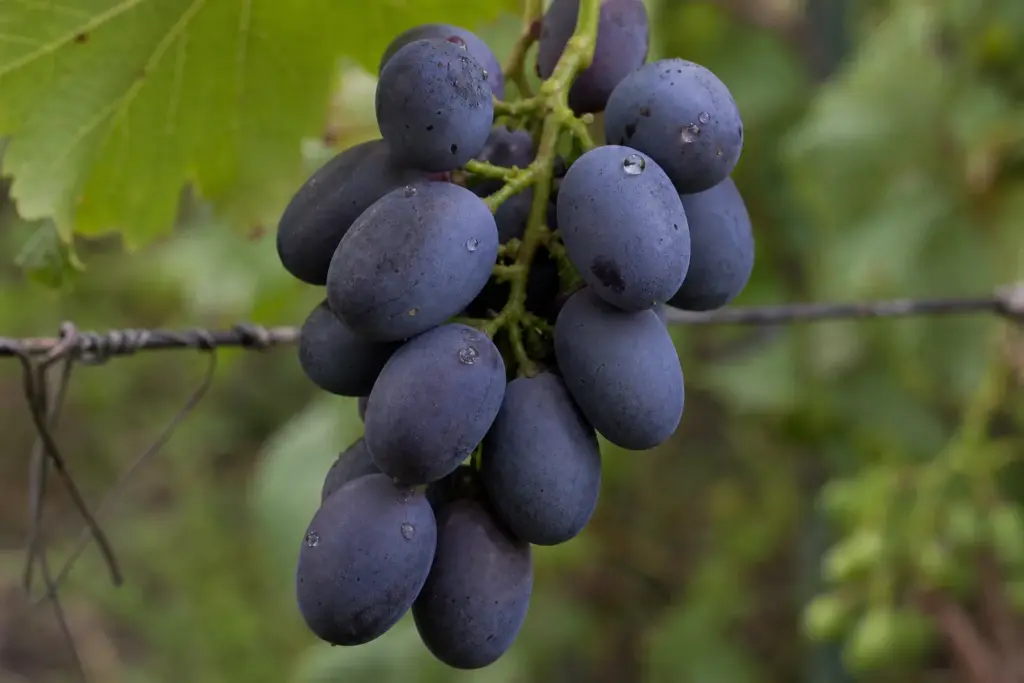
In grapes, cuticular wax has been studied as part of fruit quality and storage. One study comparing grape cultivars found that dense wax crystal structures were linked with the glaucous appearance of berries, and that cuticular wax contributed to the water-preservation capacity of grapes after harvest.4 That does not make wax a magic shield, but it helps explain why intact, gently handled grapes often look fresher than fruit that has been polished by too much picking, packing, or washing.
Plums tell a similar story. In a study of European plums, polishing or chemically removing the epicuticular wax roughly doubled measured luster. Under the study’s storage conditions, refrigerated fruit with its natural wax lost the least weight, while polishing and warmer storage increased loss.5 It is a useful experiment, not a promise that every cultivar or refrigerator will behave identically.
The crystal-covered surface is hydrophobic: a droplet on an intact bloom often beads rather than spreading flat. That helps explain one function of cuticular wax, but it is not a treatment or immunity. Wax composition and structure can influence encounters with microbes and insects in complex ways, while cracks and wounds still open routes for decay.14 Judge disease from the fruit tissue and the rest of the vine, not from bloom alone.
How to tell bloom from powdery mildew
The confusion is understandable. Both bloom and mildew can look pale. Both can appear on grapes. Both can be most visible when light catches the surface from the side. The difference is that bloom belongs to healthy fruit skin, while powdery mildew is living fungal growth.
Natural bloom is usually even, matte, and closely fitted to the skin. It follows the curve of the fruit. A touched patch often looks darker and glossier, while the heaviest bloom remains where neighboring fruit and hands have not rubbed it. Sound bloomed fruit should still be firm, clean, and normal-smelling. Rubbing is only a clue, however; a wipe test by itself cannot diagnose mildew.
Powdery mildew behaves differently. Cornell’s grapevine powdery mildew fact sheet notes that white or gray conidia can cover leaves, rachises, and berries; infected berries may turn dull gray or brown and sometimes split, while stem infections can form brown or black lesions.6 In the garden, look beyond the powder. Check the leaves, cluster stems, and fruit skin underneath for fuzzy growth, lesions, cracking, discoloration, or damaged tissue.
The clean bloom on grapes begins during normal berry development, whereas powdery mildew can involve several parts of the vine. If the foliage is clean, the fruit is firm, and an even frosted surface gives way to healthy glossy skin where it has been handled, bloom is the better explanation. White or gray fungal growth on leaves and cluster stems, dark lesions, or damaged and splitting berries point toward disease. When the evidence is mixed, compare several clusters and obtain a local diagnosis before choosing a treatment.
Harvesting without polishing it away
Because bloom is fragile, the best way to preserve it is to touch the fruit less. Clip grape clusters with clean shears rather than pulling individual berries.7 Lift plums into your palm rather than rubbing them clean on your shirt. Use a shallow basket when you can, so fruit is not grinding under its own weight.
Harvest when fruit is dry if weather allows. Penn State advises waiting a day or two after rain so grape clusters can dry before picking, which reduces storage rots.8 Remove injured or decaying berries and cool harvested grapes promptly; do not seal visibly wet fruit into storage. The goal is not to sterilize the harvest. It is to keep sound fruit sound.
For table grapes, do not let bloom distract you from better ripeness tests. Color varies by cultivar and may arrive before full flavor. Oregon State Extension recommends tasting berries at the tip of the cluster, which are among the last to ripen; aroma and flavor continue developing while grapes hang, but grapes do not ripen further after picking.7 A handsome frosted cluster that still tastes sour was harvested too early.
Near-ripe plums can finish ripening at room temperature, but cultivar and harvest maturity matter; Utah State Extension recommends refrigerating them once ripe.9 Bloom can tell you that the skin has been handled gently. It cannot tell you whether an immature plum will become flavorful or whether a ripe one suits your taste.
Washing, eating, and storing
Natural bloom is not a reason to skip washing. It is also not a reason to scrub soft fruit aggressively. The FDA recommends washing produce under running water before preparing or eating it, including produce grown at home, and says soap, detergent, and commercial produce washes are not recommended.10
For clean, dry grapes and ripe plums, refrigerate first and rinse under running water shortly before use; after washing, dry the fruit with a clean towel.7910 Cut away bruised or damaged areas and discard fruit that looks rotten. Bloom is normal. Rot, a sour smell, leaking juice, and badly broken skins are not.
One small pleasure of homegrown fruit is that you can decide when the bloom disappears. A bowl of dusty blue grapes on the counter has a different beauty from a rinsed, gleaming cluster beside breakfast. Both are honest. The first shows the fruit as the plant finished it; the second shows it as the kitchen receives it.
What bloom can teach a gardener
The powdery bloom on fruit is a reminder that plant surfaces are active, not passive. A leaf is not just green. A grape is not just sweet. A plum is not just purple. Each surface is organized at a scale too small for the hand to feel clearly, but large enough for water, light, fungi, insects, and a gardener’s eye to notice.
It also teaches restraint. Not every pale coating is a crisis, and not every mark needs correction. Sometimes the most expert response is to look more closely before acting. Is the surface even or patchy? Is the fruit firm or failing? Are the leaves clean or infected? Does the haze wipe away to healthy skin, or is the tissue underneath damaged?
In a September garden, those questions are worth asking slowly. The season is full of surfaces changing their meaning: dusty grapes, blushing apples, corking squash stems, drying bean pods, leaves beginning to yellow at the edges. The fruit bloom is one of the quietest of these signals. It is not a warning. It is a thin surface built during fruit development and carried into harvest: matte rather than shiny, practical rather than decorative, beautiful because it is doing a job.
References
- Frontiers in Plant Science: The plant cuticle, an ancient guardian barrier set against long-standing rivals
- PLOS One: Developmental pattern of grapevine berry cuticular wax
- Middleton et al. (2024), Science Advances: Self-assembled, disordered structural color from fruit wax bloom
- Frontiers in Nutrition: Comparative analysis of cuticular wax in various grape cultivars during berry development and after storage
- Mukhtar, Damerow and Blanke (2014), Postharvest Biology and Technology: Non-invasive assessment of glossiness and polishing of the wax bloom of European plum
- Cornell Integrated Pest Management: Grapevine powdery mildew fruit fact sheet
- Oregon State University Extension: Growing table grapes
- Penn State Extension: Table grape production
- Utah State University Extension: How to grow plums in your home garden
- U.S. Food and Drug Administration: Selecting and serving produce safely