
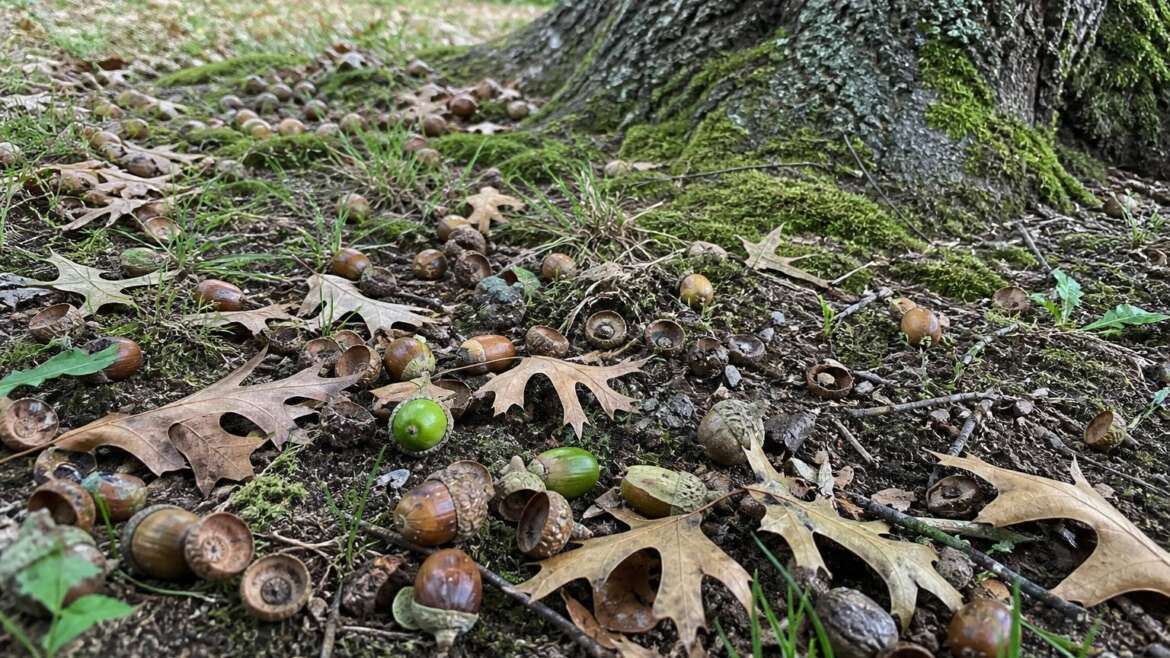
Some autumn mornings begin with a sound before they become a lesson. An acorn hits the roof, then another taps the path, then a whole corner of the garden seems to be clicking and rolling under the oak. By afternoon, the ground has changed texture. The lawn is studded with brown caps. The stone path feels like a loose ball bearing floor. Every squirrel in the neighborhood suddenly looks busy and slightly overwhelmed.
A heavy acorn year can feel excessive, especially if the tree stands over a driveway, vegetable bed, or narrow path. It is tempting to read the mess as stress, omen, or weather forecast. The oak must be worried. The winter must be severe. The tree must be dying. But in many cases, the flood of acorns is something stranger and more ordinary: a mast year.
Masting is the irregular, synchronized production of large seed crops, followed by quieter years. Oaks are a familiar example, but the pattern occurs in many woody plants. To a gardener, it can look like a cleanup problem. To the tree, it is reproduction at landscape scale, timed in pulses rather than steady installments.
A crop that comes in waves
Oak trees do not usually make the same number of acorns every year. Purdue Extension describes mast years as periods of unusually heavy seed production, with oaks often moving through irregular cycles of high and low acorn crops rather than predictable annual output.1 A tree that seemed quiet last autumn may suddenly cover the ground this year, then pull back again.
The word mast originally refers to the nuts and fruits of forest trees, especially the food that falls for wildlife. In the garden, mast is what makes an oak feel less like a single ornamental specimen and more like part of a larger woodland economy. One tree can make the event visible, but masting is often most powerful when many trees in an area produce heavily at the same time.
That synchrony is part of the mystery. Oaks are not checking calendars. They are responding to weather, stored energy, flowering conditions, and signals we still do not fully understand. UC Agriculture and Natural Resources notes that mast seeding is a population phenomenon: the term describes a group of trees producing seed heavily or lightly together, rather than an isolated tree’s productive year. The strength and geographic scale of that synchrony vary; in the cited California work, oaks whose acorns matured in one year were much more synchronized than the two-year species.2
Why make too many acorns?
An acorn is a large, resource-rich seed, not dust or fluff. Building thousands can draw heavily on a tree’s resources; Purdue Extension notes that committing a great deal of energy to seed production can leave less for other functions.1 If the tree made a modest crop every year, animals and seed-damaging insects might be able to keep up with it. A steady supply can support a steady appetite.
One major explanation for masting is predator satiation. The hypothesis is that poor crops can limit populations of some seed eaters, while a later bumper crop can exceed their immediate capacity to find and consume acorns. A 12-year USDA Forest Service study found that acorn removal slowed as crop size increased, consistent with heavy crops temporarily swamping predators. The result was not absolute: nearly all acorns were eventually removed in every study year but one.3
This does not mean the tree is thinking like a strategist. Natural selection does not require intention. A pattern that leaves more surviving seedlings over many generations can persist even if each individual tree is simply responding to internal resources and environmental cues. From the garden path, it looks like extravagance. From the oak’s long view, it is a way of making a few chances out of thousands.
The crop began before autumn
By the time acorns hit the ground, much of the story is already old. Oak flowers appear in spring, and pollination happens long before anyone is sweeping the patio. Weather during flowering and seed development can shape the eventual crop; Purdue identifies late freezes, extreme heat, summer drought, and other stresses as possible causes of reduced pollination or acorn production.1
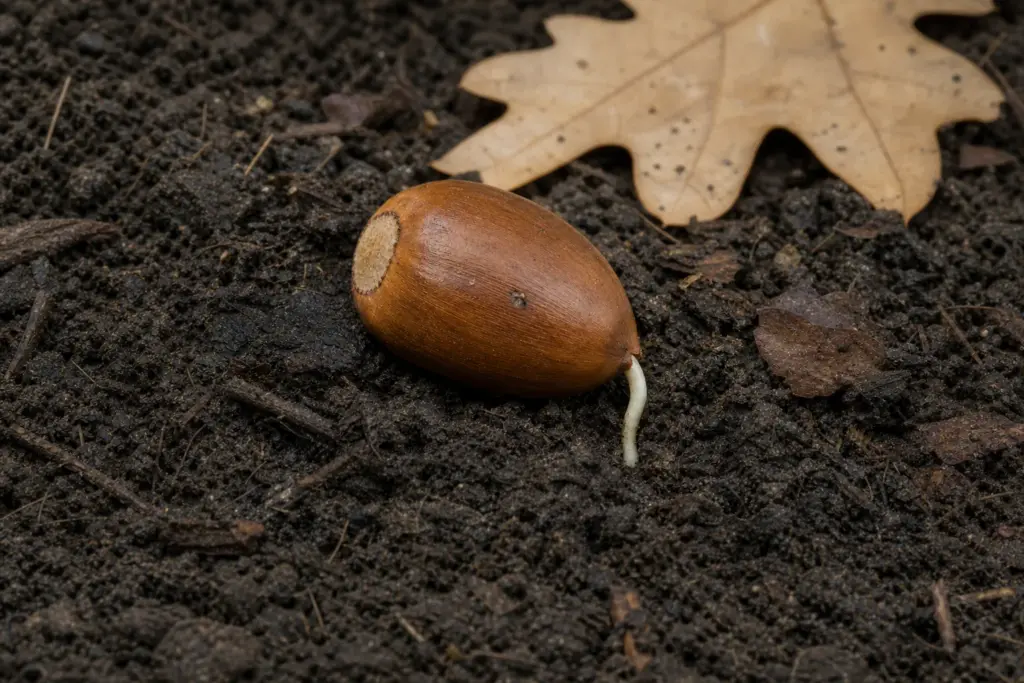
Different oaks also work on different schedules. As a broad pattern, acorns in the white oak group mature in one growing season and can begin germinating soon after they fall. Acorns in the red oak group generally mature over two seasons and remain dormant until a period of cold, moist conditions helps prepare them for spring germination. Mississippi State University Extension describes this contrast while emphasizing that storage and sowing should match the oak being handled.4 These are group-level tendencies, not a universal recipe; species and provenance still matter.
That difference matters when you read the ground. The acorns under a white oak may be ready to send a root down almost immediately. The acorns under a red oak may look still and inert through winter, waiting for cold, moisture, and time. Both are doing oak work, but their clocks are not identical.
Not every acorn is a future tree
A mast year can make the ground look impossibly fertile, but abundance is not the same as certainty. Some acorns are immature. Some dry out. Some are unfilled or insect-damaged. Some are eaten before they ever reach a safe place. Some sprout, then fail because the site is too dry, too shaded, too trampled, or too crowded. Mississippi State’s collection guide warns that even a visibly abundant crop can contain many acorns incapable of producing seedlings.4
This is why the acorn crop must seem wasteful to work at all. A single oak seedling needs the right acorn, in the right place, with enough moisture, light, soil contact, and protection to survive its first fragile years. The great carpet of nuts under a mature tree is not a promise of a forest. It is a field of attempts.
For gardeners, this can be reassuring. A path covered in acorns does not mean every bed will become an oak nursery. Most acorns will disappear, fail, or be moved. Remove unwanted seedlings while they are small; once a young oak has invested in its taproot and lateral roots, lifting it cleanly becomes harder.4
What to do with the acorn mess
On a hard path, terrace, or driveway, acorns are a practical nuisance. They roll underfoot, jam into treads, and can make a wet walkway awkward. Sweep or rake them where people walk. Under shrubs, at the edge of a woodland bed, or in a rougher corner, they can be allowed to become part of the autumn litter layer. There is no need to treat every fallen acorn as waste.
In lawns, the answer depends on depth and use. A scatter of acorns is not usually a crisis. A thick layer can make footing and mowing awkward. Rake excess acorns from high-use turf, but avoid stripping the ground under trees into bare soil every fall. Oak roots, leaf litter, fungi, insects, and seedlings all belong to the same small economy.
Acorns and caps can go into a home compost pile. University of Maine Cooperative Extension recommends treating them as a carbon-rich ingredient, alternating them with nitrogen-rich materials, and chopping them if faster breakdown is wanted.5 Whole acorns decompose slowly and may sprout before they break down, which is harmless but inconvenient. Crush them first or accept that a few oak seedlings may become part of the editing.
Growing an oak from a year of plenty
A mast year is a good time to try growing an oak, as long as you start with realistic patience. Choose acorns soon after they fall, before they have dried or been chewed. Look for firm, full acorns without obvious holes, cracks, or mold. Iowa State University Extension says sound acorns sink in water while most floating acorns are not viable, but use the test as a first screen rather than proof.6 Check species-specific guidance too: Mississippi State excludes overcup oak acorns from its float-test advice.4
Then identify the oak group if you can. White oak group acorns are often planted soon after collection because they may begin rooting quickly. Red oak group acorns usually need a cold, moist interval before spring germination; our guide to cold stratification explains why both temperature and moisture matter. Mississippi State emphasizes that red and white oaks differ in dormancy and sowing needs, so storage and planting should match the oak you are handling.4
For a home gardener, the simplest method is often to plant several sound acorns in a protected nursery bed or in pots deep enough for early root growth, then keep the strongest seedlings. Mississippi State recommends oak pots at least 1 foot deep, with good drainage and a shape that discourages roots from circling.4 Protect young plants from digging, browsing, and drying out, and plan for the mature tree, not the charming seedling. An oak is not a patio annual with better posture.
The year after abundance
After a heavy acorn year, the next autumn may feel strangely empty. That does not necessarily mean the tree is declining. Oak crops vary with species, weather, tree resources, insects, and population-level mast patterns; a low year after abundance is possible, but not a fixed schedule.1 Nor is a bumper crop a forecast of a hard winter. A UC Davis oak specialist puts the reason plainly: acorns reflect conditions that have already affected the tree, not weather that has yet to happen.7
This is one of the pleasures of living with mature trees. They refuse to behave like garden fixtures. A fence looks the same each September. A stone path waits passively. An oak, even one you have known for years, can suddenly change the sound, footing, and work of the garden. It can make a season feel full underfoot.
When the acorns come in floods, sweep where you must, save a few if you want seedlings, and leave some where the garden can afford a little wildness. The oak is not being messy for no reason. It is spending a year of stored sunlight on a gamble older than the path beneath it.
References
- Purdue Extension: Why Are There So Many Acorns This Year?
- UC Agriculture and Natural Resources: Geographical Ecology of Acorn Production by California Oaks
- USDA Forest Service: A Test of the Predator Satiation Hypothesis, Acorn Predator Size, and Acorn Preference
- Mississippi State University Extension: Growing Your Own Oak Seedlings
- University of Maine Cooperative Extension: Maine Home Garden News, October 2020
- Iowa State University Extension: Germination of Tree Seed
- UC Davis: Bumper Crop of Acorns