

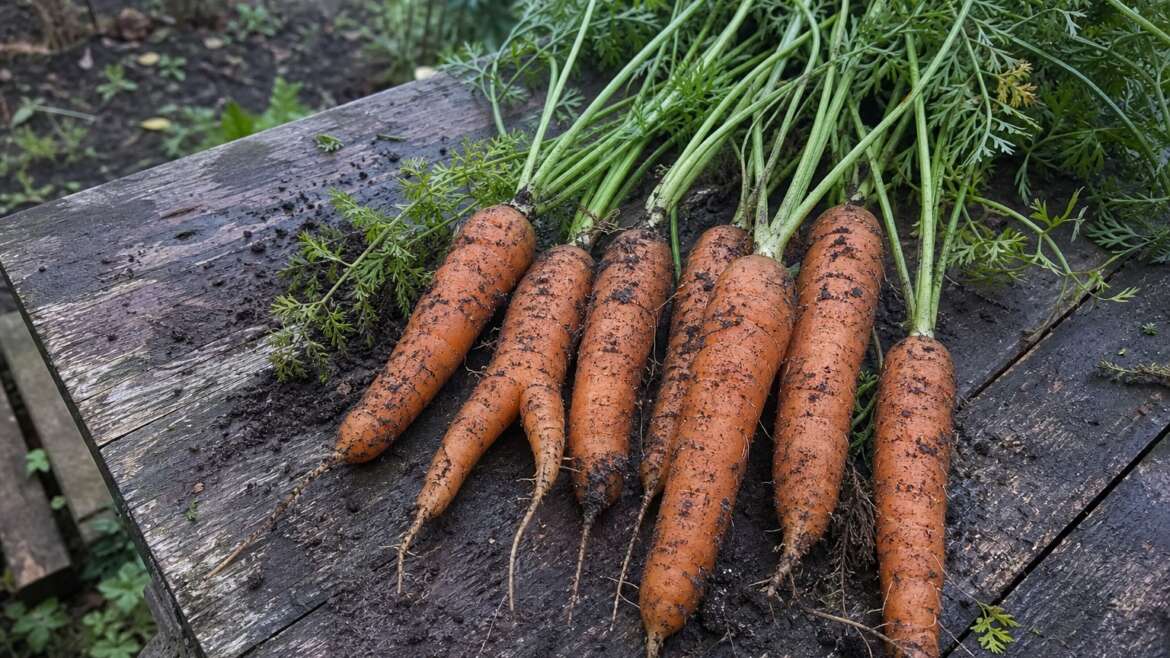
A carrot harvest has a way of making the soil confess. You loosen the row, pull what should be a clean orange taper, and out comes something with knees. One root has divided into two legs. Another has wrapped itself around a pebble. A third looks as if it tried to become a hand before remembering it was dinner.
Forked carrots are funny enough to photograph, but they are not random. They are records. While the leaves above ground were making a tidy ferny line, the root below was negotiating compacted clay, stones, crowded neighbors, drought, waterlogged pockets, fertilizer choices, and sometimes pests or disease. The shape you pull in November was written weeks earlier, when the carrot was still thread-thin and easy to disturb.
That is the useful part. A twisted carrot is rarely a failure of character, either yours or the plant’s. It is a root responding to conditions. Read it well, and next year’s carrot bed becomes easier to prepare.
A carrot begins as a decision underground
The part we eat is not a tuber like a potato or a bulb like garlic. It is a swollen storage organ built from the seedling’s hypocotyl—the short axis below the seed leaves—and the upper taproot. The proportion contributed by each region varies among cultivars.1 Below that swollen axis, the primary root grows downward and later develops lateral roots.
Carrots are best sown where they will mature. Iowa State University Extension advises direct sowing rather than starting them in containers because carrots do not transplant easily.2 That makes early handling—not simply the size of the mature root—part of the shape story.
This matters because a carrot does not wait until late summer to establish its basic route. The orange root you pull in autumn has been enlarging for months, but its primary root began growing when the plant was young. If that growing point meets a stone, dries out, hits a compacted layer, or is damaged by a pest, the plant still has to keep growing. Lateral roots may become more prominent as storage tissue expands, producing a fork.
Utah State University Extension gives the short version: carrots form multiple roots, or fork, when the primary root is damaged, and forking is associated with rocky, stony, or heavy soils as well as carrot fly damage.3 In the garden, that means a misshapen carrot is often a map of interruption.
The soil writes the shape
A carrot wants a bed that is deep, loose, moist, and free of hard surprises. It does not need pampering, but it does need a clear path. Iowa State University Extension recommends moist, well-drained, non-compacted soil for carrots and parsnips, with loamy or sandy soil giving roots the best chance to develop evenly. Heavy, rocky, or compacted soils often produce smaller, irregular roots.2
Think of the carrot root as a slow, living probe. It is not strong in the way a metal spike is strong. It is firm enough to grow through friendly soil, but not designed to drill through brick-like clay, a buried wood chip, a gravel pocket, or the compacted heel mark left by a gardener stepping into wet soil. When the tip cannot keep moving cleanly, the plant may branch around the problem.
This is why the same packet of seed can produce straight roots in one bed and tangled roots in another. The genetics set the general carrot type, but the soil edits the manuscript. Long-rooted cultivars are less forgiving of shallow or lumpy soil because they need more uninterrupted depth. Iowa State recommends shorter-root cultivars where soil is less than ideal.2
If your carrots come out forked year after year, do not start by blaming the seed company. Dig into the bed with your hands. Feel for hard layers. Look for gravel, half-decomposed sticks, clods that never broke down, or compost that was added as chunks instead of as finished, crumbly material. The carrots have already told you where to investigate.
Crowding leaves too little root room
Carrot seed is small, light, and irritatingly easy to sow too thickly. A row can look sparse at planting and then emerge as a green seam. That is charming for about a week. After that, every seedling is asking for the same thin column of root space.
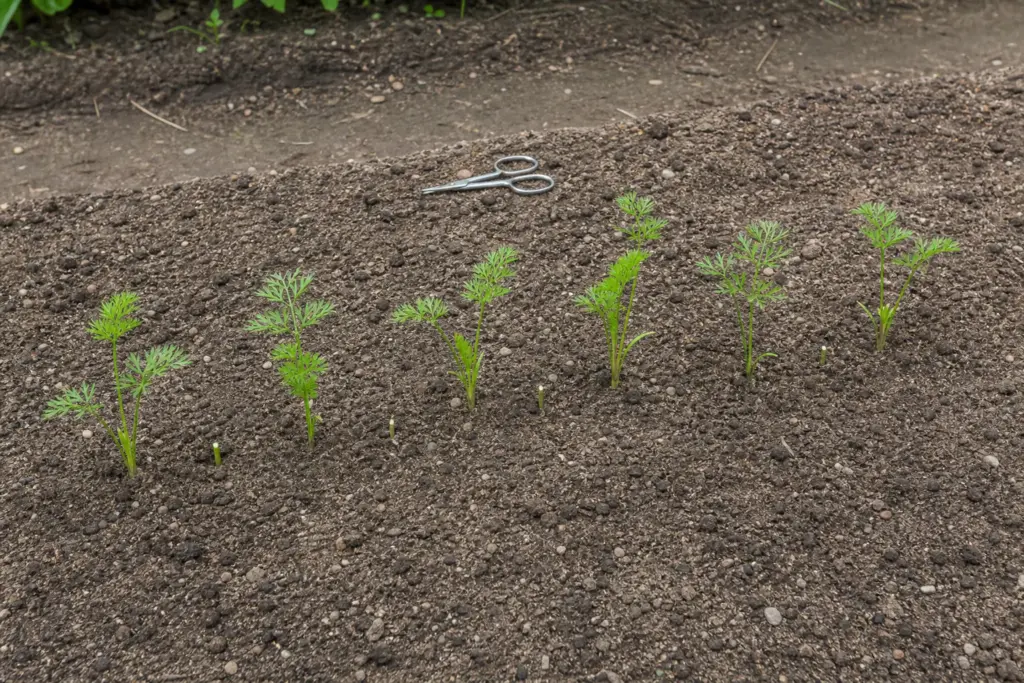
Iowa State recommends thinning seedlings so the remaining plants stand about 2 to 4 inches apart, depending on mature size. It also suggests cutting unwanted seedlings at soil level rather than pulling them, which avoids disturbing the surrounding soil.2
That cutting detail is small but important. Pulling a baby carrot from a crowded row tugs at the soil around its neighbor. Cutting is gentler and leaves the remaining seedling’s root zone in place. A pair of narrow snips may feel absurdly delicate for vegetable gardening, but this is one moment when delicacy is useful.
Pelleted seed and seed tape can feel fussy, but they solve a real problem: spacing. So does sowing carrots with a quick radish crop. The radishes germinate first to mark the row and help limit surface crusting; harvesting them after 3 to 5 weeks leaves the carrots more room to develop.2 Carrots do not need a private estate, but they do need enough space to make a useful root.
Rich soil is not always gentle soil
Carrots like fertile soil, but they do not respond well to every kind of richness. Fresh manure and excessive nitrogen can grow impressive tops while roots remain small or poorly developed. Coarse, unfinished organic matter also makes a lumpy physical bed for a root that needs a clear path.
Iowa State Extension warns that fresh manure can reduce or stunt root development because of its high nitrogen levels. There is a food-safety reason to avoid it too: carrots are often eaten raw, and fresh manure can contain disease-causing microorganisms. The same guide notes that excessive nitrogen or overcrowding may produce plants with lush foliage but little or no root development.2
The better approach is slower. Add finished compost before planting, not chunky, hot, recently manured material. Use a soil test when fertility is uncertain. Avoid treating the carrot bed like a hungry squash patch. Carrots need enough nutrition to grow steadily, but their best shape comes from a bed that is even in texture, moisture, and fertility.
Water can split the story
Water affects carrot shape in two different ways. Too little water slows growth and can leave roots small, tough, or bitter. Too much can produce hairy, forked roots. A swing from dry to wet can crack roots that were trying to catch up quickly.
Utah State University Extension recommends regular water, cautions that overwatering can lead to hairy roots and forking, and notes that wet-and-dry periods favor cracking.3 Iowa State similarly notes that drought stress may leave carrots misshapen, small, tough, fibrous, or bitter.2
The goal is not constant wetness. It is steadiness. A carrot bed should not alternate between dust and puddle. Mulch can help once seedlings are established, especially in light soil. So can drip irrigation, shallow cultivation that does not damage roots, and checking moisture below the surface rather than trusting the top half inch of soil.
Harvest timing matters too. If the soil is dry and tight, pulling carrots by the leaves can snap them. Iowa State recommends irrigating the day before harvest or digging after rain, then loosening the soil with a garden fork before pulling.2 That will not straighten a forked carrot, but it will keep a good one from becoming two broken halves in your hand.
When it is more than soil
Most forked carrots are cultural clues: rocks, compaction, spacing, moisture, or fertility. Sometimes the clue points to a living problem. If many carrots in a bed are not only forked but also stunted, hairy, swollen, or accompanied by yellowing tops, look more closely before deciding the bed simply needs more compost.
University of Minnesota’s carrot diagnostic guide lists compacted or rocky soil as a cause of forked or misshapen roots. It also lists northern root-knot nematode, which can stunt, deform, or fork the taproot and cause small lumps and fibrous roots. The guide’s third pattern is Pythium root dieback: short, stunted, forked roots, sometimes with horizontal lesions and yellow or wilted tops when damage is severe. That disease is common in heavy, wet, or organic soils.4
The pattern matters. One carrot shaped like a little person is usually just a garden joke. A whole bed of stunted, lumpy, hairy roots deserves diagnosis. Compaction, root-knot nematode, and Pythium do not call for the same response, so compare the roots, foliage, and soil conditions before choosing a remedy. Photograph affected roots while they are fresh. If symptoms are severe or confusing, a local extension office or diagnostic clinic can save you from guessing for another season.
Growing straighter carrots next time
The straight-carrot recipe is simple, but not always easy: loosen the bed deeply, remove stones and woody chunks, use finished compost, sow directly, thin without yanking neighboring roots, keep moisture even, and choose a variety that fits the depth and texture of your soil.
Raised beds can help where native soil is heavy, but only if the bed is filled with a fine, mature, well-settled mix. A raised bed full of coarse unfinished compost can create as many detours as clay. If your soil is shallow, choose shorter carrots rather than forcing long ones into a cramped root run. A squat, sweet carrot from a heavy bed is more satisfying than a long one that never had enough soil to become itself.
Prepare the seedbed more carefully than the rest of the vegetable garden. Carrot seed is slow, and the seedling is small. Rake the surface fine. Keep it moist through germination. Mark the row with radishes if that helps. Once the carrot tops are a few inches high, thin patiently. Then let them grow without heroic intervention.
Perfection is not the point. The point is to remove the avoidable obstacles. Some roots will still bend. Some will still fork. Soil is a living place, not a factory mold.
The usefulness of a crooked harvest
A forked carrot is still a carrot. If it is sound, crisp, and free of rot or serious pest damage, it belongs in the kitchen. Scrub the creases carefully. Split the awkward shapes for roasting. Chop them into soup. Save the straightest roots for storage if you want, but do not let supermarket geometry decide what counts as food.
The odd roots may be the most informative part of the harvest. They tell you to check for compaction, uneven moisture, rough compost, crowding, or pest symptoms. They make visible the hidden work of a primary root trying to grow through an imperfect world.
So laugh at the carrot with legs. Take the photograph. Then listen to it. A straight carrot is pleasant, but a crooked carrot is sometimes the better teacher.