
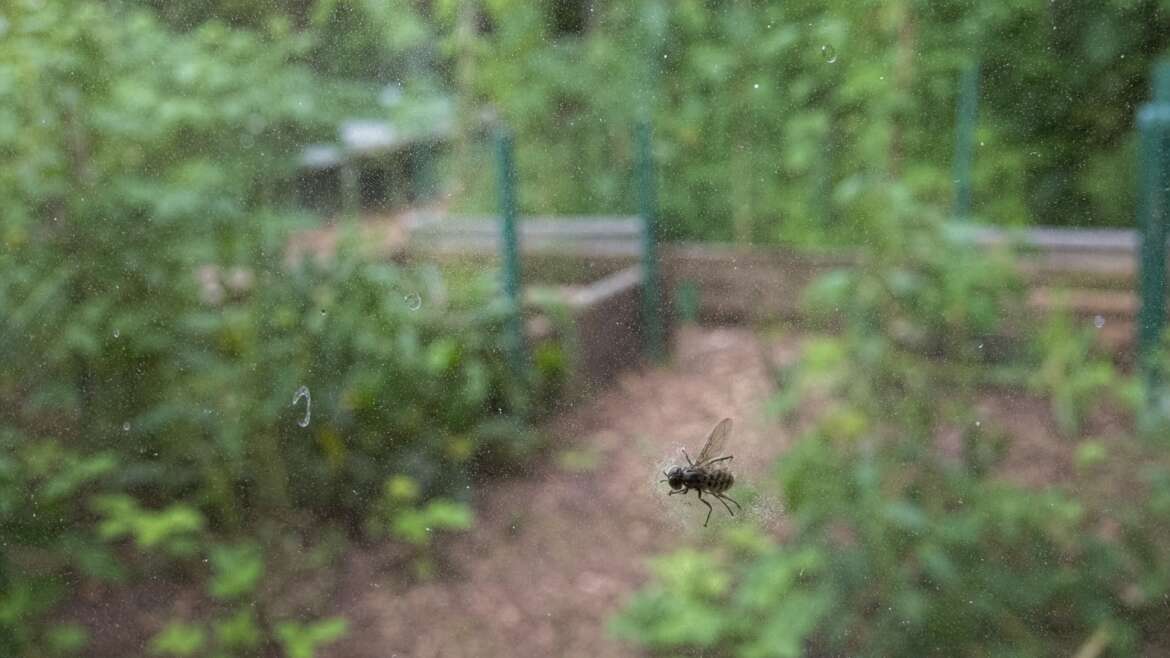
If you ever find a dead fly glued to a window, a fence rail, or the tip of a late-summer plant stem, do not wipe it away too quickly. Look at the wings first. If they are lifted like tiny glass doors, and a pale dusting sits around the body, you may be looking at one of the strangest deaths in the garden.
The fly did not simply run out of life there. It may have been driven there.
The culprit is a fungus, usually discussed under the name Entomophthora muscae. The name itself is wonderfully blunt: Entomophthora means insect destroyer. This is not a plant disease, not mold from a dirty windowsill, and not a sign that your garden has gone wrong. It is a fungal parasite of flies, and when conditions suit it, the fungus can turn a living insect into a raised spore platform.
That sounds like nature trying too hard to get clicks, but it is real.
The dead fly is the sign, not the beginning
Gardeners usually notice the last act. A fly is fixed to a vertical surface. Its abdomen may look swollen or banded. The wings are held out from the body. A faint white halo may appear on the glass, wall, leaf, or stem around it. Wisconsin Horticulture describes infected flies as attaching by the proboscis, spreading the legs, opening the wings above the thorax, and angling the abdomen away from the surface before fungal spores are released.1
That posture is the clue. A normal dead fly can fall anywhere. A fungus-killed fly often dies somewhere high and exposed, arranged in a way that makes the body better at broadcasting spores. The insect becomes less like a corpse on a windowsill and more like a launch pad placed in the traffic lane of other flies.
The white dust is not random fuzz. It is part of the fungus moving into its next generation. Spores that land on a suitable adult fly can germinate, penetrate the body, and grow inside. Once established, the fungus uses the fly as food, transport, and eventually architecture.
Why it climbs before it dies
The unnerving part is not that a fungus kills an insect. Fungi do that all over the garden. The unnerving part is the behavior. Many insect-pathogenic fungi are associated with what biologists call summit disease, in which infected hosts move upward or to exposed positions near the end of life. A review of the genus Entomophthora notes that many species elicit end-of-life behaviors that place the host in a better position for transmission.2
In the fly version, that final climb is brutally practical. A dead fly low in leaf litter is poorly placed for spores that need to reach other flies. A fly stuck to a window, flower stem, tall grass blade, or the upper surface of a leaf is much better positioned. Air moves around it. Other flies pass nearby. The fungus has turned elevation into a reproductive strategy.
Recent work on the Entomophthora muscae and fruit fly system has pushed the story even further. An eLife study describes a sequence in which infected flies summit, extend the proboscis to glue themselves in place, lift the wings away from the abdomen, and then allow fungal structures to emerge and eject spores into the surroundings.3 That is not vague creepiness. It is a sequence of physical events, each one useful to the fungus.
The fly becomes a billboard
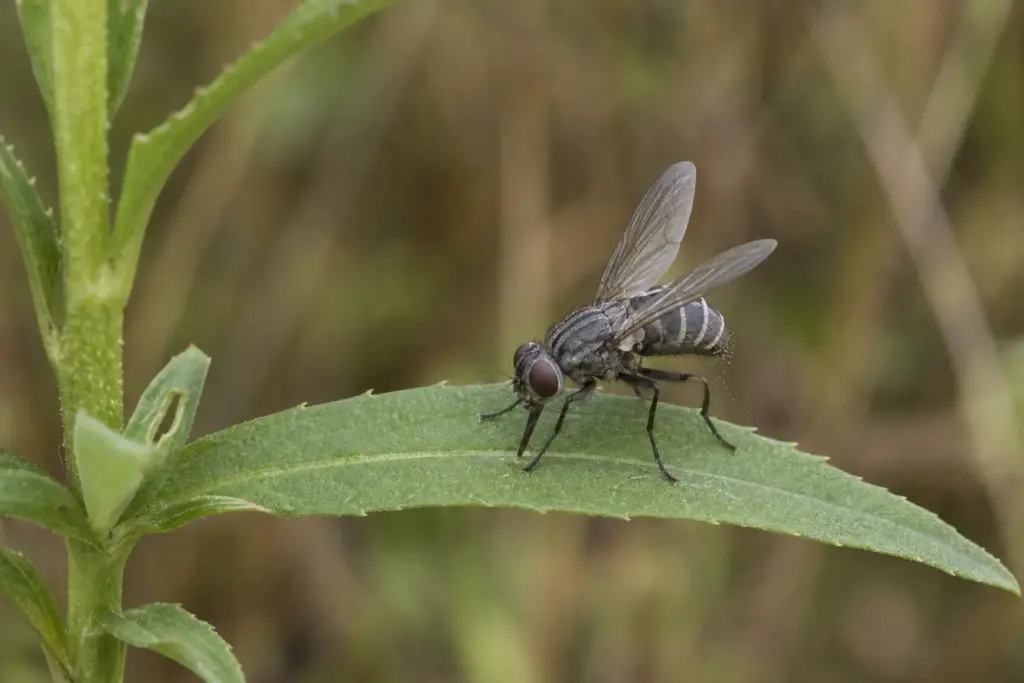
The raised wings matter more than they first appear to. A fly with wings pressed flat against its abdomen is a shielded fly. Spores emerging from the body would hit the wings and nearby surface. A fly with wings lifted gives the fungus a clearer shot.
The proboscis matters too. The mouthparts act almost like a living clamp just before death. The fly fastens itself to the surface, then the fungus finishes its work. Cornell’s biological control profile describes patent infection in house flies as a distended abdomen, spread legs, and outstretched wings, with the cadaver sometimes attached to the surface by the mouthparts.4
This is why the dead fly can stay in place for days. It is not balanced there by accident. It is fixed there. On a pane of glass, the surrounding spore pattern can look like a pale spray mark. On a plant stem or leaf, the effect is easier to miss, especially in a messy September border where seedheads, mildew, dust, and spider silk are already part of the scenery.
Is this bad for the garden?
For plants, usually no. Entomophthora muscae is not a powdery mildew attacking zinnias or squash leaves. It is not gray mold on strawberries. It is an insect pathogen, and its host range is tied to flies. Wisconsin Horticulture notes that most species in this group are very host specific, with E. muscae pathogenic to certain higher flies rather than plants.1
For people, it is mostly an observation rather than a hazard. You should still wash your hands after touching dead insects, because that is basic garden hygiene. But the dramatic part of the story is not that a dangerous organism has appeared. The dramatic part is that a common insect disease has become visible in a place where humans can read it.
For flies, of course, it is very bad news. That is why the fungus has long interested people who study biological control. Cornell notes that E. muscae has been recognized as a potential biological agent for many years.4 In an ordinary home garden, though, this does not mean you can order a miracle fungus and solve every fly problem. It means nature already has a complicated fly-control system running in the background, shaped by humidity, timing, host behavior, and spore survival.
Where to look in September
In temperate gardens, late summer and early autumn can be good seasons for noticing this fungus: cooler, more humid weather favors outbreaks while flies remain active.1 Check windows that face compost bins, chicken runs, potting benches, fruiting shrubs, or damp garden corners. Also look at the upper leaves of tall perennials, the tips of ornamental grasses, tomato stakes, porch screens, and the outside of greenhouse glass.
You are looking for a fly that seems too posed. It may be slightly elevated, fixed head-down or head-up, with legs spread and wings lifted. There may be a dusty ring or pale spore shadow around it. The body can look striped because fungal growth and the fly’s own abdominal segments create alternating bands.
Once you have seen one, you will start spotting the pattern. A garden trains the eye that way. At first you see flowers, then seedheads, then leaf mines, then galls, then the tiny evidence that an insect was turned into a delivery system while you were watering the basil.
Should you remove it?
If the fly is on a kitchen window, remove it when you are ready. If it is outside on a shed pane or on a garden stem, leaving it for a while is harmless and interesting. It may continue releasing spores for a short period, depending on conditions, and other insects or weather will eventually break down the body.
Do not spray the garden because you found one. Spraying for a dead fly is like calling the fire department because you found ashes. The event has already happened, and a broad insecticide would do more to disturb beneficial insects than to improve anything. If house flies are a nuisance around compost, garbage, livestock, or pet waste, manage the source: keep bins covered, turn overly wet compost, remove decaying fruit, and keep manure or waste from becoming a breeding site.
The fungus is not a replacement for sanitation. It is a reminder that the garden is crowded with invisible negotiations. Some are beautiful. Some are useful. Some are frankly rude.
Final thoughts
A dead fly on a September window is easy to dismiss. But if the wings are raised and the white halo is there, the scene is not random. It is the last page of a fungal life cycle written in posture.
That is what makes gardens so hard to exhaust. You can grow tomatoes for years, prune shrubs, divide perennials, complain about aphids, and still be surprised by a tiny body arranged like equipment. The weirdness is not separate from the garden. It is one of the systems holding the place together.
So the next time you see a fly stuck too neatly to glass, pause before wiping. The garden may have left you a very small crime scene, and the murderer may already be dusting the air.