
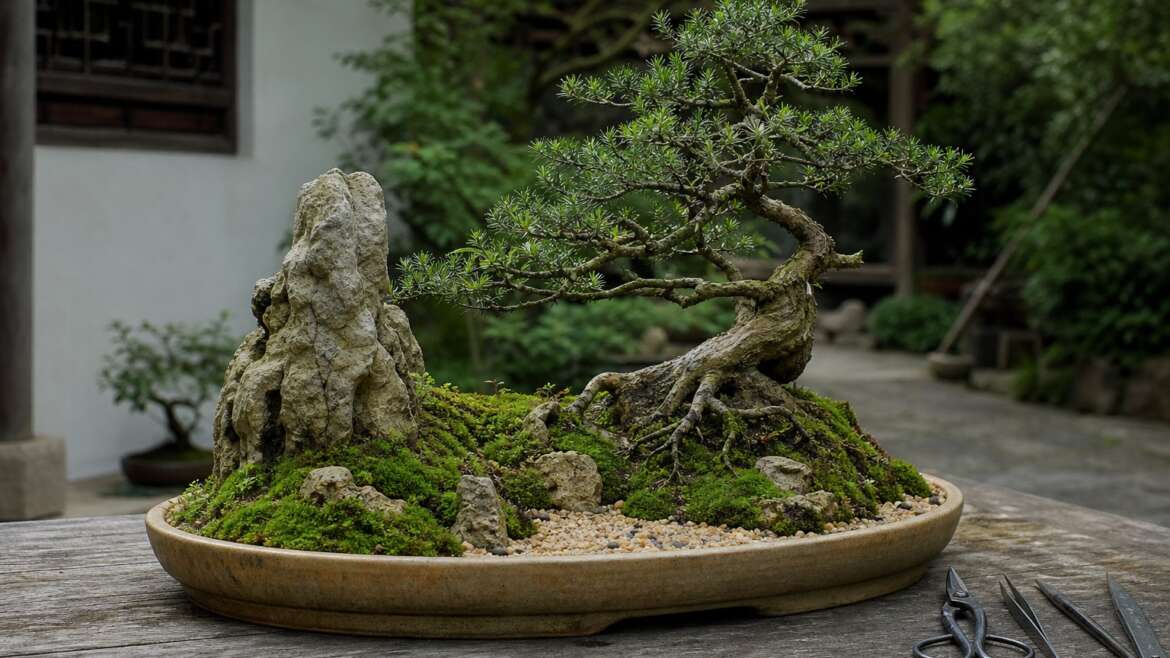
Penjing asks the gardener to think like a landscape painter with wet soil under the fingernails. A single tree may be the main character, but the tray, stone, moss, exposed root, and empty space can matter just as much. Keeping a plant small is only the starting constraint; the composition suggests age, weather, distance, and terrain through living material that never stops changing.
The word penjing (盆景) is commonly translated as “potted scenery.” Penjing artist Zhao Qingquan describes three broad forms: tree penjing (shumu penjing), mountain-and-water or rock penjing (shanshui penjing), and water-and-land penjing (shuihan penjing).1 A composition may therefore center on one woody plant, a group of plants, an arrangement of stone, or a landscape that joins all of them.
That breadth helps explain why penjing is closely related to Japanese bonsai but cannot be reduced to a rougher, looser version of it. Tree penjing and bonsai overlap in material and method; both use woody plants in containers, careful pruning, and branch training to evoke mature trees in a landscape.1 Both traditions are also internally diverse. A blanket contrast between “wild Chinese” and “perfect Japanese” hides the particular composition, school, artist, and horticultural problem in front of you.
A long tradition that keeps changing
The National Bonsai Foundation’s interview with Zhao traces penjing at least to the Tang dynasty (618–907 CE).1 It is safer to begin there than to assign the art a single inventor or a precise birthday. Potted plants, tray landscapes, garden making, poetry, and painting met and changed over many centuries, while related practices travelled between China and Japan and developed in different cultural settings.
Penjing has never been one fixed national style. Regional schools developed different preferences and techniques. A black pine in the National Bonsai and Penjing Museum’s Chinese collection, for example, was shaped in the Lingnan tradition associated with clip-and-grow training. Its long, moving branch and angular changes echo forms seen in Chinese brush painting, yet its species-specific care also limits how freely it can be clipped.2 A style has to negotiate with a living tree.
This relationship between cultivation and representation is part of the cultural context. Penjing can recall a mountain path, an island, a wind-bent tree, or an imagined place without copying every object at equal scale. Like the framed views and compressed terrain of classical Chinese garden design, it asks the viewer to complete a world from selected clues.
Scale comes from relationships
A rock does not become a mountain because it is dramatic. It becomes one when its grain, angle, exposed base, surrounding space, and relationship to the tree agree. A thick slab of moss beside a very young trunk may make the “tree” look like a cutting in turf. A restrained patch of fine moss, a narrow gravel margin, or bare substrate may support the scale more convincingly.
The same test applies to plants. Small leaves or needles, visible taper in the trunk, and branches that divide into finer twigs can help a modest tree read as an old one. The National Bonsai Foundation’s Chinese collection shows the range of devices artists use: tiny-leaved Chinese elms, tree-and-rock pairings, root-over-rock forms, forest groups, figurines, and trays that imply water.3 None is compulsory. One well-observed tree can carry the scene.
The landscape begins below the rim
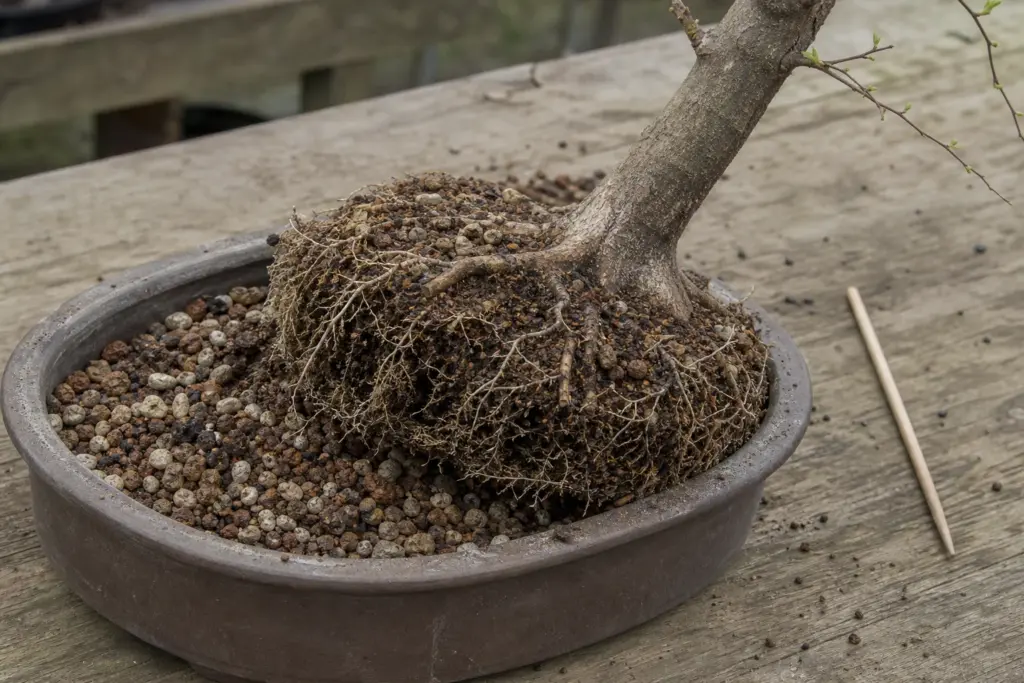
A convincing silhouette cannot compensate for failing roots. Shallow containers hold little reserve against heat, wind, missed watering, or blocked drainage. Virginia Cooperative Extension recommends coarse, fast-draining growing media and unobstructed drainage holes, and it advises developing a strong fibrous root system in a training container before moving a plant into a shallow display pot.4 Ordinary garden soil packed into a tray is usually too dense.
Water by observation, not by a slogan. Check the substrate regularly, then water thoroughly when the plant actually needs it. Species, pot depth, root density, sun, wind, season, and local weather all change the interval. A tray can be dry at the edge and damp beneath moss, so learn its weight and probe below the decorative surface rather than misting on a timetable.4
Repotting and root pruning are also seasonal, species-specific work. Extension guidance places many deciduous trees before leaf-out and many pines and other evergreens before spring growth, but the correct window depends on the plant and climate.4 Learn the species first, use a clean tool, preserve fine feeder roots, and give a recently repotted tree shelter appropriate to its needs instead of piling major root and branch work into one dramatic afternoon.
Training should leave the tree alive
Pruning, wiring, guying, and clip-and-grow are ways of redirecting growth, not recipes to apply indiscriminately. Study how the same species branches in open ground, on a woodland edge, or under wind. Decide which line carries the composition, remove the least useful growth gradually, and wait to see how the plant responds. A pine, elm, juniper, and flowering shrub do not replace buds or tolerate hard pruning in the same way.
Wire should support a planned bend without crushing bark or crossing carelessly. Check it often during active growth and remove it before thickening wood turns the coil into a scar. Virginia Cooperative Extension treats watering, fertilizing, pruning, wiring, and repotting as recurring care rather than a one-time styling session.4 Every routine task continues an artistic decision; without it, that decision disappears into unchecked growth or declining health.
Temperate trees generally need outdoor light, weather, and winter dormancy. A juniper is not made into a houseplant by placing it in a ceramic tray. Tropical and subtropical species can be managed indoors in suitable climates and light, but “indoor penjing” is not a universal plant category. Match the species to the conditions you can honestly provide, including summer heat, winter minimums, humidity, and the days when nobody is home to water.4
Moss, stone, and empty ground
Moss can soften the soil line, suggest distance, and link stone to tree, but it is a plant rather than green upholstery. Use species already suited to the moisture and light, and leave enough surface visible to judge watering. The same patient attention used for keeping a small moss garden healthy applies at tray scale: close contact, gentle watering, clean surfaces, and protection from concentrated runoff.
Choose stone for form, texture, and a believable relationship to the tree, not for a label promising ancient symbolism. Set it securely and test the composition from eye level. Leave some ground unoccupied. A bare patch can read as water, a path, mist, or distance; filling every gap usually makes the scene smaller.
A practical first penjing
Start with healthy nursery stock of a woody species that grows well in your climate and responds predictably to pruning. Look for a visible trunk line, useful low branches, and a root base with potential rather than buying a weak plant because it already looks old. Do not collect from the wild without the landowner’s permission and a clear understanding of local protected-species rules; collection is prohibited in many protected places.4
Keep the plant in a roomy training container while you learn its watering rhythm and build roots and branches. Photograph it at eye level, rotate it, and choose a front only after looking at the trunk and root base from every side. Sketch one intention in plain language—“a tree holding a windy slope” is more useful than “make it dramatic”—then make the smallest set of changes that clarifies that idea.
Stone, moss, and a final tray can wait. Waiting is a legitimate beginning because penjing’s material is alive in the present even when its imagined landscape feels ancient. Good work keeps both times visible.