
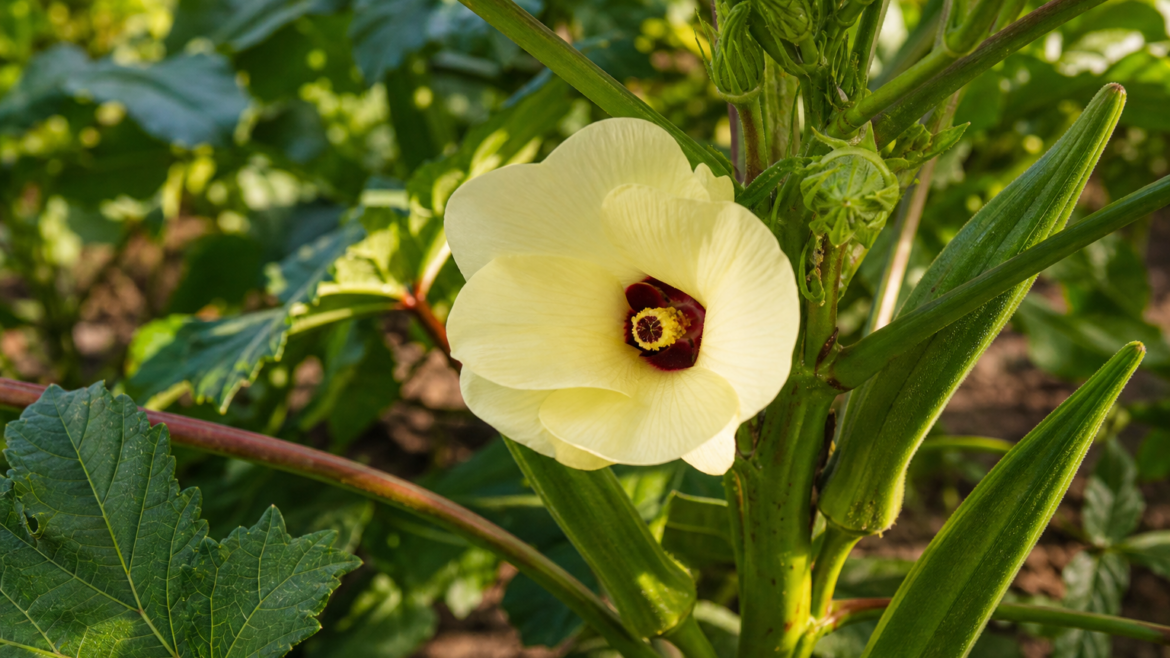
An okra plant can look almost too ornamental for the vegetable bed. By August it stands above the peppers and basil, rough leaves spread like green hands, ridged pods pointing upward, and pale yellow flowers opening with a burgundy throat. The flower looks as if it has wandered in from a hibiscus shrub. The pod, only a few days behind it, is the reminder that this is still a working vegetable.
If you have only met okra sliced into gumbo, pickled in a jar, or fried in a crisp cornmeal coat, the living plant can be a surprise. It is tall, heat-loving, slightly prickly, and oddly elegant. Its flowers are not decoration added to the crop. They are the crop in its briefest visible moment, just before the ovary below the flower lengthens into the pod you harvest.
That is what makes okra such a good late-summer plant to understand. It refuses to keep the usual garden categories separate. It is a vegetable with ornamental flowers, an edible pod with a botanical family resemblance to hibiscus, and a heat-season crop that often looks most confident when other plants are beginning to tire.
A mallow in the vegetable bed
Okra is Abelmoschus esculentus, a member of the mallow family, Malvaceae. Missouri Botanical Garden lists okra in that family and describes the species as bearing hibiscus-like yellow flowers with purplish centers.1 NC State Extension gives the same family placement and describes the flowers as funnel-shaped, yellow with a purple center, and lasting only one day.2
So the resemblance is not a gardener’s overactive imagination. Okra really is kin to the mallows that make some of the garden’s most recognizable flowers: hibiscus, hollyhock, rose mallow, cotton, and many others. Look at the broad petals, the dark eye, the prominent central column, and the coarse lobed leaves, and the vegetable begins to read differently. It is not just a pod machine. It is a mallow that happens to feed you.
This family connection also explains why okra can sit comfortably in a more designed edible garden. It has architecture. The stems are upright, the leaves are bold, and the flowers are showy without being fussy. A healthy plant can take on the scale of a small summer shrub for one season, holding flowers and pods at eye level instead of hiding the harvest under leaves.
The flower is brief, but it is doing real work
Each okra flower is a short event. It opens, receives pollen, and fades quickly, often within a day. That sounds fragile, but the plant does not depend on one dramatic bloom. It keeps making flowers as the weather stays warm and the plant remains productive. Missouri Botanical Garden notes that the flowers last only one day, while plants bloom freely through the growing season until frost.1
Unlike squash, okra does not ask the gardener to distinguish male flowers from female flowers. LSU AgCenter describes okra flowers as complete and self-pollinating, while also noting that bees and other pollinators visit them and may cross-pollinate them.3 In practical terms, a lone okra plant can often set pods, but the flowers are still part of the garden’s pollinator traffic.
The flowers are edible too. NC State Extension describes okra flowers as edible, mild, and slightly sweet, adding more color than flavor.2 If you plan to taste one, apply the same food-safety rules as for any edible flower grown for the kitchen: identify the plant correctly, use flowers grown as food, and follow pesticide labels and harvest intervals. There is also a yield tradeoff. Remove the whole bloom at its base and you remove the ovary that would have become the pod. For most home gardeners, the best use of the flower is to notice it, let insects visit, and come back a few days later with a knife or pruners.
Heat is the bargain
Okra’s generosity depends on warmth. Clemson Extension describes it as a warm-season annual vegetable, best grown in full sun, with best temperatures around 75 to 90 degrees Fahrenheit and warm soil for planting.4 Iowa State University Extension gives the Midwest version of the same advice: sow outdoors after danger of frost has passed, in well-drained fertile soil and full sun.5
This is where many cool-climate gardeners go wrong. Okra is not impressed by calendar optimism. A seed pushed into cold, wet soil may germinate slowly and face more seedling disease; a transplant set out too early can sit still while weeds get ahead of it.4 Wait for real warmth, give it full sun, and it often grows with a speed that makes the delay feel wise rather than timid.
The plant can tolerate dry conditions better than many vegetables, but tolerance is not the same as best production. Iowa State notes that moisture is especially important during flowering and pod development, and that a deep soaking every 7 to 10 days is usually enough during prolonged dry periods.5 Clemson similarly points to pod set and pod development as critical periods for soil moisture.4
Think of okra as a plant that wants heat but not neglect. Mulch helps keep the soil from swinging between baked and soaked. Water deeply rather than sprinkling lightly every day; Clemson notes that frequent light irrigation encourages shallow roots.4 Heavy early nitrogen can make a leafy tower with fewer pods, and Iowa State warns that too much nitrogen promotes vegetative growth and can reduce yield.5 Feed according to soil need rather than treating every slow week as a fertilizer emergency.
The pod is a fast clock
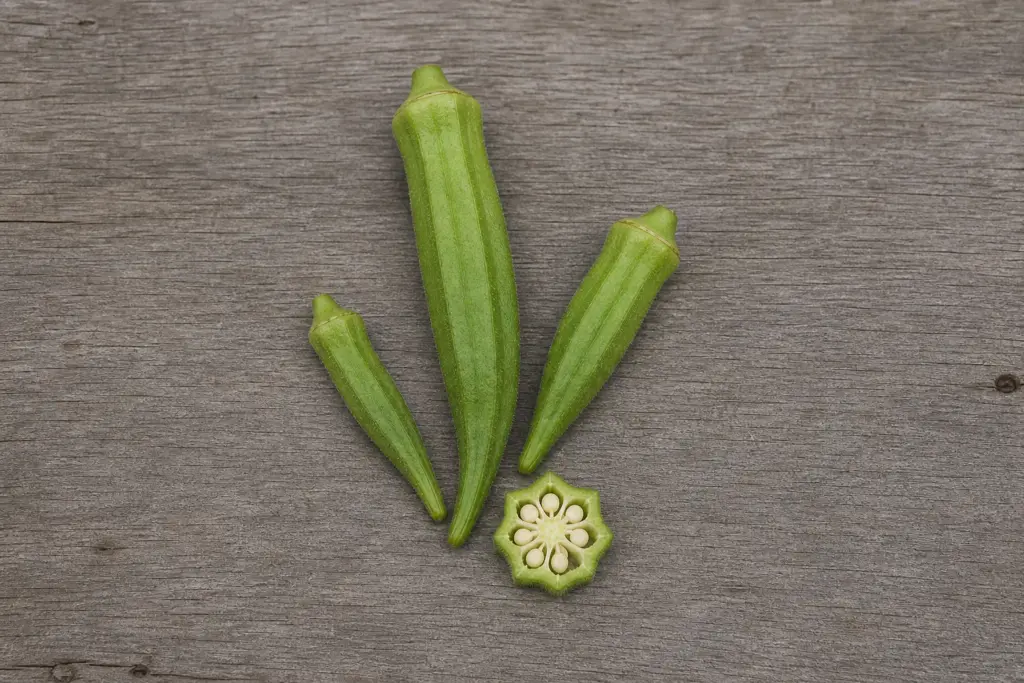
The most important thing about okra harvest is speed. Iowa State says pods are usually ready 5 to 6 days after flowering and should be picked at least every other day once fruiting begins, especially in July and August.5 Clemson recommends harvesting about 60 to 70 days after planting, when pods are 2 to 3 inches long and still tender.4
This is why okra can feel like it has a private schedule. A pod that looked too small on Tuesday can be perfect on Thursday and woody by Saturday. The plant is not being difficult. It is simply building seed capsules quickly in warm weather. If pods are allowed to mature on the plant, Iowa State notes that additional flowering and fruiting can be reduced.5 The harvest itself becomes part of plant care.
A small knife, snips, or hand pruners are better than tugging. Many okra plants have irritating hairs or prickly stems, even when the pods are described as spineless.5 Long sleeves and gloves are not theatrical. They are how you keep a useful harvest from turning into itchy forearms.
Why okra turns slippery
Okra’s texture is the part people tend to argue about. Slice a fresh pod and it releases a slick gel that can make a stew glossy and thick, or make a reluctant eater push the bowl away. That texture comes from mucilage, a viscous plant material rich in polysaccharides. A review in Plants describes okra mucilage as highly viscous and mostly composed of sugars including galactose, rhamnose, and galacturonic acid, along with proteins and minerals.6
In the pod, mucilage is a normal hydrocolloid, not evidence that the fruit is spoiled. Water draws its soluble polysaccharides from cut surfaces into a soup or stew, where they increase viscosity.6 Stews and gumbos welcome that thickening. If you want less of the slick texture, keep pods whole or in larger pieces and cook them quickly over high heat. NC State Extension notes that high heat can keep the outside crisper and make okra seem less slimy; grilling is one example.7 The same pod can be silky, crisp, thickening, or nearly dry depending on how it is handled.
Understanding that texture changes how you harvest too. Young pods are tender because their walls and fibers have not toughened. Oversized pods are not just bigger servings. They are older fruit capsules moving toward seed maturity, and the eating quality changes with that purpose.
How to keep an August plant generous
By late summer, a good okra plant may be tall enough that the newest flowers and pods are forming near the top. Keep harvesting. Keep the root zone evenly supplied with water. Remove pods that escaped you, even if they are too tough for dinner, because leaving them to mature can slow the plant’s willingness to make more.
In long hot seasons, there is another option. Clemson describes ratooning okra in mid-July to mid-August when production slows: cutting the plant back low, fertilizing, watering through heat, and expecting renewed pod production several weeks later.4 LSU AgCenter’s sustainable okra guide gives similar advice, noting that cutting mature plants back in midsummer can rejuvenate growth and bring pods within easier reach.8
That is not necessary in every garden. In a short-season climate, cutting back in August may sacrifice the harvest you already have. In a hot region with a long fall, it can turn a tired tower into a second crop. The useful habit is to read the season you are actually in, not the season described on the seed packet.
Spacing matters too. Okra becomes a large plant, and LSU recommends giving it room, using well-drained soil, and rotating plant families for several years before returning the same family to the same row.8 Good spacing is not just neatness. It reduces the scratchy wrestling match at harvest, improves airflow, and lets the plant’s bold form become an asset instead of a thicket.
Where it belongs in the garden
Okra is often treated as a purely practical crop, tucked wherever summer vegetables are allowed to sprawl and tower. It deserves a little more design attention. The plant has a strong vertical habit, large textured leaves, handsome flowers, and pods that point upward like green candles. Red-podded varieties add another layer of color.
Use that structure. Put okra where height helps rather than surprises you. Let lower herbs, flowers, or compact vegetables cover the soil nearby without crowding its stem. In a front-yard edible garden, a few okra plants can read as summer ornamentals from the sidewalk and as dinner from the kitchen door. That double identity is one of the pleasures of growing it.
It also belongs near observation. Okra rewards the daily walk. You see the flower one morning, the small pod a few days later, the tender harvest soon after that. Miss the rhythm and the plant leaves you fibrous evidence. Catch it, and August becomes a sequence of small, reliable returns.
Final thoughts
Okra blooms like a hibiscus because it is telling the truth about its family. The flower is not a disguise. It is a clue. Follow it, and the plant becomes more than a warm-weather vegetable with a divisive texture. It becomes a mallow with edible flowers, fast pods, heat-season confidence, and enough beauty to stand in the ornamental garden without apology.
Grow it warm, give it sun, keep it picked, and look closely when the flowers open. In that pale yellow cup with the dark center, the whole plant briefly explains itself: beauty first, seed pod next, and dinner if you arrive on time.
References
- Missouri Botanical Garden: Abelmoschus esculentus
- NC State Extension Gardener Plant Toolbox: Abelmoschus esculentus
- LSU AgCenter: Okra Greauxing Guide
- Clemson Cooperative Extension HGIC: How to Grow Okra in South Carolina
- Iowa State University Extension and Outreach: Growing Okra in the Home Garden
- Dantas, T. L., Buriti, F. C. A., and Florentino, E. R. Okra (Abelmoschus esculentus L.) as a Potential Functional Food Source of Mucilage and Bioactive Compounds with Technological Applications and Health Benefits. Plants, 2021.
- NC State Extension: Let’s Use the Fresh Okra!
- LSU AgCenter: Sustainable Gardening for School and Home Gardens: Okra