
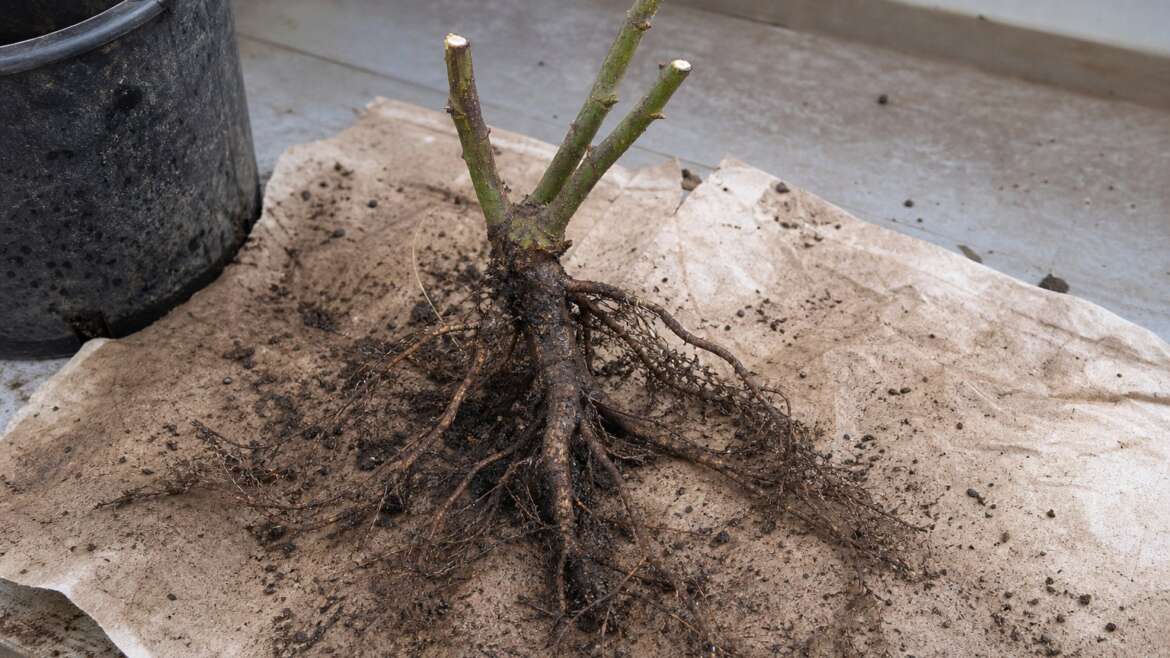
A March delivery of bare-root plants can feel like an accusation. You open the box expecting a garden, and what you find looks more like a bundle of sticks that spent the winter in a shed: no leaves, no soil, pale roots wrapped in damp paper or shavings, a few tight buds along the stems if you are lucky.
This is the odd bargain of bare-root planting. The plant arrives at the moment when it looks least alive, precisely because that is the moment when it can be moved with the least drama. A leafed-out shrub in a pot is easy to trust. A dormant whip with exposed roots asks for more botanical imagination.
But bare-root plants are not failed plants. They are plants paused at a useful point in their year. If the roots have been kept cool and moist, and if the plant is set into soil before growth begins in earnest, that bundle of quiet tissue can wake into a tree, rose, berry cane, hedge, or perennial bed.
A plant without its pot
Bare-root stock is exactly what it sounds like: a plant sold and shipped without a container of soil around its roots. Wisconsin Horticulture describes bare-root trees as dormant trees dug in autumn, stored without soil around their roots through winter, and planted before bud break in spring or after leaf fall in autumn.1 That absence of soil is not neglect. It is a nursery method built around dormancy.
Iowa State University Extension uses the broader category too, noting that bare-root trees, shrubs, roses, and perennials are usually shipped in early spring and should be planted before growth begins.2 That is why March can be full of plain brown packages for gardeners. The timing is not about convenience for the calendar. It is about moving the plant while it is still holding its breath.
A dormant plant has no full canopy pulling water into the air. Its buds are closed. Its stems are quiet. Its roots are alive, but not trying to support a leaf factory yet. That makes the plant easier to dig, store, ship, and replant. The plant is not sleeping in a human sense. Fruit-tree dormancy, for example, uses physiological brakes and temperature cues, while other temperate plants have their own controls. What matters here is that visible work has slowed enough that a careful move is possible.
Why looking dead is useful
Leaves are beautiful, but they are also thirsty. A newly moved plant with a full set of leaves must replace the water those leaves lose while its roots are still damaged, reduced, or adjusting to new soil. A dormant bare-root plant avoids much of that mismatch. It begins with little above-ground demand, then grows into its new site as soil warms and buds open.
That is the quiet advantage behind the alarming appearance. A bare-root plant can put early effort into re-establishing contact between roots and soil before the season asks too much of its leaves. Penn State Extension gives early March to early May as a planting window for bare-root tree seedlings in Pennsylvania, once frost leaves the ground and before bud break.3 The exact window shifts by region, but the principle travels well: plant while the plant is still dormant and the soil is workable.
This is also why bare-root plants can be a poor fit for procrastination. The same lack of soil that makes them light and efficient also leaves the roots exposed to drying, heating, freezing, and rough handling. Dormancy gives the plant resilience, not invincibility.
Bare does not mean dry
The living part of a bare-root plant is not only the stem with the buds. Much of the future is in the root system. Fine roots and root tips are the parts that will make first contact with the new soil, and they are the easiest parts to damage. Let them dry on a windy bench and the plant may still look unchanged, but its chances have quietly narrowed.
University of Maryland Extension advises planting trees and shrubs as soon as possible, and if planting is delayed, watering them regularly and protecting roots from excessive sun and wind.4 That guidance is especially important for bare-root material. The roots should stay cool, shaded, and damp until they are underground.
If a shipment arrives before the bed is ready, do not leave it open in the kitchen or on a sunny patio. Keep the roots wrapped in their damp packing, store the plant somewhere cool and non-freezing, and plant promptly.2 If the ground will remain unworkable beyond that short holding period, temporarily pot the roots in a well-drained potting mix and keep the plant frost-free, following any plant-specific instructions from the supplier.4 Think of temporary storage as a waiting room, not a permanent address.
The short soak before soil
Bare-root trees and shrubs are commonly given a short drink before planting. Iowa State’s bare-root tree guidance recommends pruning off damaged or broken roots and soaking the roots in a bucket of water for one to two hours before planting.5 That is enough to rehydrate tissues that have been packed and shipped, and it gives the gardener time to prepare the hole with the roots in mind.
The soak is not a resurrection ritual, and longer is not automatically better. Roots are living organs, not wicks. They need water, but they also need oxygen once they are back in the soil. For the trees and shrubs covered by this guidance, the useful practice is simple: soak briefly, keep the roots damp while you work, and plant the same day when possible. For fleshy crowns and other bare-root perennials, follow species and supplier instructions instead of assuming the tree rule applies.
While the plant is soaking, inspect it. Firm roots that bend are more promising than brittle roots that snap. A plump bud is better than a shriveled one.2 A light scratch on a questionable stem may show green cambium beneath the bark. None of these tests is perfect, but together they help you read the plant before you bury its most important part.
Make the hole fit the roots
Container planting trains gardeners to think in cylinders: remove pot, dig pot-shaped hole, drop plant in. Bare-root planting asks for a different shape. The hole should receive the root system as it is, not force the roots to bend sharply upward, circle, or bunch into a narrow cone.
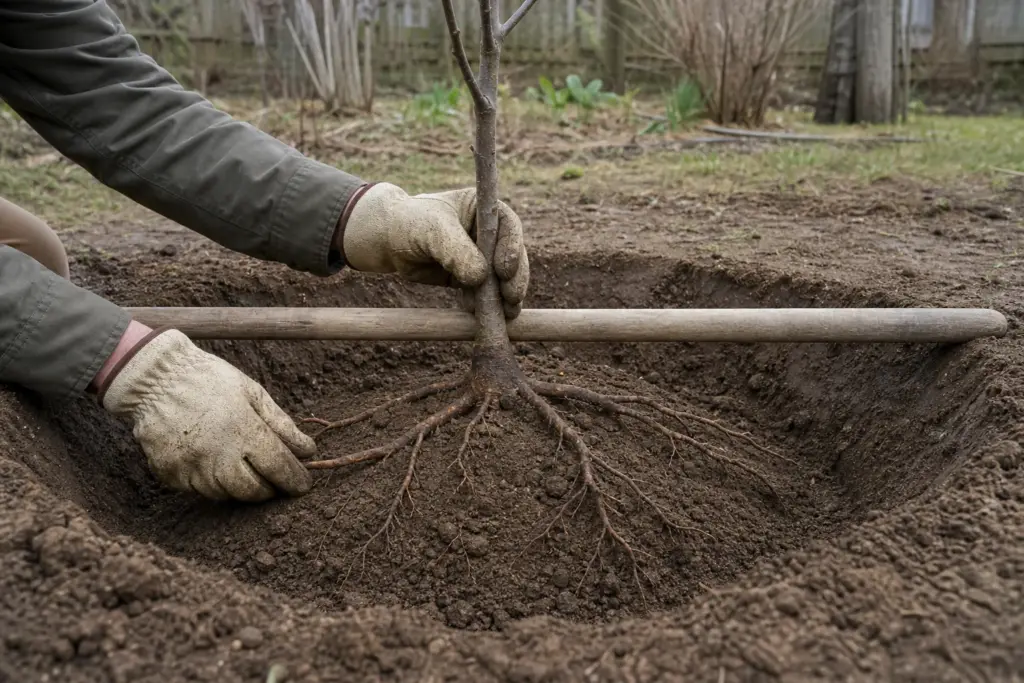
Iowa State recommends a hole two to two-and-a-half times wider than the spread of a bare-root tree’s root system, with depth based on the distance from the trunk flare to the bottom of the roots.5 That trunk flare matters. It is the place where the trunk widens into the roots, and it belongs at the soil surface, not buried several inches below a tidy mulch volcano.
Shrubs, roses, and perennials have their own clues. Iowa State’s guidance for bare-root shrubs and roses recommends placing the uppermost roots just below the soil level, after identifying where those roots attach to the stem.6 Perennials may have a crown rather than a trunk flare. Strawberries have a crown that resents being buried too deeply. Asparagus crowns, rose graft unions, fruit trees, and native perennials may each come with more specific instructions. Follow the plant in front of you, not a single depth rule applied to everything.
Backfill with the soil you removed, breaking up hard clods and settling soil among the roots with water and gentle fingers. Do not stomp the hole into a brick. The aim is close contact without compaction. A root needs soil around it, but it also needs air spaces and a way forward.
What wakes first may be underground
After planting, a bare-root plant may do almost nothing visible for a while. This can test a gardener’s nerve. The stems remain bare. The buds look the same. The neighbor’s container-grown shrub is already leafing out and making yours look like a mistake.
Visible growth is not the only growth. Before much happens above ground, the plant may be re-establishing root contact with moist soil. Penn State’s seedling guidance emphasizes planting while the stock is dormant so roots can establish before hot, dry weather arrives.3 That delay is not failure. It is often the plant doing the work that will make later growth possible.
This is where patience and water matter more than routine fertilizer. Iowa State advises waiting at least four weeks before fertilizing bare-root plants because excess fertilizer can damage young roots.2 The plant does not need to be pushed into leafy performance before its roots can support that performance. It needs even moisture, a stable planting depth, protection from drying winds, and time.
The first season is establishment, not display
A newly planted bare-root fruit tree, rose, raspberry cane, hedge whip, or perennial crown is not yet living as an established plant. Its root system may be neatly spread, but it has not claimed the surrounding soil. The first season is less about proving itself above ground and more about knitting itself into place.
Iowa State Extension recommends checking bare-root plants once or twice a week during the first growing season and watering when the soil around the roots is dry, then reducing frequency as the plants establish.2 Water where the roots actually are, then gradually widen your attention as the plant begins to grow outward.
Mulch helps, if it is used with restraint. A loose ring of wood chips, shredded bark, leaf mold, straw, or composted material can buffer soil temperature and slow evaporation. Keep it away from crowns and trunks. Mulch piled against bark keeps the wrong kind of moisture in the wrong place and can hide planting-depth mistakes.
Resist the urge to judge too early. Some bare-root plants leaf out unevenly. Some canes die back while new shoots rise from the crown. Some perennials spend their first year building roots and only become convincing the next spring. The plant should be alive and progressing, but it does not owe you an instant magazine border.
When bare-root makes sense
Bare-root planting is especially useful when you need several plants, when shipping weight matters, or when you want to see and arrange the root system rather than inherit a pot-shaped tangle. It is common for fruit trees, roses, cane fruits, strawberries, asparagus crowns, hedging plants, native shrubs, and young trees.
It is not always the easiest route for every gardener. Bare-root plants demand timing. They cannot sit around a patio for weeks waiting for inspiration. They are less forgiving of dry wind, forgotten packages, and half-prepared beds. If you like to buy a plant in bloom and decide where it goes by walking around with the pot, bare-root stock may feel severe.
But severity is part of its elegance. A bare-root plant is the garden reduced to essentials: stored energy, dormant buds, exposed roots, a prepared hole, and the weather at the edge of spring. It removes the comforting illusion that a pot of soil is the plant. The plant is the living architecture inside it.
Final thoughts
The first lesson of a bare-root plant is not how to plant cheaply, though that can be one advantage. It is how much life can be hidden when a plant is between seasons. The leaves are absent, but the buds are waiting. The roots are exposed, but they are not finished. The whole plant is paused at the narrow point where a gardener can move it from one future to another.
Treat that pause with respect. Keep the roots damp and shaded. Soak briefly. Make a wide hole. Set the crown or flare at the right depth. Water like establishment matters, because it does. Then give the plant a little time to stop looking like a bundle of sticks and start behaving like a garden.
References
- Wisconsin Horticulture: Promoting Urban Forestry: Planting Bareroot Trees in Home Landscapes
- Iowa State University Extension: How to Plant Bare Root Plants
- Penn State Extension: Planting Bare-root Tree Seedlings in Spring
- University of Maryland Extension: Planting a Tree or Shrub
- Iowa State University Extension: How to Plant Bare Root Trees
- Iowa State University Extension: How to Plant Bare Root Shrubs and Roses