
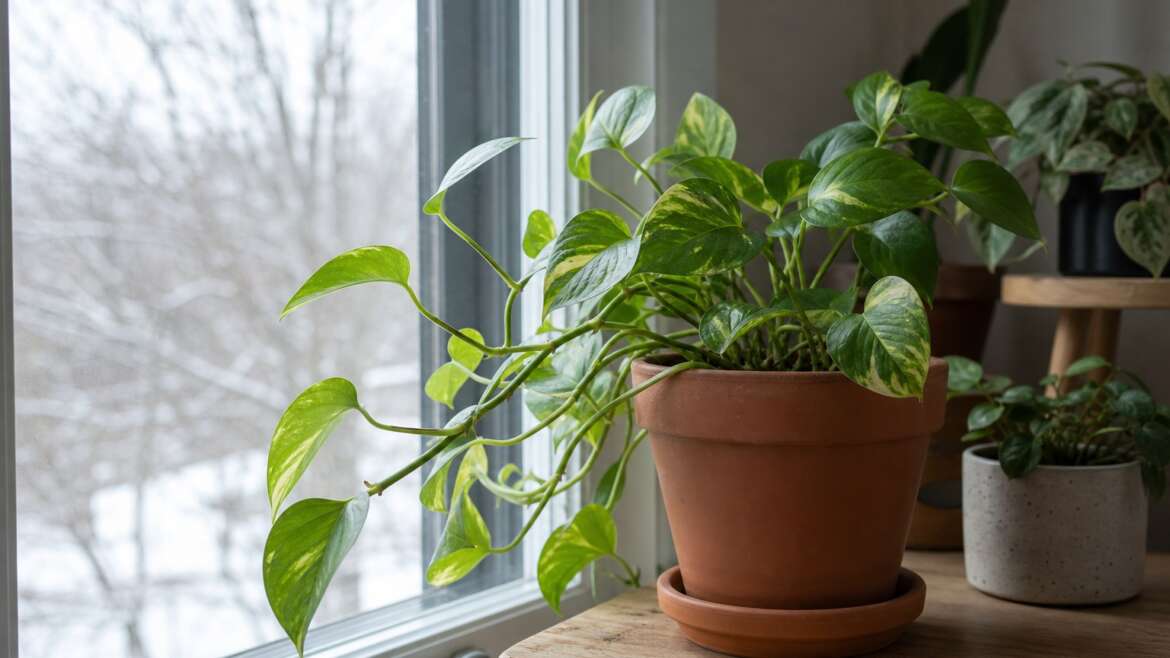
By late January, a houseplant can start to reveal the shape of the room. The pothos that looked evenly full in October now has most of its newest leaves tilted toward the glass. A heartleaf philodendron sends one vine across the sill while the back of the pot goes quiet. A jade plant slowly becomes a green question mark, leaning into the pale square of winter light.
This can look like a problem of posture. It is really a problem of information. The plant is not stretching because it wants attention, and it is not choosing the window with anything like a mind. It is growing in response to an uneven light field. One side of the plant receives more usable light than the other, and the new growth records that difference.
In many homes at temperate Northern Hemisphere latitudes, the lean becomes more conspicuous in winter. The window may still be in the same place, but the light arriving through it has changed: January days are shorter and the sun follows a lower path. Clouds, curtains, insect screens, nearby buildings, and distance from the glass all alter what reaches the leaves. Bare branches may even open a view that summer foliage blocked. A houseplant by a window is reading a small indoor climate, and its strongest light often comes from one direction.
A plant’s lean is new growth with a memory
A houseplant does not usually lean all at once. The newest stem sections lengthen at a slight angle. Petioles and leaf blades orient as they develop. Vines wander toward the window. A rosette subtly becomes one-sided. The effect builds slowly enough that you may not notice it until you turn the pot and see the plant’s private map of the room.
University of Maryland Extension notes that indoor plants grown where light reaches them from one direction can develop a lean, and that low light can also make plants spindly or leggy as they stretch for more light.1 That distinction matters. A modest lean on an otherwise healthy plant can be a normal response, not a diagnosis by itself. Long, weak internodes, unusually small or pale new leaves, leaf drop, or loss of the plant’s typical compact shape make inadequate light more likely, although other care problems can produce some of the same signs.
The lean is not a moral failing by the gardener. Indoors, almost every natural light source is directional. Outdoors, a plant receives changing light from the sky, reflections from surrounding surfaces, and sun that moves across the day. Indoors, walls and ceilings restrict the view of the sky. The plant may live with one bright rectangle and three dim sides. It responds accordingly.
The room has a light gradient
Gardeners often speak of a room as bright or dark, but plants experience light more locally than that. A windowsill, a spot two feet back, and a shelf across the room are not the same habitat. Maryland and Iowa State Extension both note that light levels fall rapidly as a plant is moved away from a window and advise matching houseplants to the light available in their exact position.12
That reach is easiest to see in flexible shoots of pothos, heartleaf philodendron, hoya, and tradescantia, but upright plants do it too. A rubber plant may angle its newest growth toward the window. A monstera may turn new petioles and leaf blades toward the brighter side. These examples do not share one light requirement, so placement still has to match the species and cultivar. Seedlings show the response quickly and dramatically; many houseplants do it slowly enough that the bend becomes part of their architecture.
Indoor light also changes with the season. Iowa State Extension notes that sun angle, overhangs, outdoor plantings, and window coverings can all change what reaches a plant; supplemental light may be needed when no suitable window is available.2 NC State Extension also notes that turning a container can encourage more uniform growth.3 That is the practical version of the science. The plant is not asking to be fussed over every day. It is asking for the room’s light imbalance to be noticed.
How a stem bends without muscles
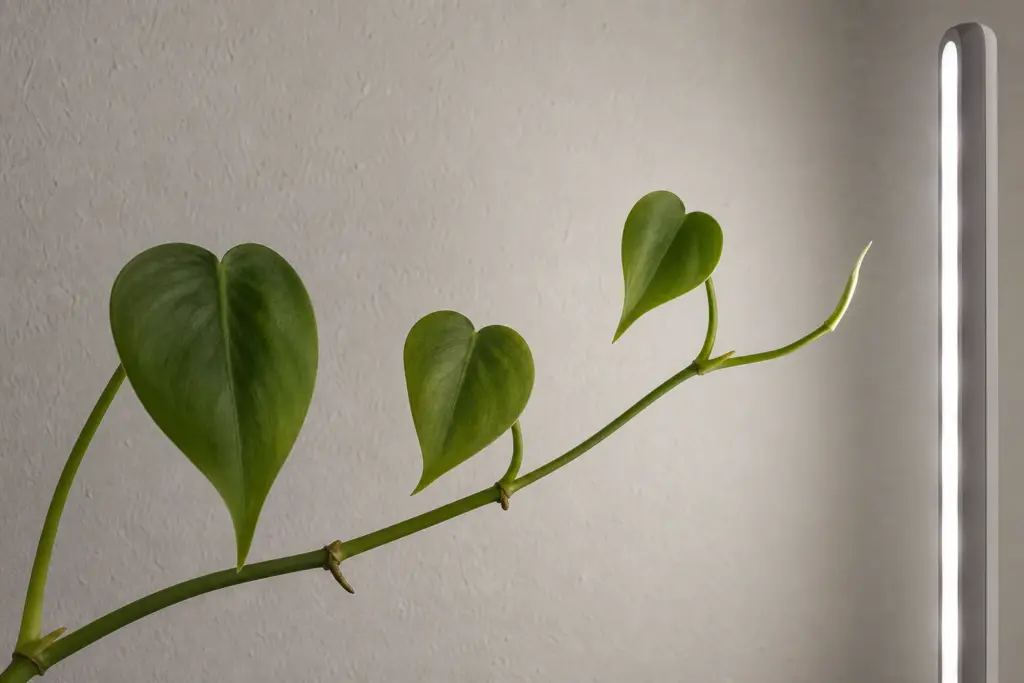
The word for this directional growth is phototropism. NC State Extension’s Gardener Handbook describes the familiar shoot response with an accessible model: cells on the shaded side elongate more, so the stem curves toward the light source.4
In plain language, the shaded side grows a little more than the lit side. The stem does not pull itself toward the window. It bends because one side lengthens faster. That is a beautiful piece of plant engineering: direction is translated into unequal growth, and unequal growth becomes shape.
The details vary among organs and species, but the general response is well studied, chiefly through seedling model systems rather than measurements of this particular potted vine. A review in The Plant Cell describes shoot phototropism as differential cell elongation in response to directional blue light, involving photoreceptors, signaling pathways, and redistribution of auxin across the growing organ.5 The tilted pothos on the sill is therefore not just leaning. Its new growth is turning a light signal into shape.
Leaning is not the same as failing
Some houseplant leaning is simply the price of growing indoors. A pothos trained along a shelf will usually favor the bright side. A philodendron on a plant stand may send its newest leaves toward the window because that is where more light is available. If the leaves have their normal color, the stems are firm, and internode length is typical for the species, the lean is mostly a design issue.
Trouble begins when the directional turn is joined by weak, stretched growth. Long bare spaces between leaves, unusually small or faded new leaves, thin weak stems, and loss of the plant’s usual compact form can all point toward insufficient light. Maryland Extension lists leggy growth, fading leaf color, and poor growth among the effects of too little light.1 Iowa State Extension likewise says pale, spindly, or slow growth may indicate too little light, while leaf drop can have several causes.2 Read the cluster of symptoms against the needs of that species rather than using any single leaf as a verdict.
That is when rotating the pot is not enough. Rotation can even the shape, but it does not create more light. When the whole plant receives too little, turning it only redistributes the available exposure. Improve the light first, then rotate for symmetry once the plant is growing in a more suitable place.
How to correct a one-sided plant
Start by moving the plant closer to suitable light, not automatically to the brightest glass in the house. University of Maryland Extension notes that window direction, curtains, screens, weather, season, shade, and window cleanliness all affect light intensity, and that south-facing or some west-facing windows can provide high light for plants that want it.1 A cactus and a pothos do not ask for the same solution. Before moving any pot close to the pane, check conditions at leaf height: keep foliage off cold glass and out of the hot-or-cold pocket between a curtain and window.2
For many foliage houseplants, the practical adjustment is modest: closer to a suitable window when winter light is weak, away from intense direct sun if summer exposure would scorch the species, and given small, regular turns during active growth. There is no universal rotation interval. Watch how quickly new growth changes direction, and remember that an already stretched stem will not become compact after the pot is turned.
Clean the window. Gently clean broad, sturdy leaves when dust accumulates. Open a sheer curtain during the day if the plant can tolerate the resulting exposure. Move a plant out from behind a tall neighbor. These are small actions, but they can make better use of the light the room already has.
If the room simply cannot provide enough natural light, a grow light is not cheating. Both Maryland and Iowa State Extension describe artificial light as a practical supplement where window light is insufficient.12 What matters is the light that reaches the leaves at a suitable intensity and on an appropriate schedule for that plant, including a daily dark period. Follow the fixture’s placement guidance and observe the response; a decorative lamp across the room may look bright to us while delivering far less plant-usable light than its appearance suggests.
Do not answer light with water
A common wrong answer to a leaning or leggy houseplant is extra water. The plant looks strained, so the watering can comes out. But water does not replace light. In a cooler, lower-light winter room, growth and water use may slow and the potting mix may stay wet longer, although species, pot size, temperature, humidity, and the mix itself all affect the drying rate.2
This is why houseplants often ask for less water in winter. Check the potting mix rather than watering by the calendar, using a depth and drying threshold appropriate to the species. Watering again while the root zone remains wet can deprive roots of air and promote root decay without improving the growth pattern.2
Fertilizer cannot compensate for inadequate light either. Maryland Extension advises withholding it when winter light and temperature have slowed growth; excessive fertilizer can add soluble salts and encourage stretched growth.6 Give the plant the missing condition first. Better light, appropriate rotation, and time will do more than a heroic watering or feeding schedule. Old stretched stems may never become compact, but new growth can be better. With vines that readily root from stem cuttings, such as pothos or heartleaf philodendron, you can prune weak reaches and rebuild a fuller plant in a brighter position.
Final thoughts
A houseplant leaning toward the winter window is easy to read as neediness. It is better read as evidence. The plant has been measuring the room with leaves and stems. It has found the direction where light is worth growing toward, and it has written that direction into its body.
That makes the lean useful. It tells you where the room is dimmer than it looks. It tells you which plants are merely adjusting and which are stretching too hard. It reminds you that indoor gardening is still gardening, even when the soil is in a pot and the weather is on the other side of glass.
In January, a tilted pothos is not just untidy. It is a small green instrument pointed at the season’s remaining light.
References
- University of Maryland Extension: Lighting for Indoor Plants
- Iowa State University Extension: How to Care for Houseplants
- NC State Extension Gardener Handbook: Plants Grown in Containers
- NC State Extension Gardener Handbook: Botany
- Liscum, E. et al. “Phototropism: growing towards an understanding of plant movement.” The Plant Cell, 2014.
- University of Maryland Extension: Fertilizer for Indoor Plants