
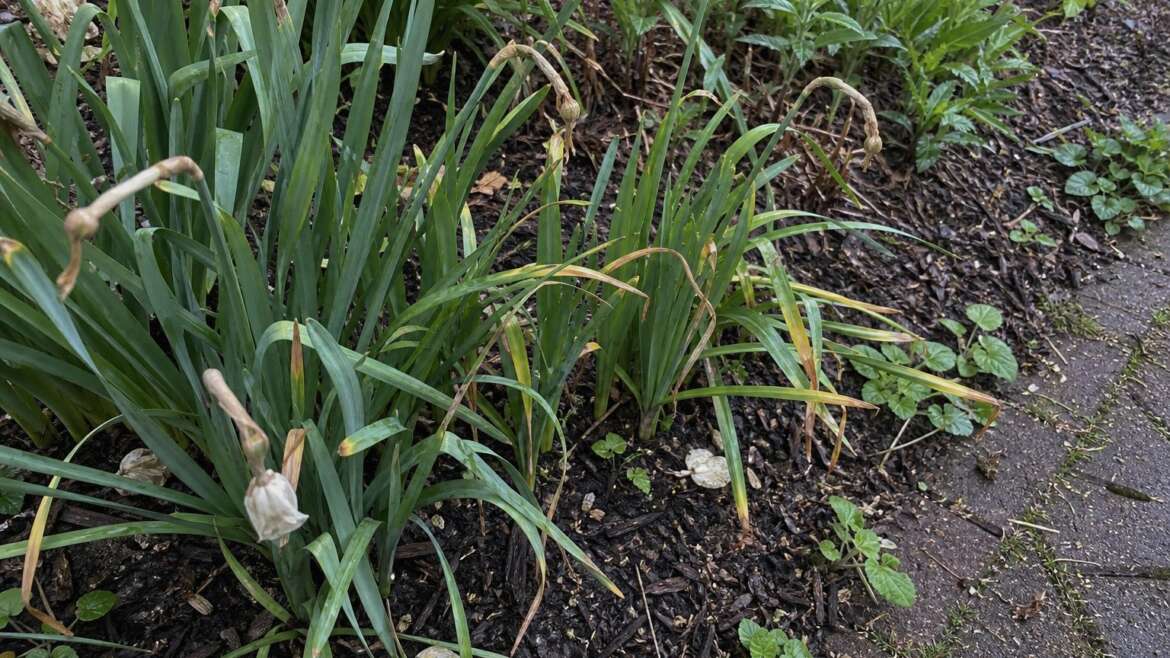
Late April is when spring bulbs start to lose the argument with taste. A daffodil that looked almost heroic two weeks ago now has a collapsed flower head, a papery stem, and a thick fountain of leaves leaning over the path. Tulips drop their petals and leave behind cups of green foliage that seem to take up more space than the flowers ever did.
This is the untidy part of spring that catalogs rarely show. The border is trying to move on. Perennials are rising. The first weeds are feeling ambitious. Meanwhile, the bulb leaves remain, strappy and increasingly yellow at the tips, as if the garden has left its laundry on the floor.
The temptation is obvious: cut them down, braid them, fold them, hide them, or pretend the lawn mower made the decision for you. But those leaves are not leftover decoration. They are the bulb’s repair crew. The flower was the public event. The foliage afterward is how the plant pays for it.
The flower is not the finish line
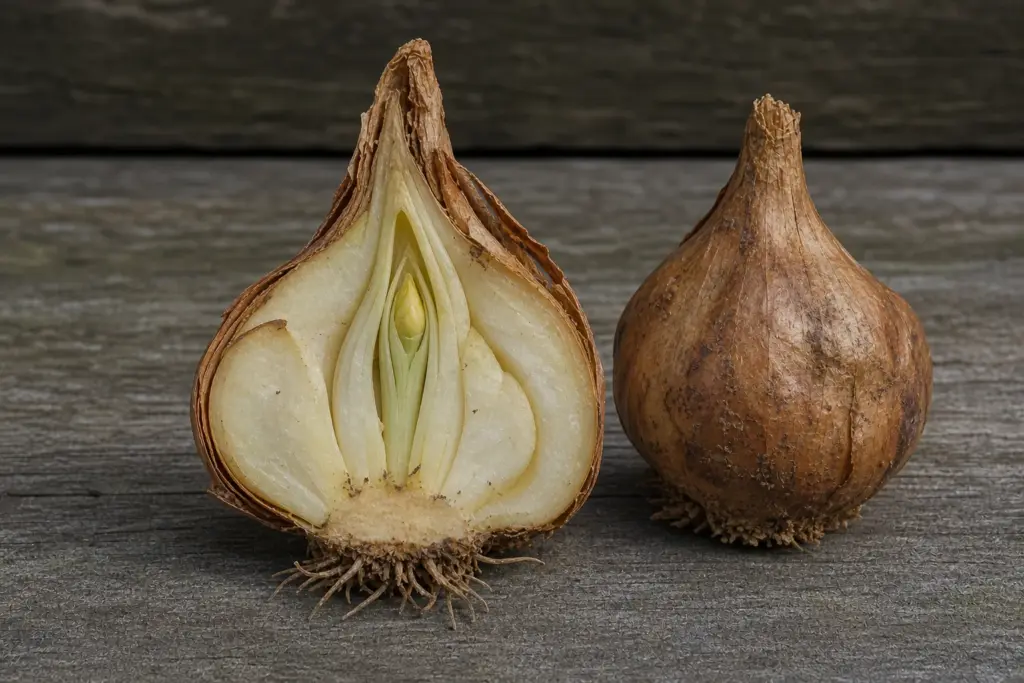
A spring bulb is a storage organ with a calendar inside it. The bulb spent the previous season packing away carbohydrates and forming the structures that would become roots, shoots, leaves, and flowers. By the time a daffodil opens in March or April, much of that flower was prepared long before the gardener noticed it.
After bloom, the plant has to rebuild. University of Illinois Extension explains that spring-blooming bulbs need their foliage after flowering so the leaves can photosynthesize and produce food for flower buds the following year.1 That is the central bargain. If you enjoyed the flowers this spring, the leaves are working on the flowers you hope to see next spring.
The green blade is not passive. It is catching light, exchanging gases, moving sugars, and sending resources down into the bulb. The leaves may look like the boring remainder after the show, but biologically they are the part that decides whether the bulb returns with strength or merely survives.
What the bulb is storing
Photosynthesis turns light, carbon dioxide, and water into sugars the plant can use. In true bulbs such as daffodils and tulips, some of those sugars are used immediately, while some are sent into storage. A true bulb is built from fleshy storage scales—the primary storage tissue—around a basal plate and developing shoot. Crocuses are different: they grow from corms, which are swollen stem bases rather than layered leaf scales.2
University of Illinois Extension puts the post-bloom job plainly: the leaves need to photosynthesize and produce the food used to form flower buds for the following year.1 Remove the leaves too early, and the plant has less time to refill the bulb. The result may not show immediately. It may appear next year as fewer flowers, smaller blooms, weak clumps, or bulbs that slowly vanish.
This is why a bed can decline even when no obvious disaster happens. Nobody dug the bulbs. No animal ate them. The soil did not fail overnight. The leaves were simply removed before they had finished their work, year after year, until the stored reserves no longer supported a good display.
How long is long enough?
The honest answer is not a date. It is a condition. Leave bulb foliage until it yellows, browns, and collapses naturally. The green parts are still useful. The brown parts have mostly finished.
For Iowa gardens, Iowa State University Extension says daffodil foliage should not be removed until it has turned brown and died, and notes that the leaves often do not die back until late June or early July.3 Climate, cultivar, light, and weather can shift that timing, so condition matters more than the date. That can feel unreasonable in a small garden, especially if the bulbs are in a lawn or at the front edge of a path. The plant’s calendar is not arranged for human neatness.
Tulips you intend to keep ask for the same patience. Iowa State gives similar guidance: wait until the foliage dies and turns brown, because premature removal stops bulb growth and can reduce flowering the following spring. Tulips intentionally grown as annuals are the exception; the whole plant can be removed after bloom.4
A useful rule is to follow color and texture rather than the calendar. Wait until the foliage is fully yellow or brown and withered, then cut it at ground level or lift away loose, dry material without pulling on still-green tissue.3
Deadheading depends on the bulb
Deadheading spent flowers can be useful after some spring bulbs fade. Once a flower is pollinated, the plant may put resources into seed. Whether removing that flower matters to next year’s bulb, however, depends on the plant.
Iowa State University Extension draws an important distinction: tulips kept as perennials should be deadheaded promptly because developing seed pods can reduce bulb vigor; daffodils do not need deadheading for vigor, and their seed pods have little impact on it.5 Removing a spent daffodil flower is therefore mostly a choice about appearance. In either case, leave every green leaf in place.
This is where bulb care differs from ordinary tidying. A spent tulip flower head can be removed in seconds, and a collapsed daffodil bloom can be taken off if you dislike the look. The leaves still need weeks. The useful edit is exact: remove only the flower or seed head when there is a reason, and leave the foliage to work.
Why braiding and tying are not favors
For years, gardeners have braided daffodil leaves, folded them into knots, or tied them in bundles to make the border look cleaner. It is understandable. The leaves are in the way, and braiding seems gentler than cutting. But a tied leaf is a leaf with less usable surface in the light.
University of Illinois Extension advises against cutting, shortening, or braiding spring-bulb foliage while it remains green.6 A leaf needs exposure. Folding it into a little green knot may make the bed tidier, but it reduces the leaf area exposed to light and does not help the bulb rebuild.
If the foliage truly bothers you, disguise it with planting rather than punishment. Useful partners include hardy geraniums, catmint, hostas in shade, ferns, appropriately scaled ornamental grasses, or later annuals tucked nearby. Choose plants whose light, moisture, mature size, and local ecological behavior suit the site, and place them so new growth screens rather than covers the bulb leaves. The foliage still needs light while it is green.1
Why bulbs in lawns fade away
Naturalizing bulbs in grass can be beautiful. Crocuses, snowdrops, small narcissus, and early species tulips can make a lawn feel briefly enchanted. The problem comes when the lawn wants mowing before the bulb leaves are done.
Naturalizing works only where mowing can wait until the bulb foliage dies naturally. Illinois Extension lists early bulbs such as snowdrops, winter aconites, crocuses, squill, and daffodils for grassy areas, but notes that daffodils often remain green until the end of June—too late for many regularly mown lawns.7 Match the bulb to the mowing calendar, not just to the spring display.
This is not a moral failure of the lawn. It is a mismatch of calendars. A meadow-like area, orchard edge, or informal strip can hold bulbs because it can be left rough for longer. A front lawn kept short every week is harder territory for bulbs whose green foliage may persist for four to six weeks or longer after bloom.3
Cold-damaged leaves still count
Spring rarely behaves. A warm week pushes tulips and daffodils upward, then a cold night burns leaf tips white or tan. Damaged foliage can look especially tempting to cut away because it seems half spoiled already.
Iowa State advises that cold-damaged tulip and daffodil foliage should not be cut back until it is completely dead, because any green portion can still manufacture food.8 This is a useful reminder that leaves do not have to be perfect to be valuable. A browned tip is not the same as a dead leaf. Green tissue still earns its place.
Designing for the ugly weeks
The best answer is not simply discipline. It is design. Put large spring bulbs where their fading leaves can lean into something forgiving. Plant them behind perennials that rise in May. Place them between shrubs, along informal edges, or in pockets where the garden can absorb a little disorder. Avoid lining a narrow front path with bulbs whose leaves will flop across the walkway for weeks after the flowers are gone.
Deadhead flowers according to the species. If rainfall is deficient and the soil becomes dry, water while foliage remains green, but keep the soil moist rather than soggy.9 Fertilizer is not a substitute for leaving foliage; use it only when local guidance and a soil test indicate a need.1
When the leaves finally yellow and release, remove them cleanly and let the space change hands. By then, the border will have moved into its next season. The perennials will have filled, the path will be clearer, and the bulbs will be underground again, storing the memory of light.
That is the small patience spring bulbs ask of us. Not admiration forever. Just enough time after the applause for the plant to put away what it needs for next year’s performance.
References
- University of Illinois Extension: Caring for spring-blooming bulbs after flowering
- University of Illinois Extension: Bulb storage structures
- Iowa State University Extension: All about daffodils
- Iowa State University Extension: All about tulips
- Iowa State University Extension: Is it necessary to deadhead daffodils?
- University of Illinois Extension: Give back to your spring-flowering bulbs
- University of Illinois Extension: Landscaping with bulbs
- Iowa State University Extension: Should I cut off cold-damaged foliage on tulips and daffodils?
- Penn State Extension: Bulbs, corms, rhizomes and tubers