

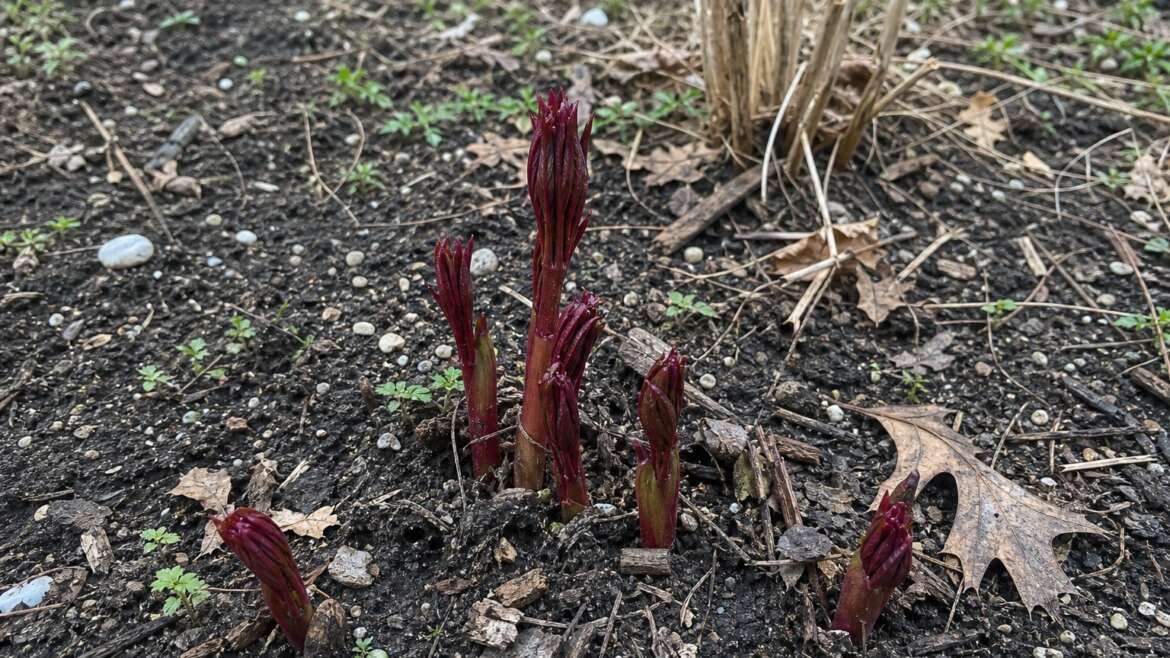
In mid-March, a peony bed can look empty until it suddenly does not. The soil is still dark and cold. Last year’s stems have been cut away. Mulch lies flat, and the rest of the border is only beginning to loosen. Then, from the crown, a cluster of red points breaks the surface.
They do not look like the flowers people wait for later in spring. They look more like little burgundy claws, folded and glossy, pushing through the soil with surprising force. A few days later they are taller. A week later the leaves begin to open. By then the red may already be softening toward green.
That red arrival is one of the best small signals of spring because it is both beautiful and practical. It tells you where the crown is waking, where not to dig, where support rings should go before the plant gets too tall, and that growth has resumed after winter. It also raises a reasonable question: why does a plant famous for lush green foliage and soft flowers begin the year so red?
The red shoots come from the crown
Herbaceous peonies are perennials that die back above ground and return from underground crowns. Iowa State University Extension describes the common garden peony as a long-lived perennial, often flowering for decades when left undisturbed, with herbaceous types growing from species and hybrids in Paeonia.1 In autumn, the stems collapse into memory. In spring, the crown spends stored energy to build the next season.
The first red points are not separate seedlings or the rounded terminal flower buds visible later. They are emerging shoots from underground renewal buds, often called eyes, on the crown. In a study of Paeonia lactiflora ‘Hangbaishao’, renewal buds formed vegetative and reproductive primordia before spring growth, and most large buds later developed into aboveground parts.8 Each red point therefore holds folded shoot tissues, and a flowering shoot may have begun forming its reproductive parts before winter. What appears sudden aboveground was prepared underground.
That is why established peonies can seem to reappear with such confidence. They are not starting from scratch the way an annual seedling does. They are drawing on a storage system built over previous seasons. The spring shoot is the visible end of a perennial bargain: last year’s leaves fed the roots, the roots carried the plant through winter, and the crown now sends up the next body.
What the red pigment tells us
The red, burgundy, or purple color in young peony growth comes from its pigment balance. In a study of one herbaceous peony cultivar, Paeonia lactiflora ‘Zilan Xijin’, anthocyanins were concentrated in the surfaces of young purple leaves. As those leaves passed through purple-green to green stages, anthocyanin content fell while chlorophyll content rose.2 That is direct evidence for the color change in a peony, although one cultivar should not be treated as every peony.
Anthocyanins are a family of pigments that can make plant tissues red, purple, or blue depending on their chemistry and cellular surroundings. A review in New Phytologist evaluates evidence that anthocyanins in vegetative tissues can reduce photoinhibition and chlorophyll bleaching under light stress, particularly when the pigments occur in outer tissue layers.3
That makes a protective role plausible for exposed young foliage, but it does not prove that a peony shoot is red because it needs a sunscreen. The peony study measured pigments and gene expression during leaf development; it did not test frost survival or photoprotection. The safest conclusion is narrower: anthocyanin-rich surface tissue helps produce the early color, then a different balance becomes visible as the leaf matures.
Redness is therefore normal development, not a guarantee against cold and not a sign that the plant is struggling. The peony is not blushing. It is launching.
Why the red fades
As peony shoots lengthen, the leaves unfold and the plant’s color balance changes. In the studied P. lactiflora cultivar, anthocyanins declined and chlorophyll increased as leaves shifted from purple to green.2 What looked almost beet-red at the soil line may become green with red edges, red stems under green leaves, or a faint bronze wash that disappears as the plant settles into ordinary growth.
That fading is not a loss of health. It is a transition. Young tissue has different risks than mature tissue. A folded shoot near the ground must push through mulch, cold soil, and erratic spring light. A fully expanded leaf later in spring has a different job: capture light, move water, feed the crown, and support the flower show above it.
Color alone is a poor health chart. In the cited study, researchers defined purple, purple-green, and green developmental stages for one cultivar; the article did not test every peony cultivar.2 Compare a clump with itself over several days rather than expecting one universal timetable or shade. The usual direction is from folded red or bronze growth toward expanded greener leaves.
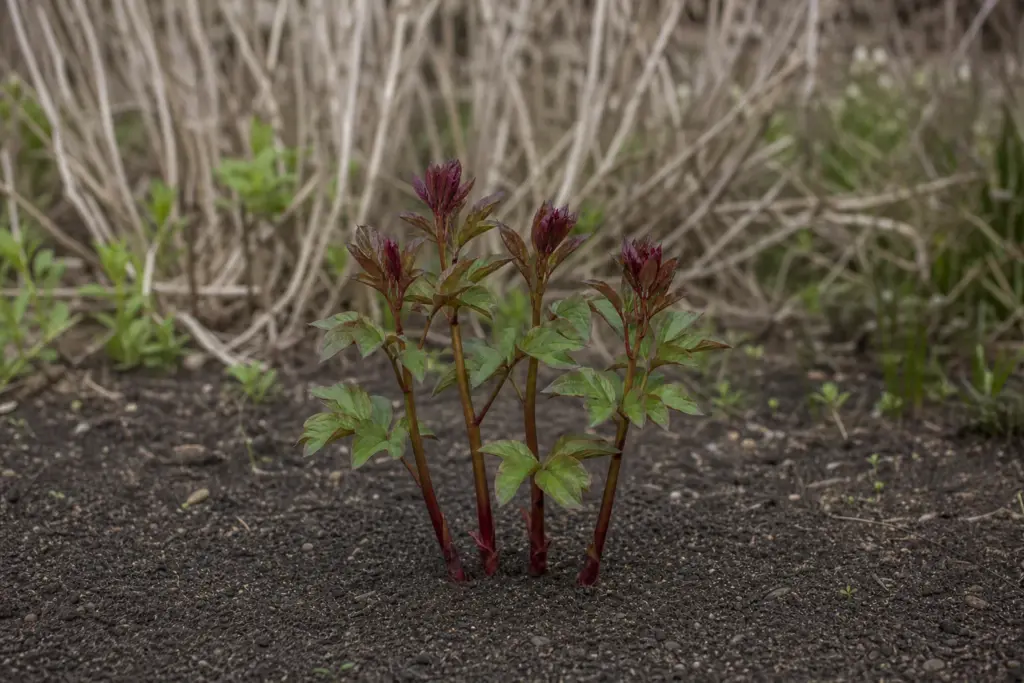
Those shoots mark the planting depth
Peonies are particular about where their crowns sit. Iowa State University Extension recommends planting bare-root peonies so the buds are only 1 to 2 inches below the soil surface, noting that plants set too deeply do not bloom well.1 The spring shoots locate the crown, but they do not by themselves measure how deeply the original eyes were planted.
If a mature peony makes strong foliage but few flowers year after year, one possible reason is that the crown is buried too deeply, either from original planting or from years of mulch and soil creeping over it. The red shoots show you where to look. If accumulated mulch is covering the crown, pull it back gently; do not dig among the brittle eyes merely to investigate. Peonies want protection from competition and drought, not a layer that becomes deeper every year.
This is also why moving soil around peonies should be gentle, especially when wet spring soil should be left alone. The crown sits close to the surface. The eyes are vulnerable. A careless fork, deep cultivator, or energetic weeding session can break the very shoots you have been waiting for. Once the red points appear, the plant has drawn its boundary for the season.
What to do when they appear
The best response to peony shoots is usually restraint. Clear away heavy, wet leaf mats if they are pressing directly over the crown. Pull mulch back if it has buried the emerging eyes. Remove last year’s stems if they were not already cut after frost. Then stop before tidiness becomes damage.
Iowa State warns that peony crowns and young shoots are susceptible to fertilizer burn and advises keeping fertilizer at least 6 inches away from the crown when feeding in early spring.1 If you fertilize, follow local soil guidance and the product label, keep it off the new red growth, and water the application into the soil instead of raking through the crown.
This is also the moment to place supports if your peonies tend to flop. Once the stems are tall and budded, wrestling a support ring over them can snap growth and leave the plant looking handled. When the shoots are still short, a ring or grid can disappear into the foliage as it rises. The best support is the one you forget by bloom time.
Do not panic at every cold night. Iowa State’s peony guide describes emerging shoots as cold resistant and advises against replacing winter mulch when a late spring freeze is forecast; piling material back over brittle growth can cause its own damage.4 Flower buds later in development are more susceptible and may brown or fail to open after freezing temperatures.5 For an unusual severe-freeze forecast, use local Extension advice for your cultivar and growth stage rather than automatically burying or wrapping the shoots.
Do not confuse early red growth with disease
Healthy peony shoots can be startlingly red. That color alone is not a disease sign. Botrytis blight is different: affected young shoots discolor at the base, wilt, and fall over, and gray fuzzy spores may appear in damp conditions.6 Peonies need good sun, air movement, and well-drained soil for best performance; Iowa State notes that wet, poorly drained soils can contribute to root rots, and that locations with good air movement help prevent foliar disease problems.1
Good cleanup helps. Cut and remove dead peony foliage after a hard freeze in fall rather than leaving diseased debris to weather in place; Botrytis can survive in old material.16 In spring, remove infected shoots promptly and avoid injuring healthy new growth.
Later in the season, ants on peony buds often alarm gardeners, but they are a different story from the red shoots. University of Illinois Extension explains that peonies do not need ants to open their buds; ants are attracted to nectar from extrafloral nectaries on the bud scales.7 The ants are not the cause of the flowers, and they are not the reason the shoots came up red.
A small design moment before the flowers
Peony flowers are so extravagant that they can make the rest of the plant’s year feel like a prelude. The red shoots argue otherwise. They are the first sculptural moment of the peony season: tight, dark, upright, and vivid against soil that still looks half asleep.
In a border, that early color pairs well with the smaller spring signals around it: crocus leaves, emerging daylilies, hellebore flowers, mossy stones, the bronze noses of hostas, and the first threads of ornamental grasses. A mature peony clump is not empty before bloom. It has an emergence chapter, then an unfurling chapter, then the famous flowering one; local climate decides which months carry them.
Marking that sequence changes how you garden around it. You leave enough room for the crown. You set supports early. You stop stepping through the bed as if nothing is there. You see the perennial border not as a blank space waiting for flowers, but as a series of returns.
Final thoughts
Peony shoots arrive red because emerging foliage carries a different pigment balance from mature leaves. In the peony cultivar studied directly, anthocyanin-rich young leaves lost anthocyanin and gained chlorophyll as they developed.2 General plant research makes a light-screening role plausible for anthocyanins, but it does not turn the red color into a promise of frost protection.
For the gardener, the red is also a message. The crown is awake. The shoots are tender. The planting depth matters. The support should go in soon. The famous flowers are still weeks away, but the peony season has already begun.
Sometimes spring does not begin with a bloom. Sometimes it begins as a red fist in the soil.
References
- Iowa State University Extension and Outreach: Growing Peonies in Iowa
- Tang, Y. et al. “Color characteristics, pigment accumulation and biosynthetic analyses of leaf color variation in herbaceous peony (Paeonia lactiflora Pall.).” 3 Biotech, 2020.
- Steyn, W. J. et al. “Anthocyanins in vegetative tissues: a proposed unified function in photoprotection.” New Phytologist, 2002.
- Iowa State University Extension: Growing Garden Peonies
- Iowa State University Extension: Flower buds form on my peonies, but don’t open. Why?
- Iowa State University Extension: In spring, some peony flower buds turn brown and fail to open
- University of Illinois Extension: Are Ants Really Required to Help Open Peony Buds?
- Zhang, J. et al. “Transcriptomic Analysis of the Underground Renewal Buds during Dormancy Transition and Release in ‘Hangbaishao’ Peony (Paeonia lactiflora).” PLOS ONE, 2015.