
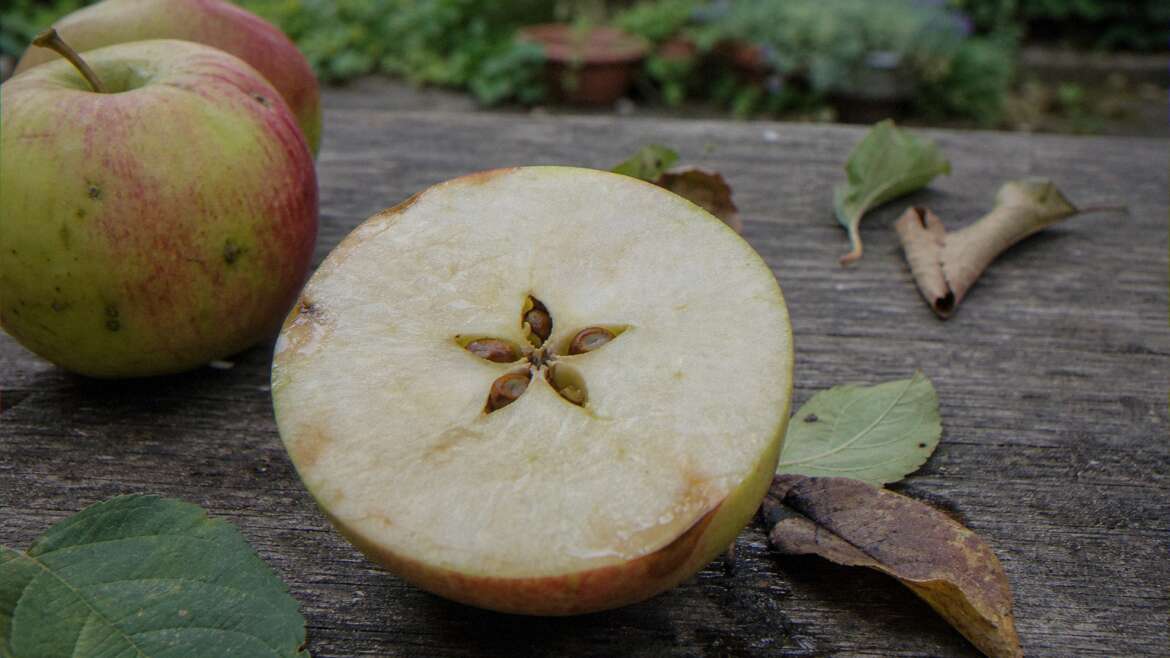
Slice an apple from stem to blossom end and it behaves the way apples usually behave in kitchens: two shoulders, a pale core, a neat place for the knife to pass. Slice it across the middle instead, and the fruit shows a different map. In the center is a small star, five little rooms arranged around a point, each one built to hold seeds.
It is a familiar surprise. Children notice it quickly. Cooks notice it when they cut thin apple rounds. Gardeners notice it differently, because the star is not decoration. It is the old flower, carried forward into fruit. The apple has not hidden a symbol inside itself. It has kept a record of how it was made.
That record is especially visible in late September, when many apples are being picked, tasted, pressed, stored, or quietly argued over at the kitchen counter. A crosswise slice can show the seed chambers, the flesh, the browning surface, the density of the core, and sometimes uneven seed development. The star is pretty, but it is also useful.
Where the apple’s flesh comes from
The simplest fruit story says that a flower is pollinated, the ovary develops, and the mature ovary becomes the fruit. That story works for many plants, but apples complicate it. The University of Illinois’s Digital Flowers resource explains that the fleshy tissue outside an apple’s core comes from the hypanthium, while tissue inside the core comes from the carpels.1
This is why apples are called accessory fruits. The word does not mean unimportant. It means that tissue outside the ovary has become a major part of the edible fruit. The crisp white flesh around the core is not simply a seed case stretched into sweetness. It is floral architecture thickened into food.
That makes the apple one of the better fruits for noticing how categories blur. To the cook, it is a fruit. To the botanist, it is a pome. To the gardener, it is the result of blossom, weather, pollination, thinning, sun, leaves, and time. A single slice can hold all three truths without much ceremony.
Why the star has five points
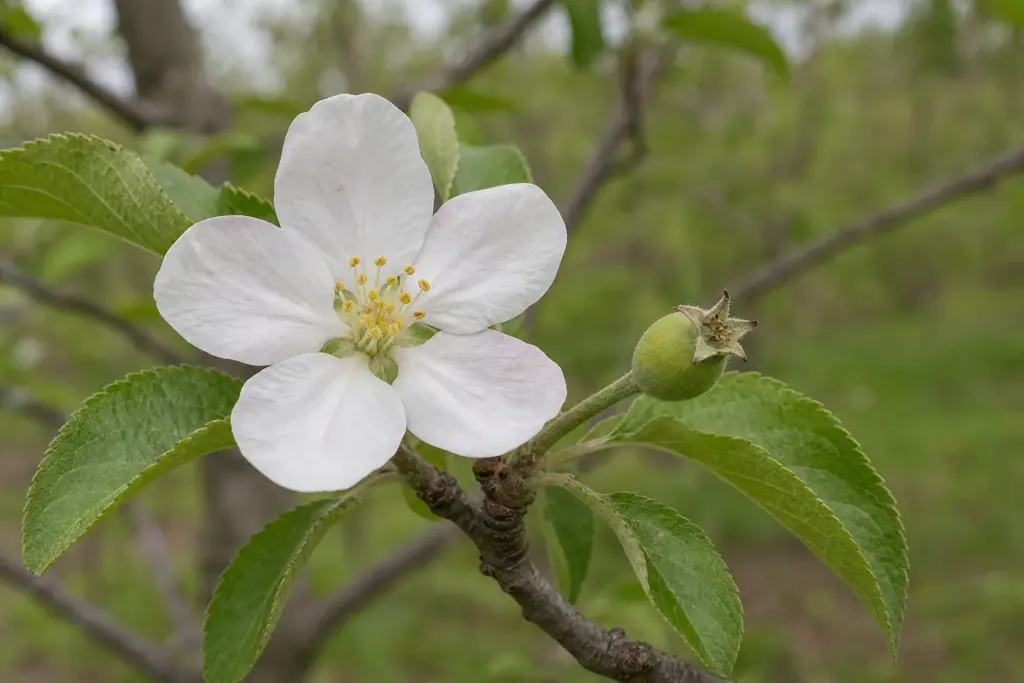
The star in a cross-cut apple comes from the arrangement of the core. A normal apple flower usually has five carpels in an inferior ovary, and those carpels form the five seed chambers, or locules. A primary study of unusual seedless apple mutants uses the normal flower for comparison and notes that a typical apple can contain up to ten seeds, depending on pollination.2
Most apples you cut open will not look like a diagram. One chamber may have two full seeds. Another may have one. Another may have a pale, empty remnant. The star can be sharp in one variety and soft in another. The flesh can open around the core like a clean little window, or the seed rooms can sit half-hidden in thicker tissue.
That variation is part of the charm. The apple is not trying to be a five-pointed stamp. It is a living result. The usual pattern is fivefold because the flower and fruit are built that way. The actual seed count reflects pollination, fertilization, embryo development, cultivar, and the conditions in which the young fruit grew.
The seeds tell a pollination story
Apple seeds are easy to treat as incidental hard bits to avoid with your teeth. Each seed began as an ovule, and in a normally seeded apple, each developed seed records successful fertilization and embryo growth. The normal fruit described in the apple-flower study can carry fewer than ten seeds without ceasing to look like an apple.2 The inside is a record, but not a simple pass-or-fail score.
Home orchardists should plan for compatible cross-pollination rather than assume one tree will be enough. Virginia Tech explains that apple flowers usually will not set fruit with pollen from the same variety; a nearby second variety with overlapping bloom can provide pollen, and a flowering crabapple can often serve that role.3 Illinois Extension adds that pollen-sterile varieties can receive pollen and crop but cannot pollinate another tree, so a third fertile variety may be needed.4
This matters because a tree can bloom beautifully and still set poorly if bloom times do not overlap, if frost kills open flowers, or if compatible pollen and insects are missing at the crucial moment.3 The star inside one apple will not diagnose the whole orchard. It is a reason to compare the fruit with bloom dates, weather, cultivar compatibility, and the rest of the crop.
Lopsided fruit is often a clue, not a curse
A badly lopsided apple can have many causes: physical injury, frost, insects, disease, crop crowding, cultivar, or uneven seed development. Seed number and distribution can affect fruit shape and weight, but the route from a pollinator visit to a finished apple is not as simple as one stigma feeding one chamber. In a study of ‘Summerland McIntosh’, pollen tubes could cross among the flower’s fused carpels, so uneven pollen among the five stigmas did not necessarily produce uneven seed set.5
You do not need to turn every apple into a lab exercise. Still, it is worth occasionally cutting a misshapen apple across its middle. If one side of the star is nearly empty while the other side has plump brown seeds, seed development may have contributed to the shape. It is an observation, not proof that a bee neglected one side of the flower.
For a home gardener, the practical response is usually not dramatic. Verify that compatible varieties flower together. Learn whether a favorite variety is triploid or pollen sterile. Record frost at bloom, crop load, pest damage, and whether odd fruit appeared across the tree or only on one branch. And accept that even a well-pollinated tree will make some peculiar apples.
The crosswise cut also shows ripeness
Cutting an apple through its equator is also how growers prepare fruit for one useful maturity test. As apples mature, starch declines while sugars increase. Virginia Tech cautions that no single index works in every year and describes immature fruit as starchy, tart, or astringent; ripe fruit has acceptable texture and flavor, though the exact balance depends on the cultivar.3
For orchard management, the cut surface can be used in a starch-iodine test. University of Minnesota’s fruit and vegetable IPM program explains that iodine darkens starch-rich areas and that apples stain less as starch disappears during ripening.6 The pattern is cultivar-specific, so a chart made for one apple may not fit another. Most home gardeners do not need iodine beside the fruit bowl, but the principle is useful: ripening is a gradual internal change.
This is why red skin alone is not a harvest date. The sunlit side can color before the fruit is ready, and different cultivars mature on different schedules. Use several clues together: the variety’s expected season, background color, taste, texture, and the way the fruit releases when lifted and gently turned. Sample more than one apple before deciding that the whole tree is ready.
What gardeners can learn from the star
The star is a small anatomy lesson that does not feel like one. It shows that the flower is still present in the fruit. It shows that the edible flesh is not exactly the ovary wall. It shows that seed chambers can be full, partial, or empty. It shows why pollination is more than a spring detail that disappears once petals fall.
It can also change how you think about harvest. A tree full of apples is not a single crop at a single moment. It is a set of fruits that developed flower by flower, seed by seed, branch by branch. Some will be perfect for eating today. Some will be better later. Some belong in sauce or cider. Some damaged fruit needs to be discarded because the garden has already made its point.
There is a quiet generosity in that. The apple gives you sugar, acidity, texture, fragrance, storage, cider, sauce, and pie. Then, if you cut it the less usual way, it gives you a picture of its own making.
A note on apple seeds
It is tempting to see the seeds in a good apple and imagine planting them for more of the same. The seed is alive, but it is not a copy of the apple you just ate. Virginia Tech notes that seed-grown apple trees are not the same variety as the tree that produced the seed; named varieties are maintained by budding or grafting them onto rootstocks.3 That is not a flaw. It is one reason apple breeding is possible and one reason old farm orchards can feel so varied.
For the home gardener, the more useful lesson is simpler: if you want a known apple, plant a grafted tree of that variety and give it a compatible pollination partner. If you want an experiment, plant a seed and make peace with surprise. The star is not a promise of sameness. It is a sign that the fruit participated in the ordinary messiness of reproduction.
Final thoughts
The star inside an apple is not folklore hiding in fruit. It is structure: five seed chambers, a papery core, accessory flesh, developed and undeveloped ovules, and ripening tissue wrapped around a flower’s old architecture. It is the sort of pattern that becomes more interesting once it stops being mysterious.
So this September, cut one apple sideways before you slice the rest normally. Look at the rooms in the center. Count the seeds if you like. Notice whether the fruit is symmetrical, whether the flesh tastes starchy, and whether the skin and flavor agree about ripeness. Then eat the evidence. Good gardening often begins exactly there: with a familiar thing turned ninety degrees and seen again.
References
- University of Illinois Digital Flowers: Pome
- Yao, Dong, and Morris, PNAS: Parthenocarpic apple fruit production conferred by transposon insertion mutations in a MADS-box transcription factor
- Virginia Cooperative Extension: Growing Apples in Virginia
- Illinois Extension: Fruit Tree Pollination Is Complicated
- Sheffield, Smith, and Kevan, Annals of Botany: Perfect syncarpy in apple and its implications for pollination, seed distribution, and fruit production
- University of Minnesota Extension IPM: Check Apple Ripeness with the Starch-Iodine Test