
February is not a generous month in most gardens. It gives you mud, flattened leaves, and a few green shoots that may or may not mean spring is serious. Then a hellebore opens, and the whole scene becomes more interesting.
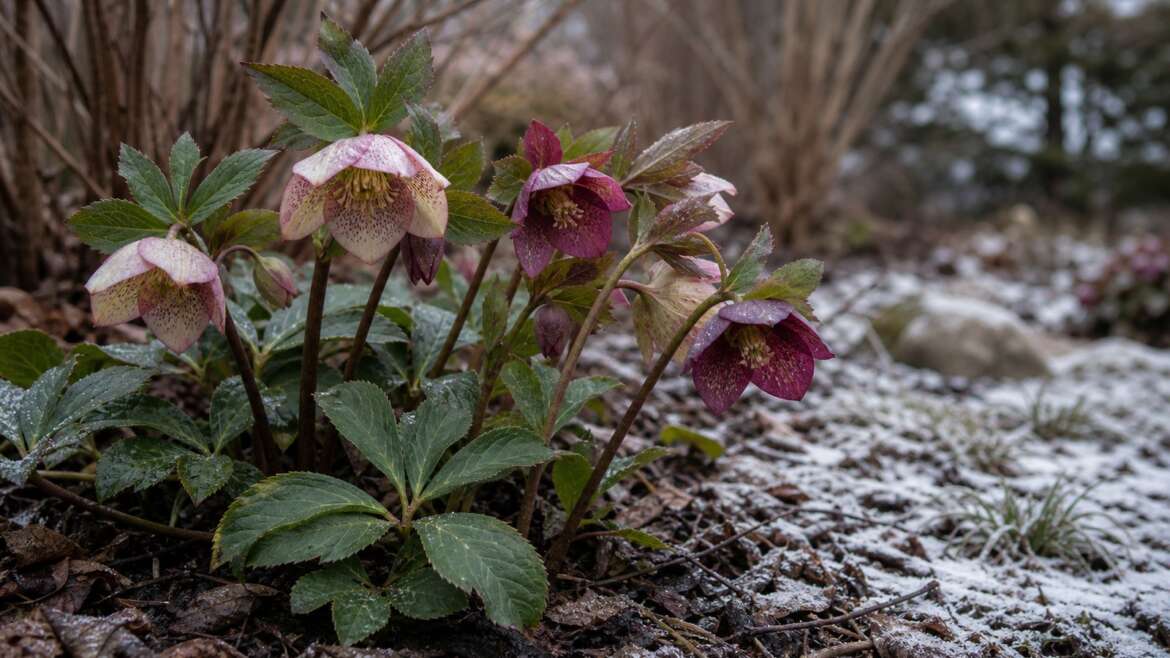
It is not an easy flower in the theatrical sense. Hellebores make you stoop. Their blooms tilt toward the soil as if they are keeping a secret from the weather. That bowing habit can frustrate gardeners who want every flower to look up for a photograph, but it is part of what makes hellebores so well suited to the cold edge of the year.
A flower built for bad weather
The plants sold as Lenten roses are usually Oriental hybrids grouped under Helleborus × hybridus, although labels may still use H. orientalis loosely. Individual species and hybrid selections also appear in the trade, where names are not always applied consistently. These are clumping perennials, often with leathery evergreen foliage in mild climates, and they bloom from late winter into spring when the rest of the border is still negotiating with frost.12
Their preferred site explains much of their character. Hellebores like the kind of place a woodland edge provides: winter light, summer shade, humus-rich soil, and drainage good enough that their crowns are not asked to sit in cold wetness for weeks. In a garden, that usually means the front of a deciduous shrub border, the feet of small trees, or a quiet path where flowers can be noticed at knee height.2
This is also why they can look awkward in the wrong design. Put a hellebore at the back of a bed and the plant becomes a rumor. Put it where you naturally pause, bend, weed, or walk in winter, and the nodding flowers become intimate instead of hidden.
The petals are not really petals
One of the best hellebore tricks is that the showy parts are not petals in the usual sense. They are sepals, the outer flower parts that protect a bud in many plants. In hellebores, those sepals have taken on the job of display, while the true petals are small modified nectaries tucked near the center of the flower.3
That botanical swap matters to gardeners. The showy sepals persist far longer than the small nectary petals and many stamens, so a bloom can seem to last for weeks. Its color may soften or green as the flower ages, but the cup remains, often while seed capsules begin to swell in the middle. What looks like a flower refusing to fade is the work of persistent sepals surrounding developing fruit.13
If you turn a bloom gently upward, the center is almost mechanical: stamens, pistils, tiny nectaries, and sometimes the first suggestion of future seed. The bowed head is not hiding emptiness. It is protecting a crowded little workshop.
Why the flowers face down
It is tempting to explain every nodding flower with one neat sentence, but flowers rarely evolve for only one reason. In hellebores, the downward angle is bound up with the weight and shape of the bloom, the way the flowering stem carries it, and the practical demands of opening during cold, wet weather.
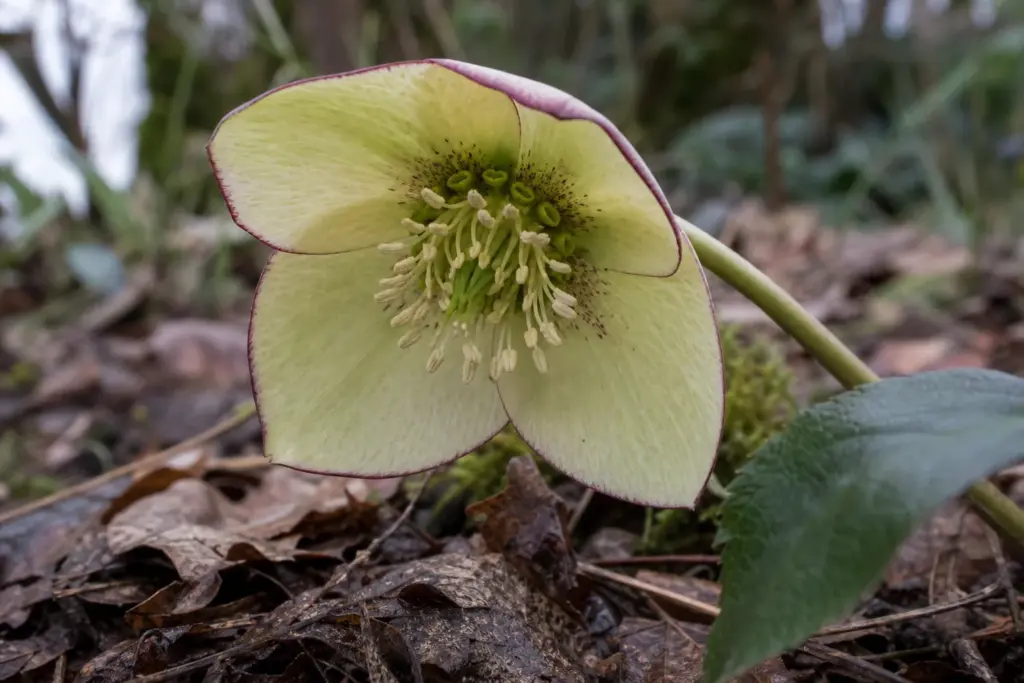
Rain is not a neutral visitor to a flower. Free water can shorten the viability of susceptible pollen, and exposed pollen may be washed away. A comparative study of 80 flowering species found that rain protection by floral structures was associated with pollen’s sensitivity to water, supporting the broader idea that rain can help shape flower form.4 That study did not test the garden hellebores discussed here, so it does not prove that their nodding habit evolved for rain protection. It does, however, make the downward cup a plausible shelter: the fertile center is less exposed than it would be in an upright flower.
The angle also changes the flower’s relationship with visitors. On a mild February day, early bees and other insects may work the flowers from below or from the side. The nectar is not presented like a summer daisy’s open counter. It is tucked in. The gardener has to lean in, and so does the pollinator.2
How to place them in a garden
Because hellebores face down, they reward thoughtful placement more than bold massing. A single plant beside a winter path can be more effective than ten plants marooned behind dormant grasses. A low retaining wall, raised bed edge, or slight slope is ideal because it lets the flowers meet your eyes without forcing them to change their nature.
They pair beautifully with plants that do not compete for the same moment. Snowdrops, dwarf cyclamen, early epimedium foliage, sedges, mossy stones, and the bare stems of deciduous shrubs all make good company. Avoid burying hellebores in coarse evergreen groundcovers that swallow the flowers just as they open.
Soil preparation is quiet but important. Work in leaf mold or compost where the soil is thin, but do not make a wet pocket. The Royal Horticultural Society notes that hellebores struggle in very dry or wet soils, which is a useful reminder that these are woodland-edge plants, not bog plants and not drought ornaments.2
Clean the stage before the show
By late winter, last year’s leaves on stemless Oriental hybrids often look tired. They have done useful work through autumn and winter, but now they can sprawl over emerging flower stems, collect spots, and make the whole plant look older than it is. On Helleborus × hybridus, cutting the old leaves at the base in late winter or early spring reveals the nodding flowers and can help control hellebore leaf spot.2 Other hellebore species may carry leaves and flowers on the same stems, so their pruning needs to be species-specific; before bloom, remove only damaged or diseased foliage from those types.
For an Oriental hybrid, use clean bypass pruners and cut each old leaf stem near the base, taking care not to nick the new flower shoots. Do not scalp the crown. The aim is to remove the tired canopy, not punish the plant for being evergreen.
Wear gloves. Hellebores are not edible flowers, despite their soft winter beauty. NC State Extension classifies H. orientalis as a low-severity poison but lists all parts as poisonous if ingested; the cell sap may also irritate skin.1 Treat hellebores as ornamentals to admire, not plants to taste, and keep cut stems away from curious children and animals.
Let the seedlings surprise you
Once established, many hellebores will seed around politely, then occasionally with confidence. Seedlings can appear a foot away, several feet away, or in a place that makes you suspect the garden is keeping its own notes. Illinois Extension points out that hellebore seeds have elaiosomes, fleshy attachments attractive to ants, which can help move the seeds through a process called myrmecochory.3
Seedlings from hybrids do not necessarily match the parent. That is part of the pleasure. A dark plum plant may give you dusky pink offspring, speckled cream, greenish white, or something quietly muddy that only a collector could love. Let a few young plants flower before judging them, then keep the best and move or compost the rest while they are still small.
If you want exact copies, buy named cultivars propagated vegetatively. If you want a winter border that feels a little self-authored, allow some seedlings. Hellebores are slow enough that the garden will not change overnight, but generous enough that it will change eventually.
Useful hellebore supplies
- Fiskars bypass pruning shears: useful for removing old hellebore leaves cleanly before the flowers open fully.
- Carson folding loupe: helpful for looking closely at nectaries, stamens, young seed pods, and the small details that make hellebore flowers so strange.
- garden marker pen: practical for labeling self-sown seedlings, promising crosses, or named cultivars before the flowers fade and memory becomes optimistic.
Final thoughts
Hellebores are not shy flowers. They are weather-wise flowers. Their downward faces ask the gardener to meet them on their terms, close to the soil, in the thin light before spring has fully arrived.
That small act of bending is part of their gift. You notice the sepals instead of petals, the hidden nectaries, the careful green machinery in the center, the old leaves that need clearing, and the seedlings waiting nearby. The flower does not look up because it does not need to. It has found a way to bloom in February without pretending February is gentle.
References
- North Carolina Extension Gardener Plant Toolbox, Helleborus orientalis.
- Royal Horticultural Society, How to grow hellebores.
- Illinois Extension, Winter blooming hellebores.
- Mao, Y.-Y. and Huang, S.-Q. 2009. Pollen resistance to water in 80 angiosperm species: flower structures protect rain-susceptible pollen. New Phytologist.