
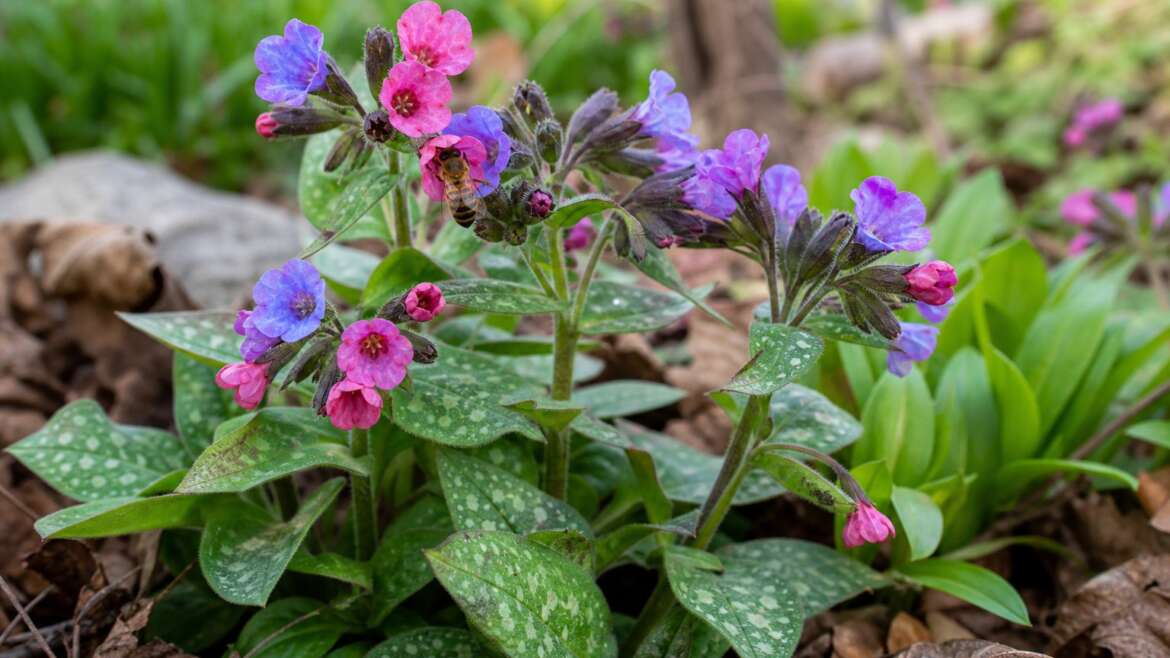
A spring shade bed can look as if it has learned to blush and cool at the same time. Lungwort opens with little pink bells, then the older flowers nearby settle into violet and blue. The spotted leaves are pretty enough on their own, but the flowers make the plant look like a small calendar. One cluster can hold yesterday, today, and tomorrow at once.
To a gardener, that two-toned effect is decorative. To a bee working close to the ground on a cool April morning, it may be information. The plant is not simply changing costume. Depending on the species, fresh and older color phases may differ in nectar, pollen, scent, or reproductive usefulness. The change may help visitors avoid flowers that are less rewarding or no longer receptive.
That does not mean every pink-to-blue bloom is a little traffic light with perfect instructions. Flowers are living tissue, and age alone changes them. Pollination can speed or sharpen the shift in some species, while others change on a more internal schedule. Still, once you learn to look for the pattern, a mixed-color cluster becomes one of the most satisfying plant signals in the garden.
The color is a signal
Flower color is usually described as attraction, which is true but incomplete. A flower has to be noticed from a distance, then understood at close range. A patch of color says, roughly, “come here.” A smaller difference between fresh and aging flowers can say, “try this one first.”
In a classic paper in Nature, Martha R. Weiss described floral color change across at least 74 angiosperm families and argued that these changes can guide pollinator movement in ways that benefit both plant and visitor.1 A later review adds an important limit: color change may follow age and/or pollination, but its value as a pollinator signal depends on particular ecological circumstances. The pattern is widespread, not a universal floral code.2
The arrangement is elegant because it does not require the plant to drop every flower the moment its best reproductive work is done. Old flowers can remain on display and help the whole plant stay visible, while the newer, more rewarding flowers carry the stronger invitation at close range. The plant keeps its billboard and edits the directions.
What changes inside the petal
The visible change often comes from pigments that are already familiar to gardeners in other contexts. Anthocyanins help create many red, purple, and blue tones. Carotenoids help create many yellows and oranges. The final color is not only a matter of which pigment is present. It also depends on concentration, companion compounds, cell shape, light, and the chemistry inside petal cells.
One of the most useful details is pH, but not necessarily the pH of the garden bed. A Frontiers in Plant Science paper on flower coloration explains that flavonoid pigments are held in the vacuoles of epidermal cells, and that vacuolar pH can strongly affect how those pigments absorb light.3 In other words, a flower can shift color because the tiny compartments inside its petal cells have changed their chemistry.
This is why lungwort should not be read like a hydrangea. If a Pulmonaria flower opens pink and matures blue, it is not asking you to lime or acidify the border. The shift belongs mainly to the flower’s own aging process. Soil still matters for plant health, of course: lungwort generally prefers light shade and soil that does not dry out excessively.4 But its two-colored spring show is not a simple soil test.
Why keep old flowers at all?
A gardener deadheading a border might wonder why a plant would bother keeping flowers that are past their prime. The answer is that prime depends on who is looking. For seed-making, a flower may be finished. For advertisement, it may still be useful.
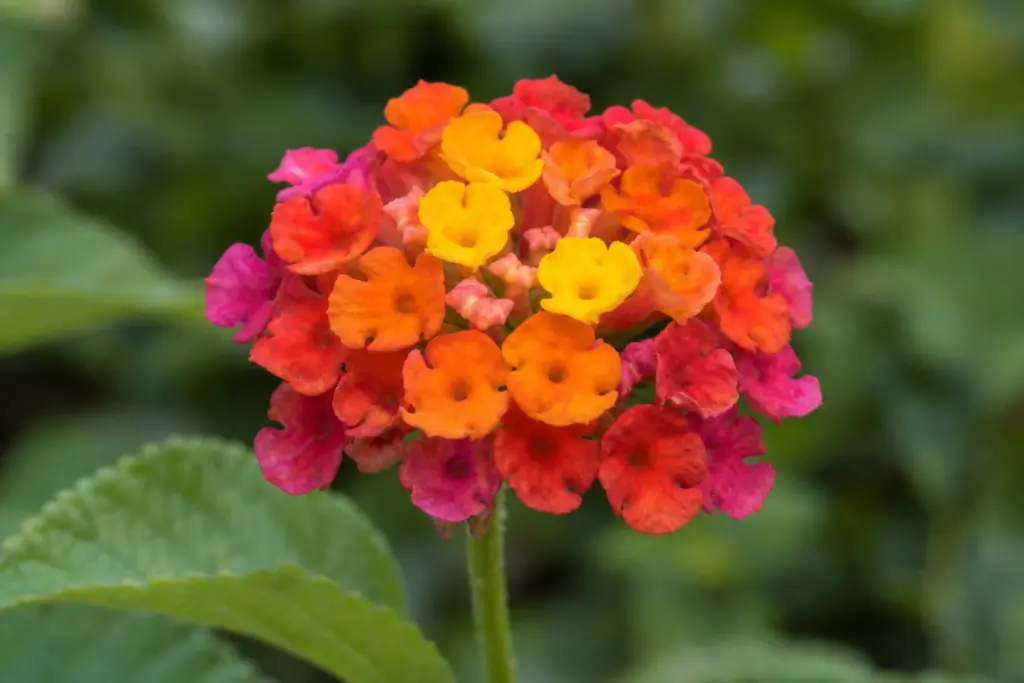
Think of a lantana head. In a color-changing selection, the cluster can show yellow, orange, pink, and red at once, like a small wheel of changing signals. UC Botanical Garden at Berkeley describes this as a form of pollinator training, with rewarding colors helping visitors learn which flowers are worth visiting.5 In one experimentally studied color form of Lantana camara, newly opened flowers were yellow and aging flowers ranged from orange to magenta; pollination triggered rapid anthocyanin synthesis.7 Cultivars vary, however: NC State Extension lists both color-changing and single-color selections.6
The older florets can help the entire cluster remain conspicuous, especially from a distance. Once a bee or butterfly arrives, the fresher phase gives finer guidance. This is a clever compromise. Dropping old flowers immediately would keep the signal honest but shrink the display. Keeping every flower visually identical would make the display larger but less informative. Color change lets a plant do both jobs at once.
Lungwort, lantana, and garden clues
Lungwort is the spring example many temperate gardeners can watch without setting up an experiment. The Royal Horticultural Society notes that Pulmonaria flowers can change color as they mature, leaving pink and blue flowers on the same plant, and that they offer bees useful early nectar.4 That makes the plant more than a pretty shade perennial. It is a small lesson in timing.
Plant it where you naturally slow down: beside a path, near a gate, under deciduous shrubs, or along the front of a woodland edge. The foliage will carry the planting after bloom, especially on silver-spotted cultivars, but the spring flowers deserve close placement. From a few steps away, the mixed colors make a soft haze. From knee height, you can see the sequence.
Lantana tells the story in a warmer, sunnier language. In cold-winter regions it is often grown as an annual or container plant. In frost-free regions, be more careful: some lantanas spread aggressively, and local invasive-plant guidance matters. Lantana camara is poisonous if eaten and can irritate sensitive skin, so keep it out of edible beds and away from children or animals likely to chew plants.6 Where it is appropriate, a lantana near a sitting area can become a pollinator theater, with visitors moving among the tiny florets as the cluster ages.
How to use the signal in your planting
Color-changing flowers are most interesting when they are allowed to be read. Avoid burying them in a muddle of equally loud colors. Lungwort is especially good with quiet companions: hellebores, epimedium, early ferns, spring bulbs, woodland sedges, and the new leaves of deciduous shrubs. The pink and blue flowers need contrast, not competition.
In a pollinator-minded border, these plants also remind us that usefulness is not always measured by peak bloom alone. A flower that helps an insect make better decisions may save that insect time and energy. A cluster that holds old flowers may look slightly messy by florist standards and still function beautifully in the garden.
The practical care is simple. Give lungwort partial shade, even moisture, and soil with enough organic matter to keep roots cool. Cut back tired foliage if summer mildew or heat makes it shabby, then let fresh leaves return. Give lantana sun, drainage, and room for air. In both cases, watch before you tidy too hard. If pollinators are still sorting through the flowers, the plant may be doing more with its aging blooms than you think.
How to watch one flower change
Choose one cluster and mark it with a small label or twig. Photograph it once a day from the same angle. Do not worry about making a formal study. Just note which flowers open first, which ones deepen or cool in color, and where bees spend their time. If you have a hand lens, look at the anthers and the throat of the flower. A blossom that seemed merely decorative may begin to look like a working room.
The best observations are slow and modest. A single plant in one garden will not prove a universal rule, but it will teach you how that plant behaves in that place. You may notice that cool weather stretches the display, that rain changes bee activity, or that one cultivar makes the color sequence easier to see than another. You can read age spatially, too: in foxgloves that bloom from the bottom up, position along the spike makes the schedule visible. This is plant science at garden scale: careful attention, repeated often enough to become knowledge.
Useful flower-watching supplies
- Carson MicroBrite Plus pocket microscope: useful for looking at pollen, anthers, tiny petal hairs, and the small structures that explain why a flower is more than color.
- Fiskars Micro-Tip pruning snips: handy for precise deadheading, taking a single spent stem for closer inspection, or cleaning up lungwort foliage after bloom.
Final thoughts
A flower that changes color is easy to admire and easy to misunderstand. It is not only becoming prettier or less pretty. It is passing through stages, and sometimes those stages are visible to the creatures that matter most to the plant. Freshness, reward, age, chemistry, and pollination can all leave a trace.
That is the pleasure of noticing lungwort in April. The plant is low, modest, and almost hidden under the larger ambitions of spring. Yet in one small cluster it shows a whole idea: the garden is full of signs, and some of them are written in color.
References
- Nature: Floral colour changes as cues for pollinators
- Current Opinion in Plant Biology: Floral colour change as a potential signal to pollinators
- Frontiers in Plant Science: Coloration of Flowers by Flavonoids and Consequences of pH Dependent Absorption
- Royal Horticultural Society: Pulmonaria plant guide
- UC Botanical Garden at Berkeley: Pollinator training strategies
- NC State Extension: Lantana camara
- Journal of Experimental Botany: Flower Colour Changes in Lantana camara