
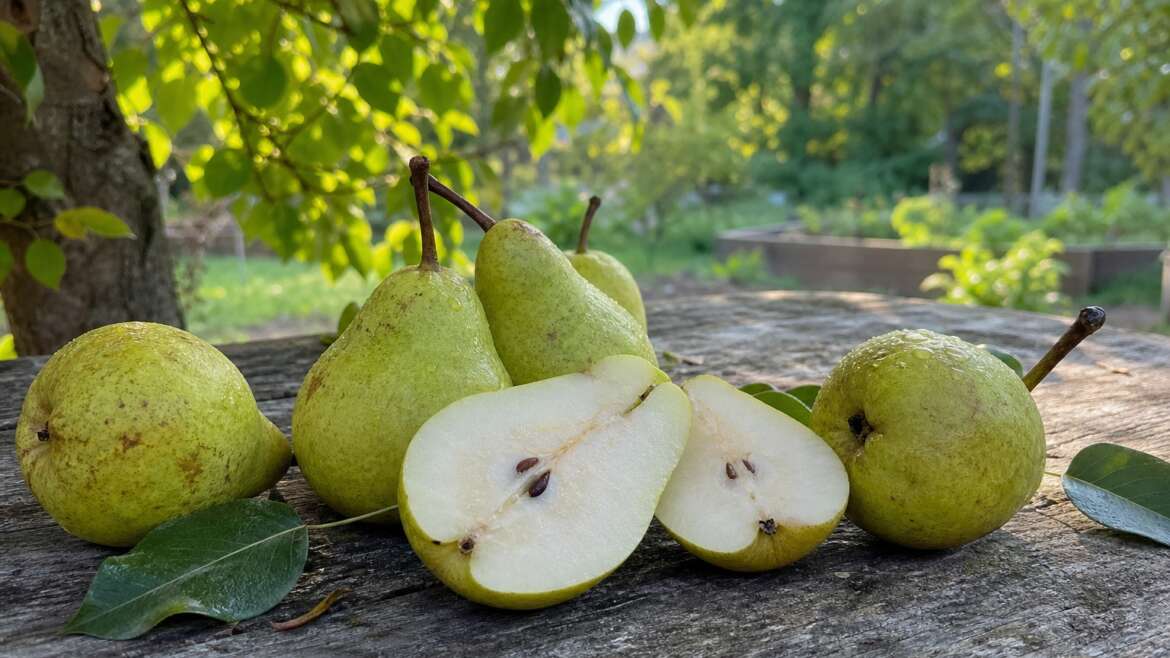
A pear tree in September can make a gardener impatient. The fruit looks full. The shoulders have rounded. A few skins have shifted from hard green toward yellow-green, and the branches are carrying that generous, slightly dangerous weight that makes you wonder whether today is the day.
With many fruits, the answer would be simple: wait until they taste ripe. Pears are different, especially the European pears most home gardeners know as Bartlett, Bosc, Comice, and D’Anjou, along with many cultivars handled in similar fashion. A good pear is often picked when it is mature but still firm, then finished away from the tree. Oregon State University Extension warns not to wait for pears to turn yellow or soft before harvest, because tree-ripened pears can break down internally and lose storage life.1
That sounds backwards until you think of the pear as a fruit with two harvests. The tree finishes building it. Then cool storage, room temperature, and the fruit’s own chemistry finish making it worth eating.
A fruit that finishes in two places
There is a useful difference between mature and ripe. A mature pear has completed enough development on the tree to ripen well later. Its seeds are darkening, its background color is easing, its stem is ready to part from the spur, and the fruit has enough stored sugar, acid, aroma potential, and cell-wall material to become itself. A ripe pear is the later stage: sweet, aromatic, juicy, and yielding at the neck.
For European pears, leaving the fruit on the tree until it is soft often gives you the wrong kind of ripeness. Iowa State University Extension warns that European pears allowed to ripen on the tree can become gritty and poorly flavored.2 The problem is not simply that the gardener waited too long. Many European cultivars reach eating quality more reliably after harvest, with conditioning needs that vary by cultivar.
This is why a pear can seem so unpromising in the hand. A mature European pear may be hard enough to feel disappointing. Bite into it straight from the tree and it may be firm, muted in aroma, and less appealing than it will be later. Given the right sequence of storage and warmth, the same fruit can become fragrant enough to scent a room.
Ethylene is the pear’s private message
Pears belong to the broad group of climacteric fruits. In practical terms, climacteric fruits can continue ripening after harvest because ripening is tied to a rise in respiration and ethylene production. University of Maryland Extension describes ethylene as a gaseous plant hormone involved in inducing ripening, with climacteric fruits producing an ethylene burst as ripening begins.3
Ethylene is not a flavor by itself. It is more like a signal that lets many changes proceed together. Firmness falls. Aromas develop. Chlorophyll declines. Cell walls loosen. Acidity and sweetness begin to feel balanced rather than separate. The pear’s flesh moves from firm storage tissue toward something melting, buttery, or juicy, depending on variety.
This is also why a paper bag can speed a mature pear. Iowa State explains that pears release ethylene; closing them in a paper bag lets the gas accumulate and promotes ripening.2 The bag does not magically sweeten an immature pear, but it can help a mature pear move through ripening once the fruit is physiologically ready.
Cold is not only preservation
Cold storage sounds like a pause button, and sometimes it is. Lower temperatures slow decay, water loss, and over-ripening. In European pears, though, cold can also be part of the ripening instruction. Washington State University Tree Fruit explains that fruit harvested at early maturity may need cold storage before ripening, with approximate conditioning periods varying by cultivar: Bartlett and Bosc around 14 days, Comice around 30 days, and D’Anjou at least 60 days in that commercial context.4
The biology behind this is still being studied, but the pattern is clear enough for gardeners to use. A study in PLOS ONE describes European pears as requiring a range of cold-temperature exposure to induce ethylene biosynthesis and fruit ripening, and compared how Bartlett and D’Anjou pears responded during cold conditioning and later ripening.5 The pear is not merely surviving the refrigerator. For many cultivars, it is being prepared by it.
That preparation depends on variety and maturity. Some early pears will soften after little cold. Some winter pears behave as if they need a real season in miniature before they will ripen properly. This is why one gardener can bring Bartletts into the kitchen and have ripe fruit within days, while another waits on D’Anjou pears that seem stubborn for weeks. This postharvest conditioning is separate from the way fruit trees count winter before they bloom: one prepares harvested fruit to ripen, while the other concerns bud dormancy.
How to pick a pear that is ready but not ripe
The difficult part is learning to harvest before softness but after maturity. Color helps, but only a little. Bartlett pears often show the clearest shift, moving from deep green toward lighter green or yellow-green. Bosc and some russeted pears may change less dramatically. Oregon State lists several harvest signs: the skin lightens, the small dots on the fruit turn from white to brown, the skin becomes waxier and smoother, seeds turn brown, and the stem separates easily from the spur with an upward twist.1
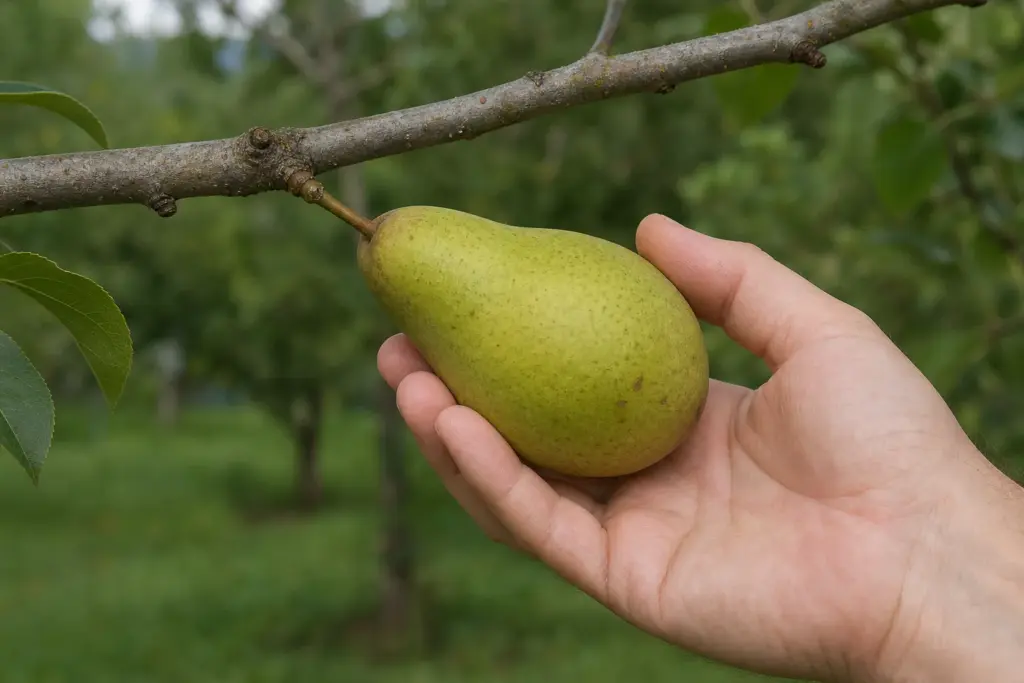
That upward twist is one of the gentlest tests. Cup the pear and lift it from its hanging position toward horizontal. A mature pear often releases cleanly, though Bosc can remain difficult to detach even when mature.6 Do not force the fruit; compare several pears and the known habit of the cultivar rather than damaging the spur. A pear tree sets next year’s possibilities on those spurs, so a careful harvest is not just kindness to this year’s crop. It is care for the branch’s future.
Fallen pears can be useful evidence, but not a full harvest plan; Oregon State’s detailed guide says fruit drop is not a key maturity trait for pears.6 Many soft, bruised, or wasp-marked fruits on the ground may mean the best window has already started closing. The aim is to gather mature fruit before internal breakdown, then sort it. Use bruised but otherwise sound pears promptly; Oregon State advises against storing bruised or damaged fruit.6 Compost or discard fruit with mold, leaking, or spreading decay. Clean, firm pears are the ones worth storing.
The kitchen becomes part of the orchard
Once harvested, pears need calm handling. Their flesh bruises easily, even when it feels hard. Set them down as if they are already ripe. Store sound fruit cool and humid, usually in a refrigerator for a home gardener. Oregon State’s storage guide notes that pears should be ripened before eating by removing them from cold storage and placing them at 60 to 70 F for three to 10 days, with Comice and D’Anjou needing longer cold periods before they ripen well.6
When you are ready to eat a few, bring only those pears to room temperature. Leave the rest cold. This staggered approach turns a short harvest window into a longer season. Instead of waiting for the entire tree to become edible at once, you move fruit from storage to the counter in small batches.
Room-temperature ripening is not a decorative bowl arrangement. It is a controlled finish. Check the fruit daily, especially if the room is warm or if you have added a ripe apple or banana nearby. Pears can cross the line from perfect to overripe quickly once the signal has taken hold.
Check the neck, not the middle
The old advice to “check the neck” is still the best home test. Press gently near the stem end with your thumb. A ripe pear gives slightly there while the broader body may still feel fairly firm. Oregon State’s storage guide recommends this neck test because most pear varieties show little dramatic skin-color change as they ripen, except Bartletts, which often turn more yellow.6
This matters because a pear does not soften like a peach. If you wait until the belly feels soft, the center may already be breaking down. The neck is a more delicate early signal. A good pear often feels almost contradictory: tender just below the stem, still shapely in the hand, fragrant but not alcoholic, and heavy with juice before it looks messy.
If a pear shrivels before it ripens, it may have been stored too dry or too long. If it stays hard at room temperature, it may have been picked too early, held too long past its storage life, or may be a variety that needed more cold first. The fruit bowl is not always at fault. Sometimes the problem began at harvest.
The grain in a pear’s flesh
A little grain is part of pear character. Pear flesh contains stone cells, also called sclereids, which are thick-walled, lignified cells. A study in Frontiers in Plant Science describes pear stone cells as sclerenchyma cells with high levels of lignin and cellulose, and notes that they affect pear quality.7 In the mouth, they are the faint sandy texture that makes a pear different from an apple.
The trick is balance. In a well-ripened pear, the juicy parenchyma tissue around those stone cells softens and becomes aromatic, so the grit reads as texture. In a poorly ripened or over-mature pear, the flesh can feel coarse, tired, or oddly dry around the grit. The pear has not become more pear-like. It has lost the harmony that makes its texture work.
This is one reason the right harvest moment feels almost like a craft. You are not just collecting fruit. You are choosing when to interrupt one process so another can finish cleanly.
Asian pears follow a different rule
Not every pear wants this treatment. Asian pears are the crisp, often round fruits sometimes called apple pears. They are usually eaten firm and crunchy, and their harvest logic is closer to an apple than a melting European pear. Iowa State says Asian pears should be allowed to ripen on the tree, with color and taste as the best indicators of maturity.2 Washington State University similarly notes that Asian pears do not require cooling to ripen and are harvested near-ripe.4
That distinction can save a lot of disappointment. Pick a European pear soft and it may be past its best. Pick an Asian pear too early and it may never become the crisp, sweet fruit you were hoping for. The common name says pear in both cases, but the kitchen behavior is not the same.
What this changes in the garden
Understanding pear ripening makes the tree feel less mysterious. It also makes harvest less frantic. Instead of tasting one hard pear and assuming the crop is not ready, look for maturity signs. Instead of waiting for softness on the branch, test the stem. Instead of filling a counter with every pear at once, store the crop cool and bring fruit out in small waves.
For a mixed home orchard, it also helps to label varieties and learn their habits. Bartlett may teach you with color. Bosc may ask you to trust shape, stem release, and timing. D’Anjou may test your patience in cold storage. A pear tree becomes easier after a few seasons because you stop asking one universal question and start asking better local ones: how did this variety behave here, in this weather, on this branch, at this stage?
That record is worth keeping. Note bloom time, rough harvest date, weather, color, storage length, and when the fruit finally tasted right. The next September, your notebook may know more than the fruit bowl.
Final thoughts
A pear asks for a different kind of trust than a tomato or a strawberry. It does not always announce readiness with softness, perfume, and color while it is still on the plant. It asks you to recognize maturity before pleasure, then carry the fruit through the last part of its life with cold, warmth, and attention.
That is part of its charm. The best pear is not simply found. It is finished. The tree grows the possibility, the harvest preserves it, and the quiet days on the counter release what was waiting inside.
References
- Oregon State University Extension: When are pears ready to be picked?
- Iowa State University Extension and Outreach: How to Harvest, Ripen, and Store Pears
- University of Maryland Extension: Ethylene and the Regulation of Fruit Ripening
- Washington State University Tree Fruit: Pear Harvest
- Hendrickson et al. Evidence for pre-climacteric activation of AOX transcription during cold-induced conditioning to ripen in European pear (Pyrus communis L.). PLOS ONE, 2019.
- Oregon State University Extension: Picking and storing apples and pears
- Yan et al. Effects on stone cell development and lignin deposition in pears by different pollinators. Frontiers in Plant Science, 2023.