
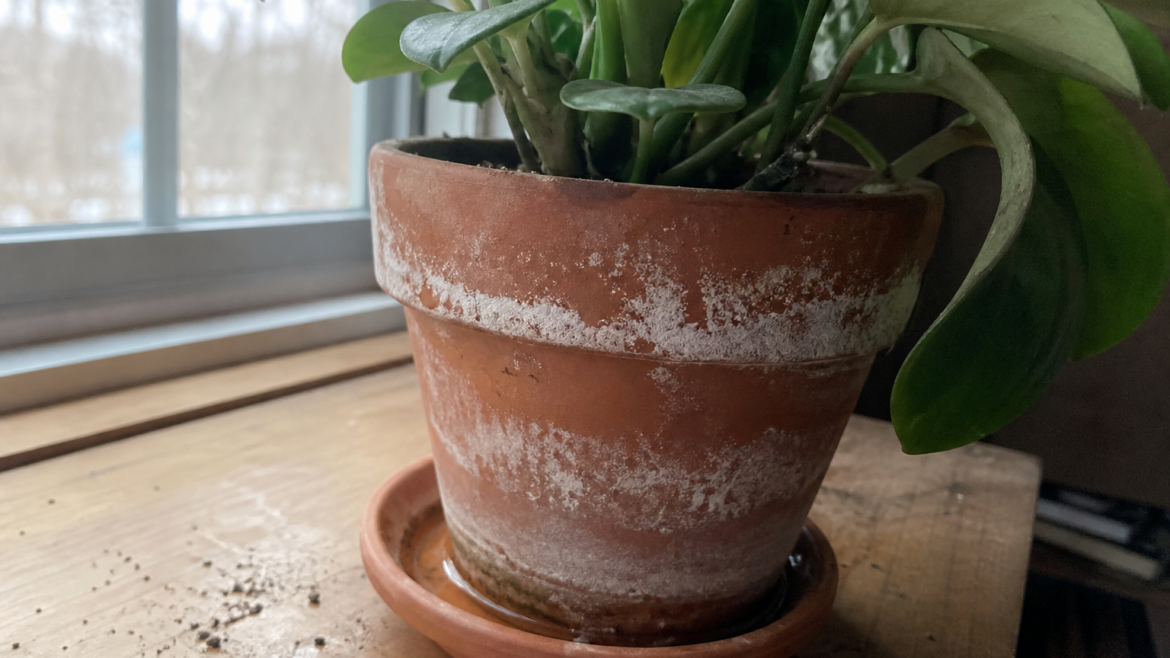
By late January, a terracotta pot can start to look as though it has weathered a tiny winter of its own. The plant may be perfectly alive: a pothos making another heart-shaped leaf, a jade sitting quietly, a fern still asking for its usual careful watering. But the pot has changed. Around the rim, along the saucer line, or near the drainage hole, a pale crust appears. It may be white, tan, chalky, powdery, or faintly crystalline. On a good clay pot, it can look almost antique. On a favorite houseplant, it can look like a warning.
Most of the time, that white crust is not mold and not a sign that the pot is falling apart. It is the visible edge of an invisible habit: dissolved minerals moving with water, then being left behind when the water evaporates. Colorado State University Extension describes whitish crust on potting mixes, clay pots, drainage holes, and even plant stems as a buildup of soluble salts from potting mix, fertilizer, or irrigation water.1 Clemson Cooperative Extension gives the same practical clue for indoor plants: a white film on the soil or a white crust on the rim or drainage hole can point to soluble salts, often tied to overfertilizing or overwatering.2
The useful part is that the crust is readable. It is a small record of your water, your fertilizer, the pot’s material, the saucer, and the pace at which the plant is actually growing. It can be cosmetic. It can also be a nudge to change a habit before the roots complain.
The pot is acting like a wick
Unglazed terracotta is not a sealed wall. It is fired clay full of tiny pathways that allow air and moisture to move through the pot. That is one reason gardeners like it for plants that resent wet feet. Clemson notes that clay pots are porous, allowing air movement through the sides and helping the soil dry as water evaporates from the container.2 In a plastic pot, most water leaves through the plant, the soil surface, or the drainage hole. In an unglazed clay pot, some of it also migrates outward through the pot itself.
Water rarely travels alone. Tap water carries dissolved minerals. Fertilizer dissolves into the water in the potting mix. The mix itself can also contribute soluble material. As moisture moves toward a drier surface, those dissolved materials move with it. When the water evaporates from the pot wall, rim, or soil surface, the solids cannot evaporate. They stay.
That is why the crust often follows repeated wetting and drying. A ring near the saucer can reflect repeated contact with drainage water. A chalky line around the upper rim may show where moisture evaporates again and again. A white patch near the drainage hole can mark the place where dissolved minerals repeatedly exit the pot. The pot is not making the crust from nothing. It is revealing what the water has been carrying.
Hard water is only part of the story
Hard water gets blamed for nearly every white deposit in a house, and it often deserves some of that blame. University of Maryland Extension explains that hard water contains elevated calcium and magnesium ions and can leave mineral scale on household surfaces.3 If your kettle, faucet, or shower glass collects pale mineral marks, your terracotta pots may do the same.
But the crust on a plant pot is usually a mixture, not a single ingredient. Fertilizers matter because many plant nutrients are supplied as salts in the chemical sense: soluble compounds that separate into ions in water. That does not mean you have sprinkled table salt into the pot. It means the plant food is designed to dissolve, move through the root zone, and be taken up with water. When more dissolves than the plant can use, or when water evaporates faster than it drains away, some of that mineral load remains behind.
This is especially easy to do indoors in winter, when many houseplants ask for less water and fertilizer. A plant in a dim January room is not growing the way it grows in June. University of Georgia Extension notes that indoor plants need less fertilizer when light is low and growth is limited, with fertilizer needs rising again when light and active growth return.4 The pot crust is sometimes the plant’s quiet objection to our calendar. We keep feeding because it is the first of the month. The plant is reading light, temperature, and growth.
Sodium-based water softeners can complicate the picture, too. They may feel gentler to us because they reduce hardness, but ion-exchange systems commonly replace calcium and magnesium with sodium. North Dakota State University Extension does not recommend sodium-softened water for houseplants because of that added sodium.7 If a white crust is persistent and your home uses this kind of softener, use an unsoftened tap or another low-salt source appropriate for the plant.
When it is cosmetic and when it matters
A crusted terracotta pot can be healthy in the ordinary, imperfect way that working garden objects are healthy. Clay ages. Water marks it. Minerals leave a bloom. Some gardeners even like the look because it makes a new pot feel settled into the room. If the plant is growing steadily, the leaves are not browning at the tips, the soil drains well, and the crust is mostly on the outside wall, you may not need to do more than brush the pot and adjust your watering habits a little.
The warning begins when the crust is paired with plant symptoms. Colorado State University Extension lists brown leaf tips, yellowing, wilting, and root problems as signs that salt buildup may be affecting a houseplant.1 Clemson also connects salt buildup with root damage, reduced growth, brown leaf tips, lower leaf drop, and wilting.2 Those symptoms are not unique to salts, which is why diagnosis should be cautious. Overwatering, underwatering, cold drafts, low humidity, old potting mix, and poor light can all mimic one another. But a heavy white crust is evidence worth taking seriously.
A crust on the soil surface deserves closer attention than a few marks on the pot wall. An exterior deposit may be mostly a cosmetic trace of evaporation through clay. A crust on top of the potting mix means salts have accumulated in the root zone. That is where roots need water, oxygen, and a manageable chemical environment. When the solution around roots becomes too concentrated, water uptake becomes harder for the plant. A plant can wilt in moist soil because the water is present but not easy to use.
The saucer is another clue. A terracotta pot sitting in a shallow dish of old drainage water is not draining in the meaningful sense. Water has left the bottom of the pot, but then the pot and soil can draw some of it back. Colorado State University Extension warns that saucers holding excess drainage water allow salts to be reabsorbed rather than carried away.1 That is how a pot can be watered often and still never be rinsed clean.
Water through, not just in
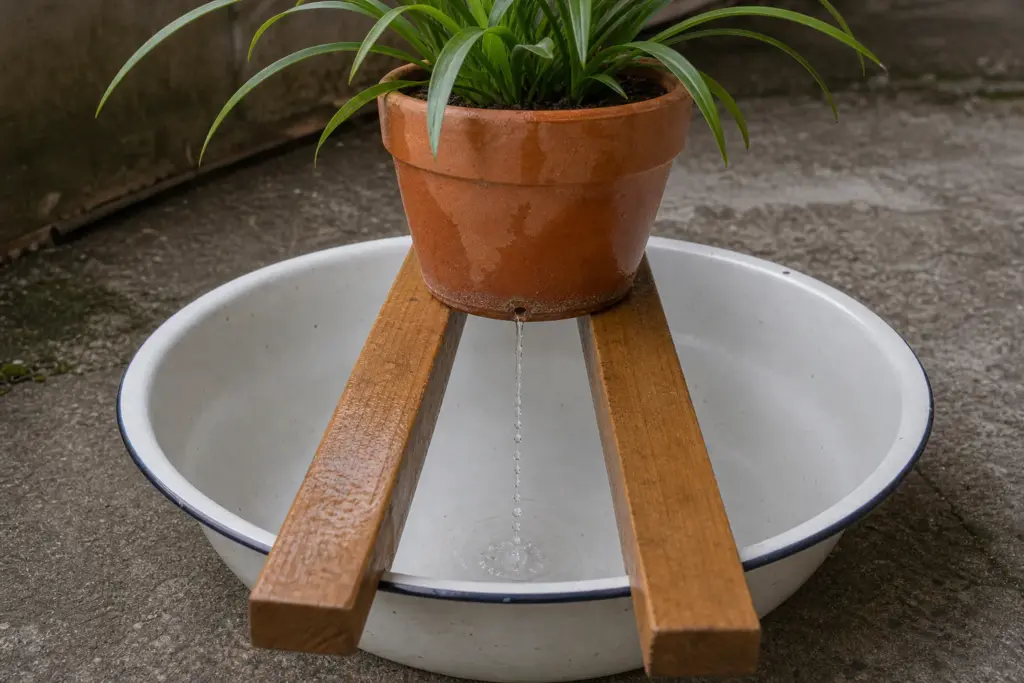
The simplest prevention is not a special cleaner. It is ordinary watering done with enough follow-through. When a plant is dry enough to need water, water the potting mix thoroughly so water moves through the root zone and drains from the bottom. Then empty the saucer. This does two jobs at once: it wets the whole root ball more evenly, and it gives dissolved salts a route out of the container instead of letting them concentrate at the surface.
Small sips can create a neat-looking routine and a messy chemistry. If you always add just a little water, the upper mix gets wet, the plant survives, and minerals keep accumulating in the places where evaporation is strongest. Bottom watering can be useful for some plants, especially when a dry mix resists wetting from above, but a pot that is routinely watered from below may benefit from an occasional top-down rinse when salts are accumulating, provided it drains freely.5
Leaching is the more deliberate version of this rinse. Colorado State University Extension recommends removing surface crust, placing the pot where water can drain freely, making sure drainage holes are open, and running tepid water through the potting mix more than once, allowing it to drain between rinses.5 This is not something every houseplant needs every week. It is a corrective habit for pots that show salt buildup, plants that have been fertilized heavily, or containers that have sat too long in their own drainage water.
There is one important restraint: do not leach a plant that is already drowning. If the potting mix stays wet for days, smells sour, or has no working drainage hole, running more water through it may make the immediate problem worse. Fix drainage first. Salts are a chemistry problem, but roots still need air.
Cleaning the pot without confusing the plant
If the plant is staying in the pot, keep cleaning simple. Let the outside of the pot dry enough that the crust brushes off easily. Use a stiff dry brush, an old toothbrush, or a damp cloth on the exterior. Scrape gently near the rim and drainage hole, where deposits often thicken. Avoid strong cleaners while the plant is still potted. Unglazed clay can absorb what you put on it, and the goal is to help the root zone, not introduce a new irritant.
If you are repotting or reusing an empty pot, you can be more thorough. Iowa State University Extension recommends removing loose soil, washing containers with soapy water, rinsing, then disinfecting with a bleach solution before rinsing again.6 For mineral deposits on clay and terracotta, Iowa State suggests steel wool or a wire-bristle brush, with careful scraping for stubborn material, followed by a thorough rinse.6
The last rinse matters. A clean-looking clay pot can still hold residues in its pores. If it has been scrubbed, disinfected, or stored dry, soak it in clean water before planting. Iowa State notes that dry clay pots can wick moisture away from new potting mix, which can dehydrate a newly potted plant.6 That little detail explains why a newly cleaned terracotta pot sometimes seems to drink the first watering before the plant gets much of it.
Do not expect a favorite terracotta pot to return to factory orange. Clay is a working material. A few pale freckles after cleaning are not failure. The practical goal is to remove heavy deposits, clear drainage holes, reduce soluble salts in the potting mix, and make sure the plant is not sitting in stale drainage water.
What the crust is asking you to change
The white crust is easy to treat as a housekeeping problem, but it is more useful as a gardening note. It may be asking for less fertilizer during a period of slow growth. It may be asking for a real watering followed by an emptied saucer. It may be telling you that your water is mineral-rich, that your potting mix is old, or that a plant has been in the same container long enough for the chemistry to become stale.
A practical reset is modest. If growth is slow and salt buildup is evident, reduce or pause fertilizer, then resume according to the plant’s growth and the product label. Remove the surface crust if there is one. Leach the potting mix if the plant and container drain freely. Empty saucers after watering. Check that the drainage hole is open. If the potting mix has collapsed, smells unpleasant, or sheds water strangely, repot into a fresh, airy mix rather than trying to rinse an exhausted one forever.
There is a quiet pleasure in learning to read a pot this way. The plant speaks through leaves, roots, posture, and growth. The pot speaks through stains, crusts, wet rings, and dry edges. Terracotta simply writes the message in chalk. Once you understand what it is recording, the white crust stops looking like a mysterious failure and starts looking like one of the small, useful measurements a home garden gives you for free.
References
- Colorado State University Extension, PlantTalk Colorado, “Whitish crust on potting mixes”.
- Clemson Cooperative Extension Home & Garden Information Center, “Indoor plants – cleaning, fertilizing, containers & light requirements”.
- University of Maryland Extension, “Hardness in household water”.
- University of Georgia Extension, “Growing indoor plants with success”.
- Colorado State University Extension, PlantTalk Colorado, “Leaching salts from potting mixes”.
- Iowa State University Extension and Outreach, “How to clean and disinfect plant containers”.
- North Dakota State University Extension, “Water softening (ion exchange)”.