
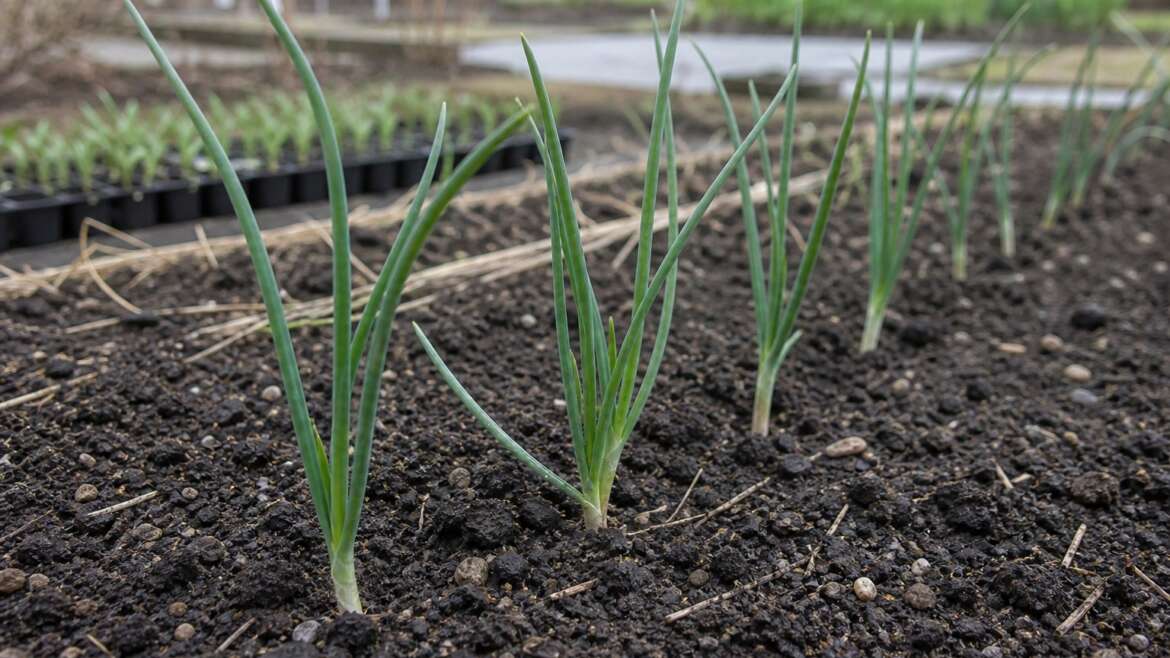
An onion row in March does not look like much to brag about. The plants are thin, blue-green, and a little awkward, each one a narrow tuft set into cold soil. They do not sprawl like squash, gleam like peppers, or make the quick promises of radishes. A young onion looks almost underbuilt for the job ahead.
Then summer arrives and the base begins to swell. A white, yellow, or red bulb starts to push the soil aside. It is tempting to explain that moment with fertilizer, rain, or good soil, and all of those matter. But the onion is listening to something larger than the bed. It is counting daylight.
That is the quiet trick behind growing onions well. They are not planted early only because gardeners are impatient. They are planted early because the plant needs time to build leaves before a daylength signal tells it to start making a bulb. Miss that timing, or choose the wrong daylength type for your latitude, and the onion may obey the sky perfectly while disappointing the gardener completely.
A bulb is made from leaves
An onion bulb is easy to treat as a single object. In the kitchen it rolls across the counter as one thing. In the garden, it is more like a compressed record of leaves. Michigan State University Extension explains that true bulbs are made mostly of modified leaf tissue called scales, with growing points in the center.1 Cut an onion in half and the lesson is visible: rings nested around a center, each one connected to the plant’s leafy work.
This is why young onion tops matter so much. The green leaves are not decoration above the real crop. They are the factory that builds it. North Dakota State University Extension puts the gardener’s rule plainly: the key to big onions is having large plants when bulbing begins, because every leaf creates a ring of onion.2
That makes an onion seedling more interesting than it looks. Each hollow leaf is a future contribution to the bulb. A plant with only a few leaves when the bulbing signal arrives has fewer chances to make size. A plant that has spent spring growing a strong top has more green machinery ready when the base begins to swell.
The daylength switch
Many vegetables respond to temperature in ways gardeners can feel: beans sulk in cold soil, spinach bolts in heat, tomatoes wait for warm nights. Onions respond to temperature too, but bulb formation depends heavily on daylength. Ohio State University Extension notes that daylength induces bulbing in onions, and that different onion groups need different amounts of light before that process begins.3
University of Tennessee Extension divides onions into short-day, intermediate-day, and long-day types. Its home-garden guide gives approximate ranges of 10 to 13 hours for short-day cultivars, 13 to 14 hours for intermediate-day cultivars, and 14 hours or longer for long-day cultivars.4 Other extension guides give slightly different ranges, but the practical idea is consistent: onions are regional crops because the sky changes by latitude.
A short-day onion planted far north may start bulbing before it has made enough leaves. The plant has received its signal, but it is still small, so the bulb stays small. A long-day onion planted too far south may grow leaves for a long time without receiving the long-day cue it expects, especially as heat arrives. Nebraska Extension warns that short-day onions grown in northern regions can begin bulb development too soon and produce small bulbs.5
This is why onion variety descriptions matter more than they seem to in winter catalogs. Color is not the first question. Sweetness is not the first question. Storage life is not even the first question. The first question is whether the onion belongs to your daylight.
Why March planting matters
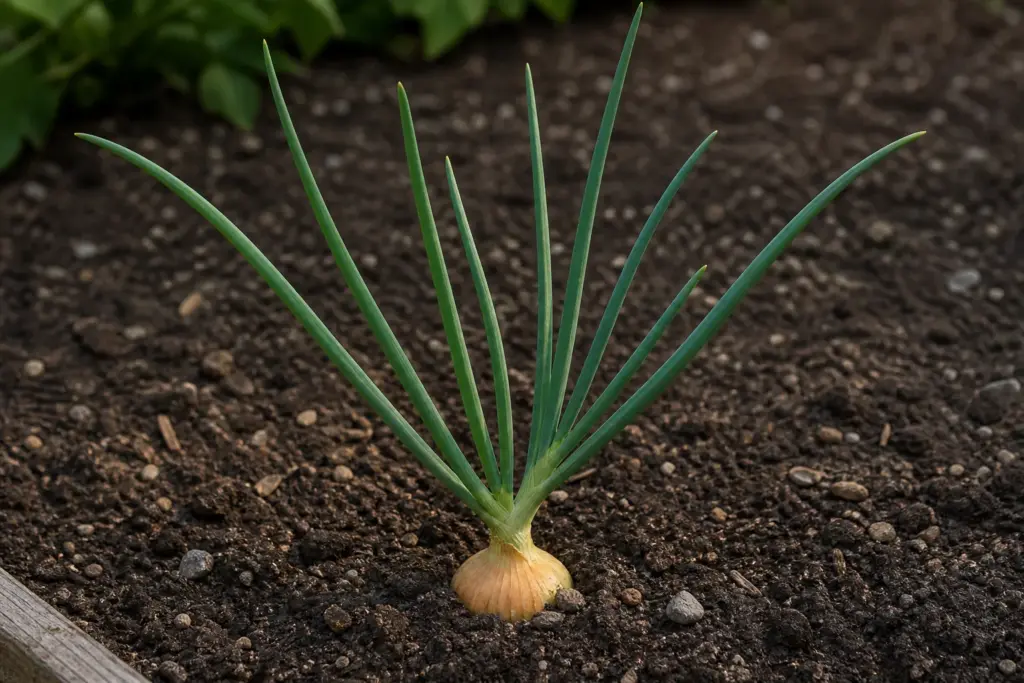
March onions are not being asked to make bulbs immediately. They are being asked to make leaves. In many temperate gardens, onions can go into the ground as soon as the soil can be worked, especially as transplants or sets. NC State’s Extension Gardener Plant Toolbox describes onions as cool-season crops that should be planted in moist but well-drained, fertile, loose soil in full sun as soon as the ground can be worked in spring.6
That early start gives the plant a head start before the daylength switch flips. A seedling set out in cool spring soil may not look dramatic at first, but it is establishing roots and adding leaves. The more healthy leaves it carries when the correct daylength arrives, the more material it has available for bulb building.
Illinois Extension notes that long-day onions are bred for northern latitudes, while short-day varieties perform best farther south.7 In a northern garden, the gardener’s job is to have strong plants ready for the long days of late spring and early summer. In warmer southern areas, the calendar shifts because short-day onions may be fall or winter crops that bulb as days lengthen earlier in the year.
Seeds, sets, and transplants
Onions can begin in three common ways: seed, set, or transplant. Seeds offer the widest variety choice, which matters when daylength is the main decision. Sets are small dormant bulbs, easy to plant and forgiving for beginners, but they offer fewer variety options, and larger sets are more prone to flowering.7 Transplants split the difference: someone else has already done the tiny seedling work, and the gardener receives plants ready to settle into the row.
Maryland Extension summarizes the home-garden options as seeds, sets, or transplants and notes that onions need full sun and fertile, well-drained soil.8 Iowa State University Extension also points out that onions take little space and can be grown from seeds, sets, or plants, with site quality and fertility playing a large role in success.9
The biology explains the choice. If the goal is big storage onions, variety and timing usually matter more than convenience. A gardener in a northern latitude who buys a bag of unnamed onion sets from a warm-region type may grow perfectly healthy plants that bulb at the wrong size. A gardener who starts the right long-day variety from seed or buys suitable transplants has a better chance of getting large bulbs because the plants are synchronized with the local daylength curve.
When the necks soften
The same plant that seemed so strict about daylight gives a very physical harvest signal. As bulbs finish enlarging, the tops begin to weaken and fall. NC State Extension Publications describes harvest timing for bulb onions by neck fall, when 50 to 80 percent of plants have fallen over, indicating that bulb enlargement is complete.10
That falling top is not laziness. It is the plant closing the season. The leaves that built the bulb have done their main work. The neck softens, the outer scales begin moving toward papery storage skin, and the gardener shifts from growing to curing. Iowa State’s onion guidance notes that storage quality depends on variety, harvest, curing, and storage conditions.9
A crop that reads the sky
Onions look humble because they keep their drama compressed. Their leaves are plain. Their flowers are usually beside the point in a vegetable garden. Their bulbs swell quietly at the soil line. Yet the crop is a remarkably precise conversation between plant, latitude, and season.
Choose the right daylength type, plant early enough for leaves, give the roots steady soil, and the onion can turn spring light into rings. Choose the wrong type, delay the start, or let weeds and drought steal the spring, and the sky may still give the plant its signal before the plant is ready to use it.
That is what makes a row of March onion transplants worth a second look. They are not just waiting for warmth. They are preparing for a particular length of day. The bulb you harvest later is already being negotiated in those thin green leaves, long before the onion looks like an onion.
References
- Michigan State University Extension: What is a bulb?
- NDSU Extension: How to grow big onions
- Ohio State University Extension: Growing onions in the garden
- University of Tennessee Extension: Onions, leeks and shallots for the Tennessee vegetable garden
- Nebraska Extension in Lancaster County: Onions, long day, short day or neutral?
- NC State Extension Gardener Plant Toolbox: Allium cepa
- Illinois Extension: Onion
- University of Maryland Extension: Growing onions in a home garden
- Iowa State University Extension: All about onions
- NC State Extension Publications: Bulb onions