
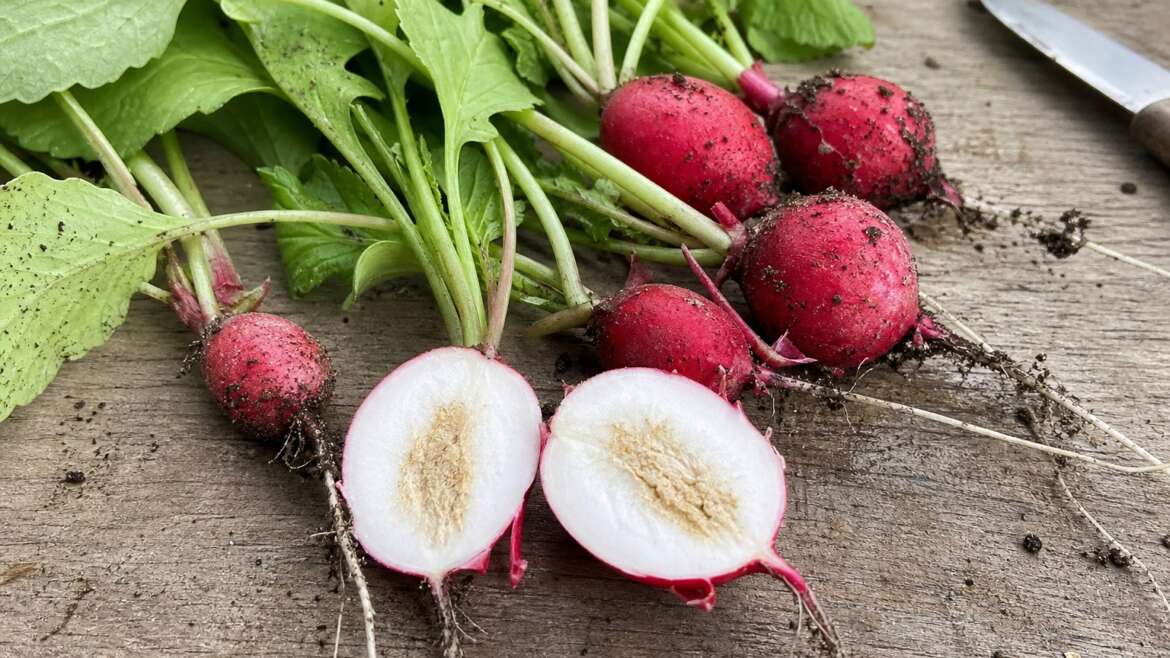
A good spring radish should feel almost impossible for something so quick: crisp, juicy, sharp enough to wake up a salad, and gone from seed to harvest before slower vegetables have settled into their stride. Then, some years, the first bite is a disappointment. The root looks fine from the outside, but inside it is dry, spongy, woody, or hollow. The heat in its flavor has moved from lively to harsh.
Radishes are honest vegetables. They do not hide timing mistakes for long. Leave a tomato on the vine an extra day and it may become sweeter. Leave a spring radish too long once the weather turns, and the root quickly stops behaving like a crisp storage organ and starts behaving like a plant with other plans.
That is the useful thing about a bad radish. It is not random. It is usually a record of heat, age, moisture stress, crowding, soil texture, or too much nitrogen. The root is telling you how the spring got away from it.
A fast crop with a narrow window
The round red radishes most gardeners grow are built for speed. Iowa State University Extension notes that garden radishes can go from seed to harvest in as little as three to five weeks, and that they prefer the cool temperatures of spring and fall.1 That speed is part of their charm, but it also means their peak quality is brief.
A radish is not waiting politely for the gardener’s schedule. Once the root reaches usable size, the plant is still alive, still responding to warmth and day length, still deciding whether to stay vegetative or move toward flowering and seed. What we harvest as a radish is a temporary stage, not the plant’s final ambition.
That is why succession sowing works better than one large sowing. Iowa State recommends sowing garden radishes every 7 to 10 days in the spring so the crop reaches maturity in small waves rather than all at once.1 A few radishes ready each week are easier to catch at their best than a whole row that becomes urgent on the same afternoon.
The root is really a short-term pantry
Botanically, radish is a little stranger than the grocery word root suggests. A USDA Agricultural Research Service summary describes cultivated radish as being consumed as a root vegetable made up of the hypocotyl plus true root.2 In garden language, the swollen organ includes the seedling-stem region below the cotyledons as well as true root tissue.
That mixed organ thickens into the fleshy part we harvest. Pithiness is not simply a radish “drying out.” In a 2024 field study of one radish line, white spongy tissue appeared as roots matured; severe cases developed cavities, and water content and elasticity fell. The researchers also observed cell death and reactive oxygen accumulation as pithiness progressed.6
This is why an oversized radish can be disappointing even if it looks impressive: spongy regions and cavities may be hidden from view. Bigger is not always better in a crop grown for tenderness. A radish that has been allowed to enlarge past its eating window may be larger because it is older, not because it is better fed.
Heat changes the bargain
Radishes are cool-season plants. Iowa State gives ideal growing temperatures of 70 to 75 degrees Fahrenheit during the day and 55 to 60 degrees at night, and warns that summer warmth can make radishes spongy, woody, excessively hot in flavor, and quick to make seed heads.1 That is the entire spring problem in one sentence. The crop is fast, but spring can be faster.
In April, the garden may still feel cool to a person in a jacket, but the soil and the radish may be receiving a different message. A sudden warm spell can accelerate growth, increase stress, and shorten the harvest window. A row that seemed too small on Monday can be ready on Thursday and declining by the weekend.
Warmth also changes flavor. Radishes belong to the mustard family, and their sharpness comes from sulfur-containing defense chemistry. A Frontiers in Plant Science paper on radish glucosinolates explains that glucosinolates and their breakdown products contribute to plant defense and generate pungent flavor in radish.3 A little of that chemistry is the peppery bite gardeners enjoy. Warm weather and delayed harvest can make the flavor excessively hot.1
Late harvest makes a hollow promise
The simplest cause of pithy radishes is also the easiest to miss: they were harvested too late. Iowa State’s harvest guidance recommends pulling radishes when they reach usable size, about one inch in diameter for common garden types, and notes that radishes get pithy and hot when harvested too late.4
This is where gardeners can be fooled by patience. Many crops reward waiting. Radishes often punish it. The shoulder of the root may look handsome above the soil. The leaves may be generous. The plant may seem to be gaining value. Inside, however, the texture can be moving toward spongy, fibrous, or hollow.
The practical habit is to sample the row. As the packet’s maturity date approaches, pull one or two roots every couple of days. Do not wait for every radish to match the catalog photo. A mixed harvest of small and perfect is better than a delayed harvest of large and tired.
Water decides whether crispness holds
Texture is not only about age. It is also about water. Radishes grow fast enough that a dry week can leave a mark inside the root. Iowa State recommends consistent moisture throughout growth, about an inch of water per week if rain does not provide it, and notes that drought stress causes tough texture and poor flavor.1
A radish is valued for crisp, water-filled tissue. When moisture swings between dry and wet, roots can respond unevenly: some split, and some develop an overly hot flavor.1 Even without visible cracking, drought stress can cost the clean snap that makes the crop worth growing.
The answer is not heavy watering after neglect. It is steadiness. A shallow-rooted, fast crop in a light spring soil may need more frequent attention than a gardener expects. Organic mulch can help conserve moisture once seedlings are up and thinned, but check the soil beneath rather than watering by the calendar.1
Crowding grows leaves instead of roots
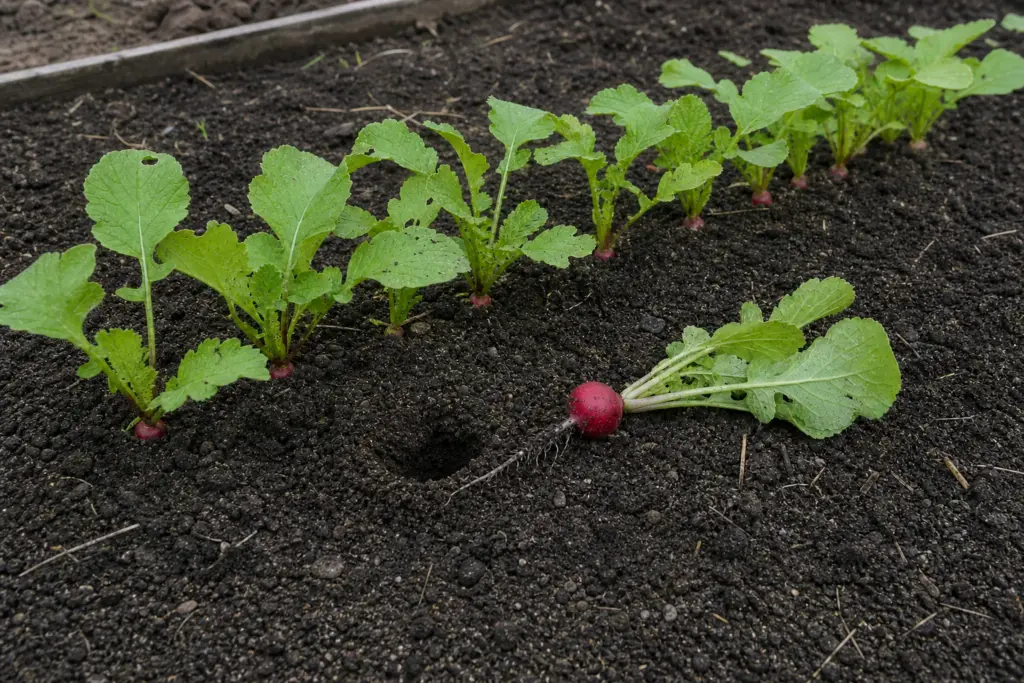
Radish seed is easy to sow too thickly. The seedlings come up quickly, the row looks satisfyingly full, and thinning feels wasteful. Then the harvest arrives as a tangle of little roots, oversized tops, and only a few proper globes.
Iowa State’s radish FAQ points to overcrowding as a cause of small, misshapen roots, and also names excessive nitrogen, rapid hot weather, and late harvest as common causes of poor root development or hot, pithy radishes.5 Thinning is not cosmetic. It is part of making room for the swollen root to form.
Soil texture matters for the same reason. Compacted, rocky, or heavy soil interrupts the shape of the root. Iowa State recommends moist, well-drained, non-compacted soil, with loamy or sandy soil ideal for uniform development.1 A radish will grow in many ordinary garden soils, but it shows every obstacle quickly.
How to keep the next row crisp
The best fix for woody radishes usually happens before the seed goes in. Sow early enough that the crop matures before reliable warmth. In many temperate gardens, that means waiting until spring soil is workable rather than merely thawed, then making short succession sowings instead of one big ceremonial row. When the weather forecast begins to look more like May than April, switch from sowing more radishes to harvesting the ones already close.
Prepare the bed as if speed matters, because it does. Remove stones. Break up compacted crust. Add finished compost if the soil needs structure, but do not turn the bed into a nitrogen banquet. Too much fertility can encourage lush tops while the edible root lags behind.
Thin early. Water evenly. Pull samples as soon as shoulders swell. Harvest usable roots even if some are smaller than expected. The gardener’s best tool for radish quality is not a special fertilizer or a secret variety. It is attention at the exact moment the crop becomes ready.
When a bad radish is still useful
A woody radish is disappointing, but it is not wasted knowledge. If the roots are hot and pithy, the next sowing should be earlier, thinner, moister, or harvested sooner. If they are small and misshapen, look at spacing and soil texture. If the tops are lush and the roots are poor, look at nitrogen and crowding. If they split, look at inconsistent water.
The plant has compressed a whole season of feedback into three or four weeks. That is part of the appeal. Radishes are not just beginner vegetables because they are easy. They are beginner vegetables because they teach quickly. They show the difference between cool and warm, moist and dry, timely and late.
Final thoughts
A crisp radish is a small spring luxury, but it is also a narrow agreement between weather, soil, seed, and gardener. The plant must swell quickly while the air is still kind. The soil must stay loose and evenly damp. The gardener must harvest before the root begins to belong more to the future seed stalk than to the salad bowl.
When radishes turn woody, the answer is rarely to try harder in summer. It is to respect the crop’s brief cool window. Sow lightly, thin bravely, water steadily, and pull them while they are still young enough to snap.
References
- Iowa State University Extension: Growing Radishes in Iowa
- USDA Agricultural Research Service: Population structure and diversity estimates in a geographical core set of radish
- Frontiers in Plant Science: Dynamic profiling of intact glucosinolates in radish
- Iowa State University Extension: When should radishes be harvested?
- Iowa State University Extension: My radishes produce lush foliage, but don’t develop good-sized roots. Why?
- Plants: RsRbohD1 Plays a Significant Role in ROS Production during Radish Pithiness Development