
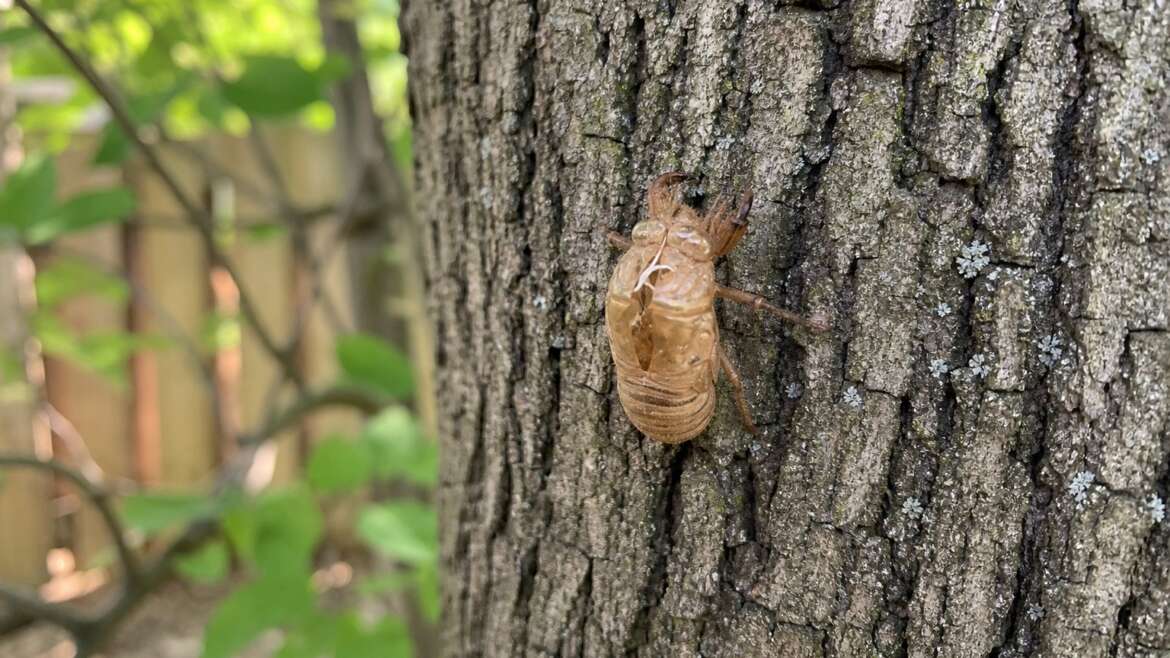
By early August, a tree trunk can start to look faintly haunted. A dry amber husk grips the bark at eye level. Another clings to a fence post beside the compost heap. One turns up on the underside of a hydrangea leaf, still shaped like a creature, but light as old paper.
These are not dead cicadas. They are the cast skins cicadas leave behind when they climb out of the soil and molt into adults. Gardeners usually notice the sound first, that electrical summer whine from the trees. But the shells are the better clue. They show exactly where the insect crossed from an underground life into the brief, winged part of its year.
For a gardener, that little shell is worth reading carefully. It is part plant science, part soil story, and part practical tree-care note. It can tell you when to relax, when a young tree may need protection, and why a shell is usually evidence of a completed molt rather than a diagnosis of plant trouble.
A shell is not a corpse
A cicada shell is called an exuvia. It is the empty outer cuticle of the nymph, left behind after the insect has slipped out of it. The shell keeps the shape of the nymph almost perfectly: legs, claws, eyes, ribbed abdomen, and the split down the back where the adult emerged.
Cicadas are true bugs in the order Hemiptera, with piercing-sucking mouthparts. University of Maryland Extension describes both annual dog-day cicadas and periodical cicadas as insects that feed from the xylem of trees and shrubs, the water-conducting tissue inside woody plants.1 That sounds dramatic, but adult cicadas are not chewing leaves or hollowing stems. They are not caterpillars, beetle grubs, or borers.
The shell on the bark is even less threatening. It is just the old suit of armor. By the time you see it, the living cicada has already expanded its wings, hardened its new body, and moved into the canopy or shrub layer. The abandoned shell cannot bite, sting, lay eggs, or harm the plant it is attached to.
Most of the story happened underground
The visible cicada is the short chapter. The hidden chapter is much longer. Cicada nymphs live in the soil, feeding on fluids from roots while they grow through several juvenile stages. UConn’s cicada information pages describe periodical cicada nymphs as underground root-fluid feeders that spend years below the surface before emerging together in a brood year.2
Non-periodical cicadas are often called annual or dog-day cicadas, but “annual” describes their yearly appearance, not a one-year life cycle. Their multiyear generations overlap, so some adults emerge every summer. That is why August often brings cicada song even when no famous periodical brood is making the news. In eastern North America, a lone shell on a maple or tomato stake in late summer is more likely to come from one of these non-periodical cicadas than to signal a synchronized Magicicada emergence, which is concentrated in late spring or early summer in a local brood year.12
This underground life explains why shells show up where they do. The nymph leaves the soil, searches for something vertical and secure, then climbs. Bark is ideal because it has ridges, cracks, and enough texture for the tiny claws to hold. Fence posts, porch screens, tall weeds, garden furniture, and perennial stems can all serve the same purpose.
Why the back splits
The split along the back of a cicada shell is the exit seam of the final molt. Once the nymph is anchored, the old cuticle opens along the thorax. The adult pulls free slowly, often pale and soft at first, then hangs while its wings unfold and its new exoskeleton hardens. Penn State Extension reports that the final molt takes an hour or less; the newly emerged adult is initially soft and white and needs a few hours for its new exoskeleton to harden.3
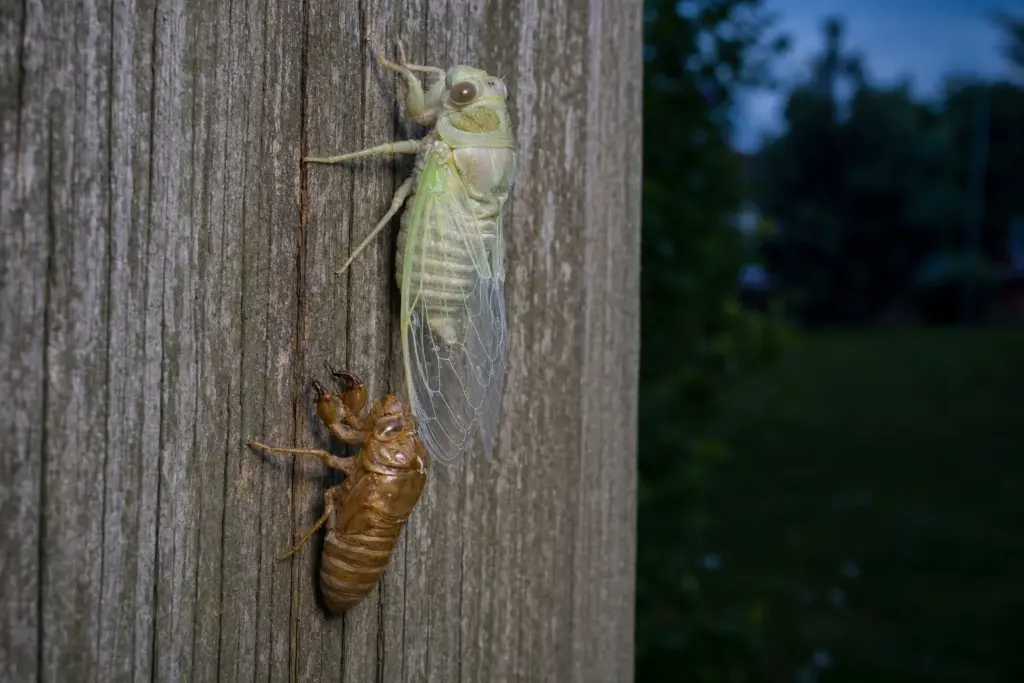
This is one reason the shell holds on so stubbornly. It had to hold the insect safely through a vulnerable transformation. A bad grip would mean falling before the adult had working wings. The empty husk remains locked to the bark because its claws are still hooked into the surface, even after the cicada has left.
Look closely and the shell becomes less creepy and more mechanical. It is a cast mold of a former body, made of dry cuticle and built for leverage. The arch of the legs, the ridged abdomen, and the torn opening all point to the same problem: how to climb out of one body without losing your place in the world.
What gardeners should watch
The shell itself is harmless. The adult cicada is usually harmless too, at least to established trees and shrubs. The main plant concern comes from egg laying. Female cicadas cut small slits into twigs and lay eggs in them. Heavy egg laying can cause branch tips to brown, hang down, or break, a symptom called flagging. University of Maryland Extension notes that this twig damage is not serious for mature trees, but young or newly planted trees can be stunted or injured if the damage is extensive during brood years.1
NC State Extension gives the same practical frame for landscapes: periodical cicadas spend most of their lives underground, adults live only a few weeks, and the landscape problem is largely egg laying in twigs rather than feeding damage.4 That distinction matters because it changes the response. A shell on an old oak trunk is a curiosity. A heavy periodical emergence around a newly planted fruit tree is a protection problem.
For established shade trees, the best response is usually none. A few flagged twigs are natural pruning. The tree will grow past it. For a young redbud, cherry, apple, oak, maple, or ornamental sapling in a major emergence year, temporary exclusion can make sense. Maryland Extension reports that insect netting with openings from 1/4 inch to 3/8 inch prevented injury to small trees in observations from a previous emergence, while bird netting was too open to keep cicadas out.1
What to do with a tree full of shells
If the shells bother you, brush them off with your hand or a soft broom. They can go into the compost, though they are just as acceptable left in place. Dry shells will weather, fall, and break down. Children often find them more interesting than almost anything else in the garden, which is a fair instinct. They are one of the few insect life stages you can study without chasing anything.
Do not treat the shells as a reason to spray. By the time shells appear, the molt has already happened. Broad insecticides are a poor fit for this kind of observation, especially in a garden that also supports bees, predatory wasps, spiders, butterflies, birds, and the many small insects that never make themselves famous. If you need to protect a young tree during a heavy emergence, use a physical barrier before egg laying, secure it so insects cannot crawl underneath, and remove it after the adult cicadas are gone.
Also remember that cicadas are part of the larger food web. During periodical emergences, birds and fish can feed heavily on the temporary abundance.3 Dead adults and uneaten fragments then become organic matter for decomposers. A loud cicada year can feel excessive to human ears, but to the garden it is a pulse: roots, soil, bark, wings, song, eggs, and decomposition all connected in a cycle that mostly runs without our help.
Final thoughts
The empty shell on summer bark is a small object with a long biography. It began underground, attached to a root-feeding nymph. It climbed through the night or early morning, held fast through a difficult molt, and stayed behind after the adult flew toward the sound and heat of the canopy.
That makes it useful garden evidence. It tells you that a nymph emerged from soil nearby and used this surface for its final molt; it does not identify which roots fed the insect underground. It also says summer has reached one of its louder thresholds. Leave the shell, move it, or place it on a windowsill for a closer look. Just do not mistake it for damage. More often, it is the garden showing you one of its oldest seasonal tricks.