
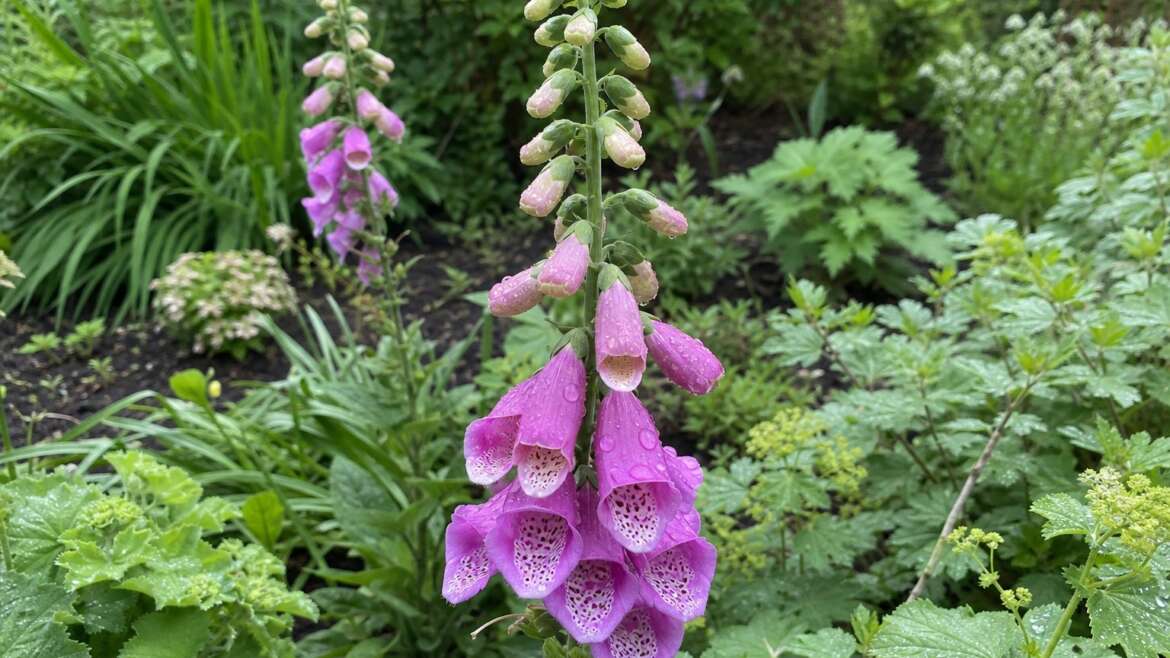
In late May, a foxglove spike can look as though it is keeping two calendars at once. The lowest bells are open, freckled, and deep enough for a bumblebee to disappear into. Halfway up the stem, the flowers are still folded tubes. At the tip, a queue of green buds waits, as if the plant is saving tomorrow’s color for later.
That pattern is easy to admire and just as easy to misunderstand. A foxglove is not making one tall flower. It is making many individual flowers on a vertical stem, each at a slightly different age. The result is a bloom that moves rather than simply appears.
This is part of why foxgloves feel so alive in a border. They do not arrive as a single finished ornament. They climb through their own season, opening from the bottom upward, feeding pollinators in a steady procession, then quietly turning the lower flowers into seed while the upper buds are still deciding what color they will be.
A flower spike is a schedule
Common foxglove, Digitalis purpurea, is usually a biennial or short-lived perennial. In its first year it makes a low rosette of downy leaves. In its second year, that stored energy is sent upward into a flowering stem. Wisconsin Horticulture describes the spike as an elongated terminal raceme, with individual flowers opening progressively up the cluster.1
A raceme is a simple idea with beautiful consequences: flowers are arranged along a central stem on short stalks. The older flower buds sit lower on the spike, so they open first. Newer buds continue to develop nearer the top. Clemson Cooperative Extension notes that foxglove spikes may carry twenty to eighty individual flowers and that they bloom from the bottom up toward the top of the spike.2
For the gardener, this means a foxglove should not be judged the way we judge a tulip. A tulip is mostly one event. A foxglove is a sequence. Lower bells may already be bruised, pollinated, or fading while the upper third still looks young. That is not failure. It is the plant’s normal order.
Why the lower flowers go first
The bottom-to-top rhythm comes from growth itself. The flowering stem does not mature everywhere at once. Its lower buds are older, and the tip keeps extending as the upper buds are still forming. By the time the gardener notices the spike, the lower flowers have had a head start.
That staggered timing lengthens the display. Lower flowers can be fading while fresh flowers open above, so the spike is not spent in one brief flush. Weather and pollinator activity still vary from day to day; the sequence spreads flowering across more of those days.
It also changes how we should care for the plant. If the bottom flowers are finished but the top is still tight with buds, the spike may have plenty left to do. If seed is your goal, the earliest capsules will form low on the stem before the last flowers have opened above them. If seedlings are not your goal, waiting until every upper bud has bloomed may be waiting too long.
The bee route up the tower
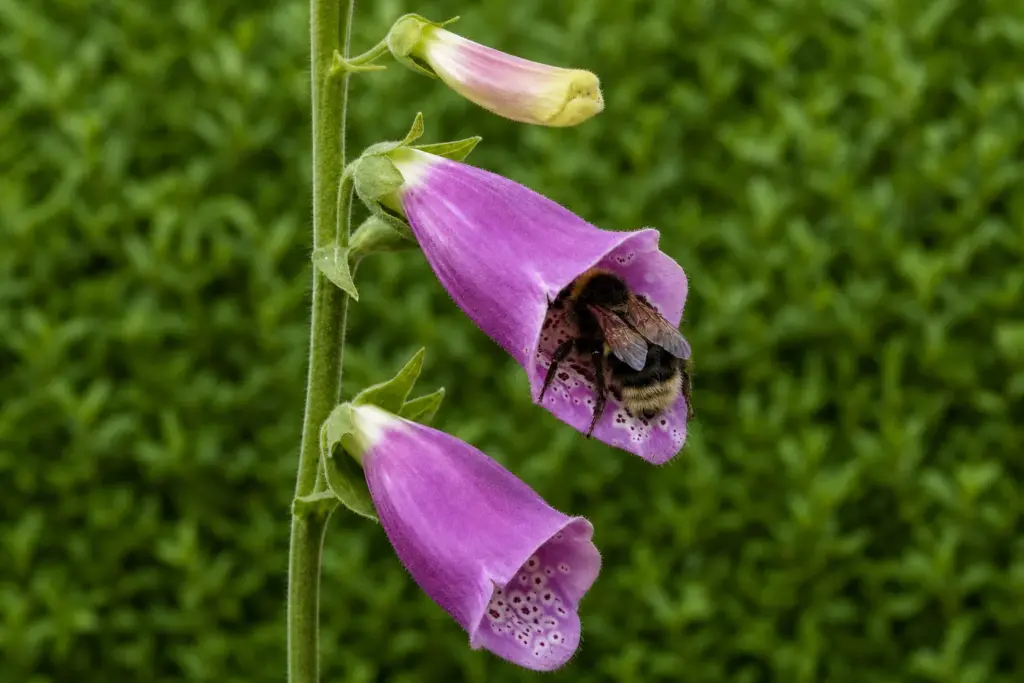
The foxglove’s spotted throats are not just decoration. They guide attention inward, toward the tube where nectar waits. Wisconsin Horticulture describes bees, especially bumblebees, climbing deep into the flowers and rubbing against the flower parts as they reach the nectar ring at the base.1
The direction matters. Oxford University Herbaria notes that the flowers at the bottom of the spike open first, and that bumblebees tend to start with lower flowers before working their way upward and leaving for another plant.3 A foxglove spike becomes a small traffic system: enter low, climb, depart high.
This route makes sense from the bee’s point of view. A vertical line of flowers is easy to follow. Moving upward from one nearby tube to the next costs little time, and the next opening is almost in front of the insect. A field experiment in Annals of Botany used tall larkspur, Delphinium glaucum, to test how raceme architecture shapes bumblebee movement and found proportionally more upward movement on one-sided displays. The authors also cite earlier observations in which bumblebees moved upward during most within-spike flights on Digitalis purpurea.4
The plant benefits from that habit because foxglove flowers also change as they age. Oxford describes foxglove as protandrous, meaning a flower’s pollen-shedding phase comes before the female part is receptive.3 On a bottom-up spike, the older lower flowers are more likely to be in a receiving stage, while younger upper flowers are more likely to offer pollen. A bee that arrives carrying pollen from another foxglove may deposit it low, then leave with fresh pollen from higher flowers. The tower is not only pretty. It is organized.4
What it means in the garden
Foxgloves earn their place by height, but their timing is just as useful. They give a border a vertical mark without making it feel static. One week the lower bells are the show. A few days later the middle of the spike is alive. By the end, the last flowers may be opening near the tip while the lower stem has already begun the seed-making work.
That moving display pairs well with plants that soften the base. Lady’s mantle, hardy geraniums, ferns, hostas, columbines, and loose grasses can hide the rougher lower leaves as the flower spike rises above them. Foxgloves are especially good near shrubs, walls, woodland edges, and the back or middle of a cottage-style border, where their vertical lines can stand against a quieter background.
The seed question is where many gardeners lose track of the sequence. Wisconsin Horticulture notes that foxglove can produce enormous numbers of seeds and readily self-sows when conditions suit it; deadheading limits excess seedlings, but some flowers must go to seed if you want the planting to renew itself.1 So the decision is not simply deadhead or do not deadhead. It is how many spikes you want to become next year’s rosettes.
If you want a self-renewing patch and local guidance does not flag common foxglove, let one or two good spikes ripen after flowering, then edit the seedlings later. Wisconsin Horticulture notes that the species is widely naturalized and considered invasive in some places, so check local invasive-plant guidance before deliberately encouraging seed spread.1 Where foxglove spreads too freely, cut the stems before the lower capsules mature. If you want a tidier plant and a chance of smaller side shoots, remove the main spike once the best of the bloom is over rather than leaving every stem to age in place.2
Growing the rhythm on purpose
The hardest part of growing foxgloves is often remembering the first year. A seedling rosette can look modest, even weedy, while the plant is storing the energy that will become next year’s tower. North Carolina Extension describes foxglove as a biennial that makes only a rosette in the first year, then sends up a tall spike in the second.5 If you pull every rosette during cleanup, you remove the future display.
Seedlings are easiest to manage when they are small. Move them while the roots are still compact; Wisconsin Horticulture recommends spacing or thinning plants to about 18 inches (45 cm).1 For deliberate sowing, surface matters. Wisconsin also recommends leaving foxglove seed uncovered because it is among the seeds that need light to germinate.1 Press the seed into prepared soil, keep it gently moist, and resist the urge to bury it deeply.
Foxgloves prefer the kind of soil many woodland-edge plants like: moist, well-drained, and rich in organic matter without being waterlogged. North Carolina Extension notes that drought stress can limit flower production and that afternoon shade suits the plant well.5 In cool climates they often tolerate more sun. In hotter gardens, light shade can keep the leaves from flagging before the spike has finished its climb.
Do not overmanage a permitted self-sown patch into stiffness. Where local guidance allows it, let a few seedlings appear where the garden has room for them, then thin hard where they crowd paths, smother smaller perennials, or put tall poisonous plants where children and pets are likely to investigate.
The necessary warning
Because Soil Sages often celebrates edible flowers, this needs to be said plainly: foxglove is not an edible flower. It is a beautiful, bee-visited ornamental, but it should never be used in teas, salads, decorations for food, or homemade remedies.
Poison Control states that all parts of foxglove are poisonous, possibly deadly, if swallowed.6 North Carolina Extension identifies cardiac glycosides as the toxic principle and lists Digitalis purpurea as having high-severity poison characteristics.5 The lesson is not to panic at the sight of a foxglove in a border. It is to place it intelligently, label it if needed, and keep it out of edible plantings and play spaces.
If anyone may have swallowed foxglove, do not wait for symptoms: contact a local poison center or emergency medical service promptly, and do not induce vomiting unless a clinician instructs you to do so.6
Wear gloves if the leaves irritate your skin, and wash your hands after handling cut stems.1 Gather stems and seed capsules promptly and keep them away from children and animals that might mouth them. A plant can be both beloved and off limits. Foxglove is exactly that kind of plant.
Final thoughts
Once you notice the bottom-up flowering of a foxglove, the spike stops being just a column of bells. It becomes a record of time. The lower flowers are yesterday’s invitations, the middle is today’s traffic, and the top is still holding tomorrow in green.
That is the pleasure of growing plants closely. The garden is full of shapes that are also processes. A foxglove spike is height, color, pollinator architecture, seed strategy, and warning label all at once. Plant it where it belongs, give it moist, well-drained soil and climate-appropriate light, and let the tower open at its own pace. The best part is watching the bloom climb.
References
- University of Wisconsin-Madison Division of Extension: Common Foxglove, Digitalis purpurea
- Clemson Cooperative Extension HGIC: Foxglove
- Oxford University Herbaria: Digitalis purpurea
- Annals of Botany: Flower orientation influences the consistency of bumblebee movement within inflorescences
- North Carolina Extension Gardener Plant Toolbox: Digitalis purpurea
- Poison Control: Foxglove: Toxic to the heart