
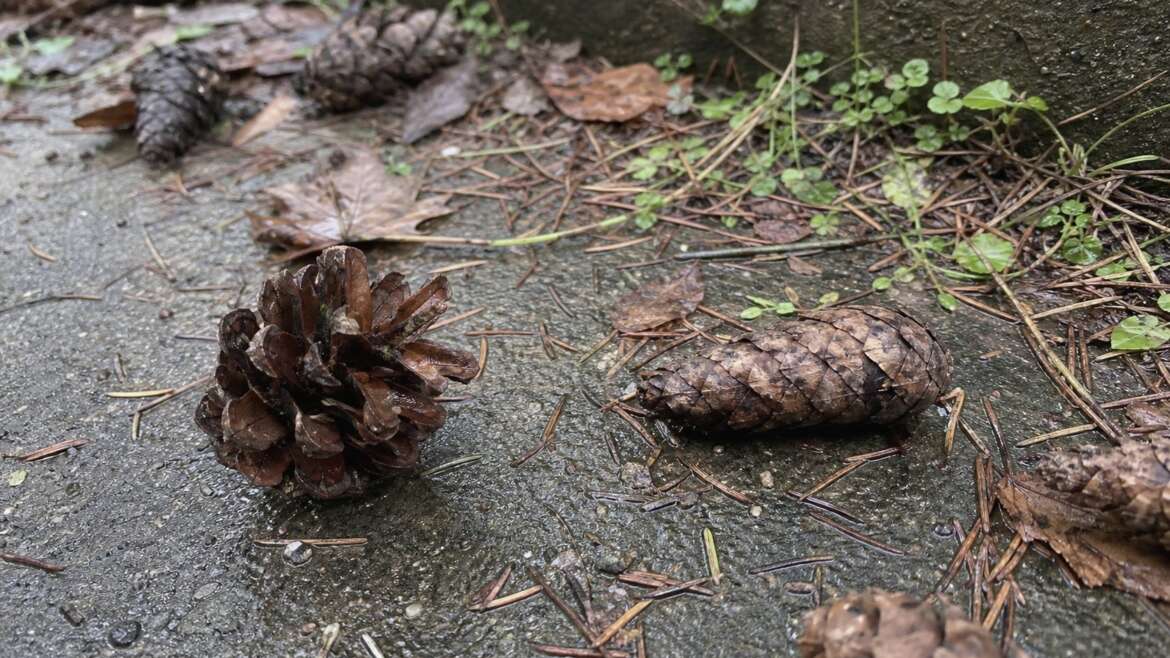
A pine cone on a December path can look like a small piece of carved weather. On a dry afternoon, its scales flare outward and cast little shadows. After rain, the same cone tightens into a darker, neater shape, as if it has tucked itself away from the cold.
It is tempting to read this as a kind of plant mood. Open means bright weather. Closed means rain. There is some truth in that, but the cone is not forecasting the sky in any mystical way. It is responding to the air and water around it, using a built-in structure that still works after the cone has fallen from the tree.
That is the quiet charm of pine cones. They are familiar enough to step over, decorate with, or toss into a basket by the door, yet they are also little machines for timing seed release. A mature cone can keep opening and closing without nerves, muscles, or living green tissue. Wood, water, and geometry do the work.
A cone is not a fruit
The brown pine cone most people recognize is a female seed cone. Pines, spruces, firs, cedars, junipers, and many of their relatives are gymnosperms, plants whose seeds are not enclosed inside a fruit the way apple seeds are enclosed in an apple. University of Missouri Extension describes pine cones as protective structures for developing seeds, with pollen produced in smaller male cones and seeds forming on the upper surfaces of female cone scales after fertilization.1
That makes the cone more than a decorative object. It is a seed shelter, a weather gate, and a dispersal device. While the seeds are developing, the cone and its resinous surface help protect them from erratic weather and herbivores.1 When the seeds are mature, the scales can separate enough for seeds to leave; in many pines, those seeds have wings that let moving air carry them.
Humidity is a gate, not a wind forecast. Studies of pine-cone movement describe closure in damp conditions as delaying release when dispersal would tend to be short, while dry scales gape and make release possible.4 How far a seed then travels still depends on air movement and its surroundings; a cone can open on a dry, still day. The mechanism selects a release window, not a destination.
The hinge that keeps working after death
The classic study on this mechanism, published in Nature in 1997, examined Monterey pine, Pinus radiata, and showed that seed-bearing cone scales respond to relative humidity: they open when dry and close when damp. The important surprise is that mature cone scales are made of dead cells, so the movement is passive rather than controlled by metabolism.2
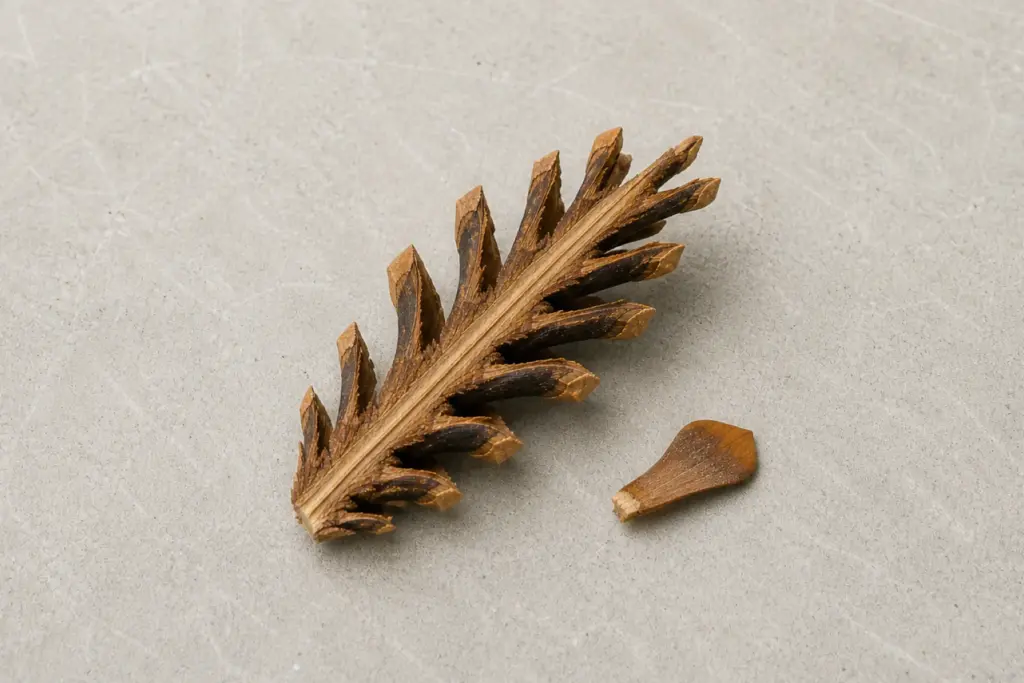
Near the hinge, a useful mechanical model treats each scale as a layered strip of plant material. In experiments on Pinus coulteri, Reyssat and Mahadevan found that long, thick-walled cells in the responsive outer tissue lengthened as humidity rose, while the inner layer changed much less. Because the layers are bonded together, they cannot expand independently. The mismatch bends the scale.3
When the scale becomes damp, unequal swelling draws it inward and helps close the cone. When the scale dries, the scale bends outward again. Most of that deformation is concentrated near the scale’s attachment to the cone’s central axis; the long outer portion acts as a lever that magnifies a small change at the hinge.3 It is the same broad physical idea that makes a bonded strip curl when one layer changes length more than the other.
Reyssat and Mahadevan described pine cones as natural hygromorphs, objects that change shape in response to environmental humidity. Across the cone scales they tested, wetting and drying took from minutes to hours, with response time increasing as the active tissue became thicker. Geometry and water transport help determine how quickly and how far a scale moves.3
Rain does not soak the cone by accident
A wet pine cone can look as if water has simply drowned it into closing, but the details are more elegant than that. In a Scientific Reports study called “Journey of water in pine cones,” researchers followed how water moves across and into cone scales. They found that on rainy days cone scales fold to reduce seed release in humid weather, and that water moves along the outer scales toward the inner parts where it can drive structural change.4
The study also showed that the motion is not spread evenly through the whole scale. Its distal and middle points moved most, while the proximal point at the base remained nearly still.4 That matches the hinge geometry measured in the earlier hygromorph study: deformation near the attachment is amplified into a much larger sweep at the tip.3
This is why the transformation feels so dramatic when you bring a cone indoors. A wet cone on a windowsill may slowly loosen over several hours as the house air dries it. Wet it again, and it can close again. The cone is not coming back to life. It is behaving like a well-made wooden instrument that keeps answering moisture long after growth has ended.3
Why the movement has force
The motion is slow, but it is not weak. In a laboratory test of scales removed from maritime pine, Pinus pinaster, wetted scales pushed against a restraint with 2.2 to 3.6 newtons of force, depending on where each scale had grown on the cone.5 That measurement does not turn an intact cone into a tiny vise, but it shows that the closing scale can press rather than merely drift inward.
A cone is not just changing shape at the surface. Water is entering cell walls and tiny spaces within the tissue. Those tissues swell, and because their fibers constrain swelling in some directions more than others, the swelling becomes organized movement. A pine cone scale is small, but it is built from many microscopic fibers all obeying the same physical rule.
This is one reason pine cones have interested designers of responsive architecture and materials. Related hygroscopic geometry lets the dead awn of a self-burying seed twist as humidity changes.3 Neither structure needs batteries or a living motor. Water movement is both signal and power source.
A small winter experiment
If you want to see the mechanism clearly, collect two mature brown cones of the same species and similar size. Use cones that are already dry and open. Immerse one in room-temperature water and keep the other dry and airy as a comparison. As the wetted cone takes up water, its scales should draw inward; weathered cones and different species may respond at different rates.
Then swap them. Let the closed cone air-dry on a plate, and immerse the open one. The change is not instant: the research measurements ranged from minutes to hours depending on tissue thickness and drying conditions, so check several times and again the next day.3 The cones underfoot are not forecasting devices, but their changing shape makes a normally invisible exchange of water easy to watch.
The same principle matters if you collect cones for seed or crafts. Do not seal damp cones in plastic. Let them air-dry in a paper bag or shallow tray in a ventilated place. As the cones open, seeds and small fragments may fall out, so a contained but breathable setup is useful.
The fire exception
Humidity-driven bending is not every cone’s only gate. Jack pine, Pinus banksiana, is predominantly closed-coned, but individual trees can carry nonserotinous cones or a mixture of open and serotinous types. In a serotinous cone, a resinous bond holds the scales shut. The USDA Forest Service notes that high heat, usually from fire, opens these cones, although hot, dry weather can open some of them.6
Fire does more than supply heat. When fire opens serotinous jack pine cones, seeds can fall onto burned duff or exposed mineral soil, where establishment is more likely than in deep, undisturbed organic matter.6 The variation matters: not every jack pine cone waits for fire. The larger point is that cone opening is a release mechanism shaped by species, population, weather, and disturbance, not one universal schedule.
What gardeners can read from cones
A pine cone is not a precise hygrometer, and it will not replace a weather station. Different species, cone ages, tissue thicknesses, and degrees of weathering behave differently. A cone lying half buried in mulch will respond more slowly than one on a dry step. Treat its shape as a lagging sign of the cone’s own recent moisture balance, not a prediction: open scales usually indicate a drier state, while tight scales indicate that the tissue has taken up water.
In the garden, that is a gentle reminder that plants are always living inside microclimates. The path, the mulch, the raised bed, the shed wall, the evergreen canopy, and the open lawn do not share one uniform atmosphere. A cone under a spruce may stay damp long after the patio dries. A cone near a south-facing wall may open while the rest of the border still feels wet.
That does not mean you need to manage every cone you see. Leave them where a little surface litter suits the site, and rake them off paths if they become slippery. Heavy accumulations close to buildings deserve a separate decision in fire-prone regions, guided by local defensible-space advice. The cone’s humidity response is interesting; it is not a reason to ignore ordinary access or fire safety.
The pleasure is mostly in noticing. A winter garden can seem still because the obvious green growth has paused. Pine cones prove that stillness is not the same as immobility. Even after their cells are dead, the cones keep answering moisture, opening as they dry and closing as they take up water.
Next time you pass one on a wet path, pick it up and remember that it is not a trinket shaped like a tree. It is the tree’s old seed gate, still moving by the rules of wood and water.
References
- University of Missouri Extension: Cone-bearing plants of many shapes, sizes, and species
- Dawson, Vincent and Rocca: How pine cones open
- Reyssat and Mahadevan: Hygromorphs, from pine cones to biomimetic bilayers
- Scientific Reports: Journey of water in pine cones
- Scientific Reports: Evaluation of force generation mechanisms in natural, passive hydraulic actuators
- USDA Forest Service Fire Effects Information System: Pinus banksiana, jack pine