

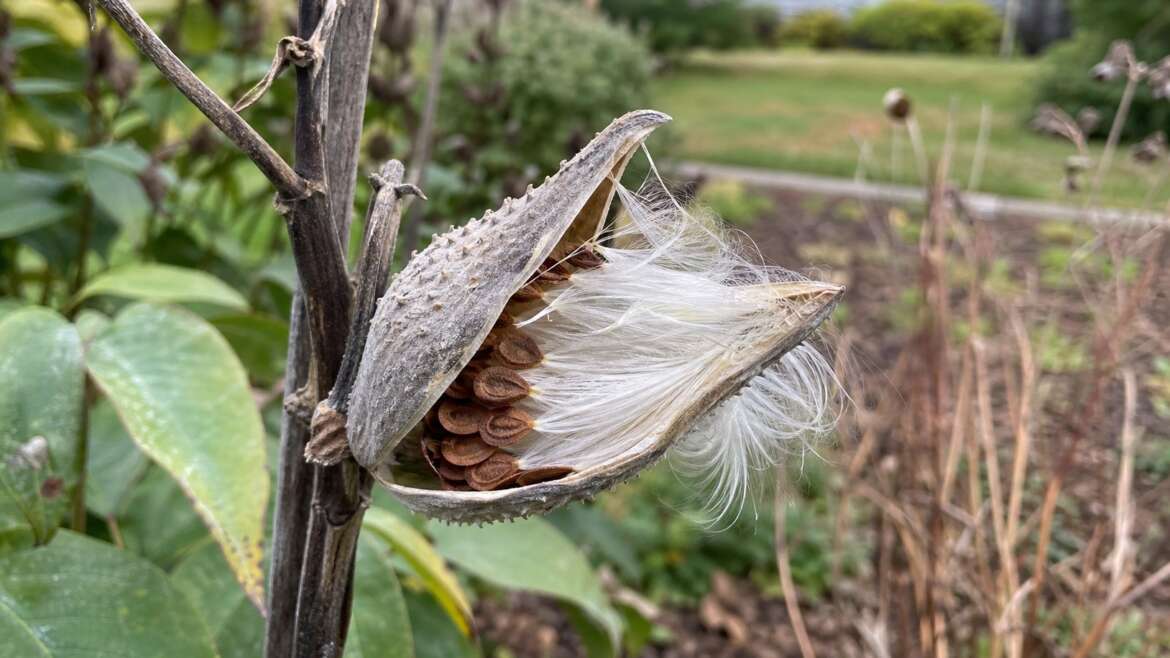
By early October, a milkweed pod can look as if it is holding its breath. The green has faded toward gray. The skin has toughened. A seam that was almost invisible in August begins to lift, and inside the pod is a compressed little weather system: brown seeds packed like shingles, each one tied to a white silk sail.
The first loose strands are often the sign to stop walking and look. They catch on a stem, shine in low sun, and then, when the pod finally opens far enough, the whole arrangement starts to behave less like a seed head and more like a quiet launch. Milkweed fruits split when mature, and each seed carries a tuft of floss, coma, pappus, or silk that helps the wind move it away from the parent plant.1
That is the charm of milkweed in autumn. It is not only a monarch plant, not only a pollinator flower, and not only a slightly unruly perennial. It is a plant with an exit strategy you can hold between two fingers.
A pod built to open once
Gardeners usually call it a pod, which is fair enough, but botanically a milkweed fruit is a follicle: a dry fruit that opens along one side. Common milkweed, Asclepias syriaca, makes spindle-shaped follicles covered with soft hairs, according to the USDA NRCS plant guide.7 NC State Extension describes the familiar warty seed pods and the many hair-tufted seeds that are dispersed by wind.3
The structure explains why the opening feels so deliberate. The pod does not crumble like a dry leaf or scatter seed in every direction at once. It splits along its seam and exposes rows of seeds attached to silk. In damp weather the bundle may stay compressed. In dry air it loosens. The hairs spread, the seed tilts, and the wind suddenly has something to grip.
This is why a milkweed pod can look ready for days before it actually lets go. Maturity is not just the pod turning brown. The seed inside has to finish. If the seeds are still pale, the pod is only acting ripe. If the seeds are brown and the seam opens under gentle pressure, the timing is much closer.5
Why the silk matters
The silk is not decoration. It is drag. A bare milkweed seed is a small brown oval that would mostly fall near the parent plant. Add a fan of fine hairs and the seed becomes slow in air. It can lift, tumble, snag, pause, and lift again. Oklahoma State Extension calls those feathery filaments the coma and notes that they aid wind dispersal.4 Illinois Extension gives the gardener’s version of the same story: mature milkweed flowers become pods whose seeds are attached to white fluffy floss, easily moved through the landscape by wind.6
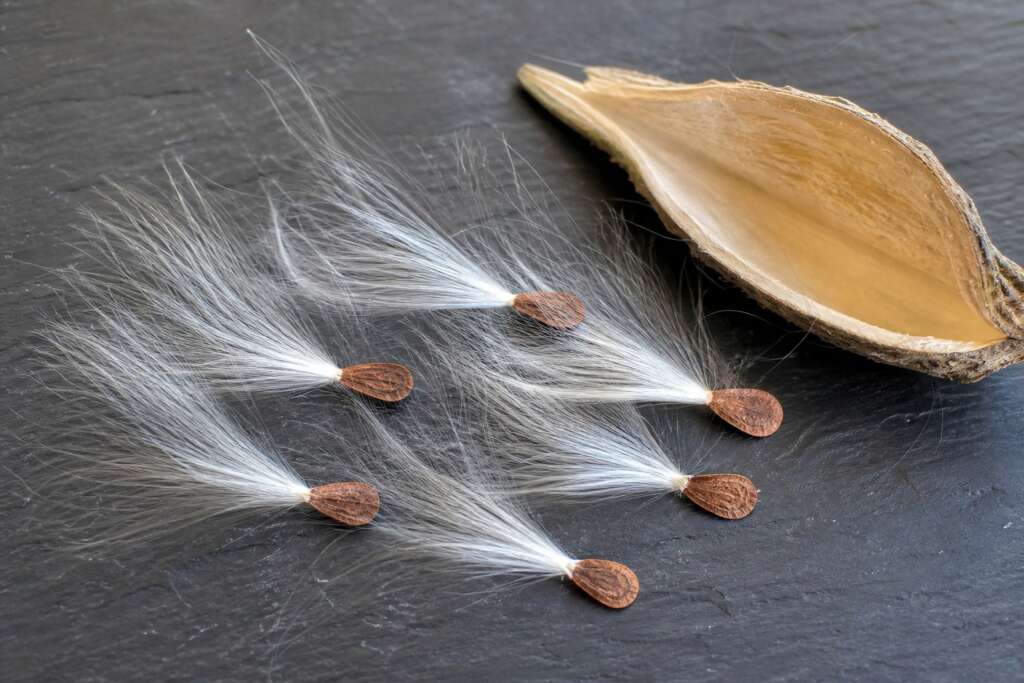
A single seed does not need to fly like a maple samara or drill itself into soil like a stork’s-bill seed. It only needs enough time aloft to leave the shade, crowding, and competition of the plant that made it. Most will fail anyway. That is normal. Seed dispersal is not a guarantee of success. It is a widening of the odds.
The silk also changes how the gardener sees the plant. In summer, milkweed is often judged by flowers, leaves, caterpillars, aphids, and height. In October, the seed machinery becomes the main event. A border that looked tired can suddenly be full of pale fibers and small departures.
The monarch connection is real, but not the whole plant
Milkweed deserves its monarch reputation. Monarch Joint Venture describes milkweed as essential monarch habitat because monarchs lay eggs only on milkweeds and monarch larvae eat only milkweed leaves.2 Common milkweed also provides nectar for butterflies, bees, and other pollinators, and NC State lists it as a larval host plant for monarchs.3
Still, the best milkweed patch is not designed for a single photograph of a caterpillar. It is designed as habitat over time. Adult monarchs need nectar too, especially during fall migration, when late-blooming nectar sources help them store energy.2 A milkweed planting works better beside asters, goldenrods, mountain mint, blazing star, coneflowers, and other regionally appropriate flowers than as a lonely clump in mulch.
It also helps to think beyond common milkweed. Monarch Joint Venture notes that there are more than 100 milkweed species in North America and emphasizes using milkweed species native to your region.2 In a small formal bed, common milkweed may be too vigorous. Swamp milkweed, butterfly weed, whorled milkweed, or another local species may fit better, depending on soil, moisture, and climate.
One caution belongs here because the plant invites touching. Milkweed sap is not salad dressing. NC State warns that the bark, flowers, seed pods, leaves, roots, and stems of common milkweed are poisonous, which can be a problem for cats, dogs, and horses.3 Admire the pods. Save seed. Do not turn curiosity into a snack.
How to save seed without stealing the whole show
The simplest seed-saving rule is to take less than the plant offers. Monarch Joint Venture advises collecting only a portion of the seeds in a location and leaving some for natural regeneration.5 Oklahoma State Extension makes the same practical point for native sources: do not overharvest, because some seed should remain to distribute naturally.4
Choose pods one by one. They do not all ripen together, even on the same plant. A good pod opens at the seam with light pressure, and the seeds inside are brown.5 The Missouri Extension and Xerces native milkweed guide says mature pods split along a vertical seam and that collection is easiest when the seam has just begun to split but before the floss has fully expanded.6 That is the sweet spot: ripe enough to trust, not so open that the whole pod escapes into your sleeve.
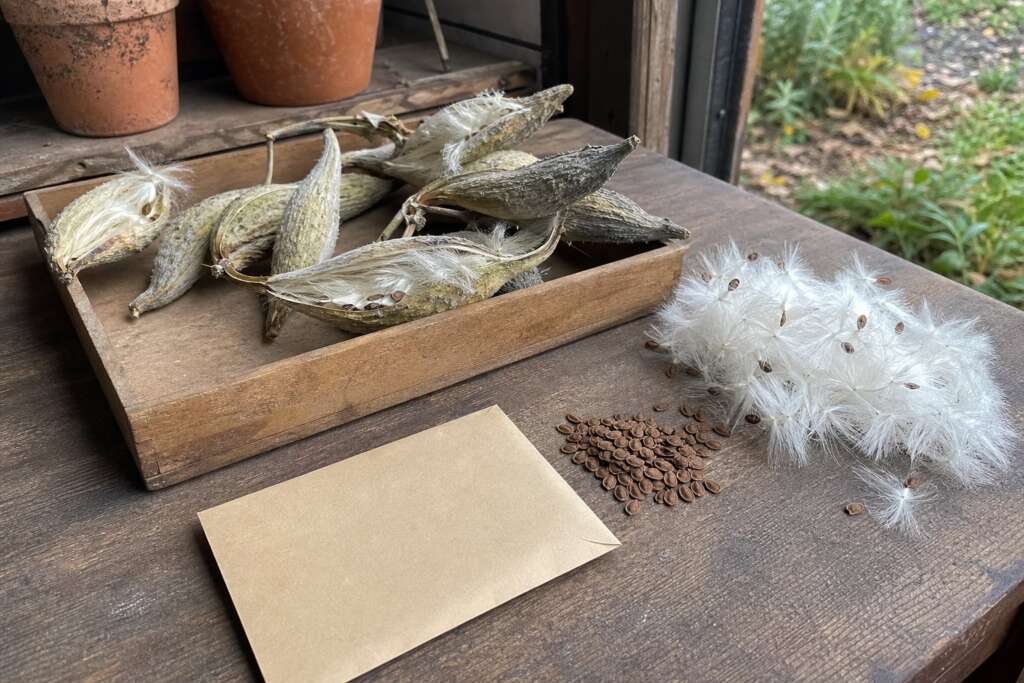
Use a paper bag, paper envelope, or breathable container for fresh pods. Moist seeds sealed in plastic can mold. Monarch Joint Venture recommends breathable containers for moist pods or seeds, thorough drying before packaging, and labeling seed with species, collection location, and date.5 The label matters more than it seems. A packet that says only milkweed becomes much less useful a year later.
Milkweed bugs complicate the harvest. They are part of the milkweed world, but they feed on seeds. Monarch Joint Venture advises avoiding open pods with numerous milkweed bugs, and the Missouri Extension and Xerces guide notes that feeding by milkweed bugs can make seeds inviable.56 If a pod is already busy with bugs, leave it or choose another.
Sowing the next patch
Milkweed seed often wants a winter cue. Oklahoma State Extension explains cold moist stratification as a way to mimic the time seeds would naturally spend in winter soil and notes that most native milkweed species need at least some period of cold moist stratification.4 Monarch Joint Venture also notes that milkweed seeds need cold treatment and can be planted in fall so winter temperatures stratify them naturally.5
For a home garden, fall sowing is usually the most graceful method. Clear a small patch of competing vegetation. Scratch the soil surface. Sow lightly, press the seeds into contact with the soil, and mark the spot so you do not weed out the seedlings in spring. The USDA NRCS guide for common milkweed recommends direct sowing in fall and gives greenhouse cold treatment as an option for spring propagation.7
Do not expect every seed to become a plant, and do not expect every new plant to stay exactly where you imagined. Common milkweed can spread by underground shoots and may be too assertive for tight ornamental borders.7 That is not a flaw in the plant. It is information for placement. Give vigorous species a meadow edge, a sunny back corner, or a pollinator strip where some movement is acceptable.
Once plants are established, resist the urge to manage them like precious houseplants. Many native milkweeds are perennials that die back and return from established root systems.1 Leave room for that seasonal disappearance. The empty-looking spot in winter may be holding the next year’s stems below ground.
Final thoughts
A milkweed pod opening in October is a small lesson in restraint. The plant does not chase its future. It builds a chamber, dries at the right time, loosens one seam, and lets air do the carrying.
For the gardener, the answer is much the same: notice the pod, save a little seed if you have a place for it, leave plenty for the garden, and choose milkweeds that belong where you live. The silk is beautiful because it is useful. It is the plant’s way of making departure visible.
References
- Western Monarch Milkweed Mapper: Milkweed Biology
- Monarch Joint Venture: Habitat Needs
- NC State Extension Gardener Plant Toolbox: Asclepias syriaca
- Oklahoma State University Extension: Native Milkweed Germination Guide
- Monarch Joint Venture: Milkweed Seed Collection
- Missouri Extension and Xerces Society: Pollinator Plants of the Central United States, Native Milkweeds
- USDA NRCS Plant Guide: Common Milkweed