

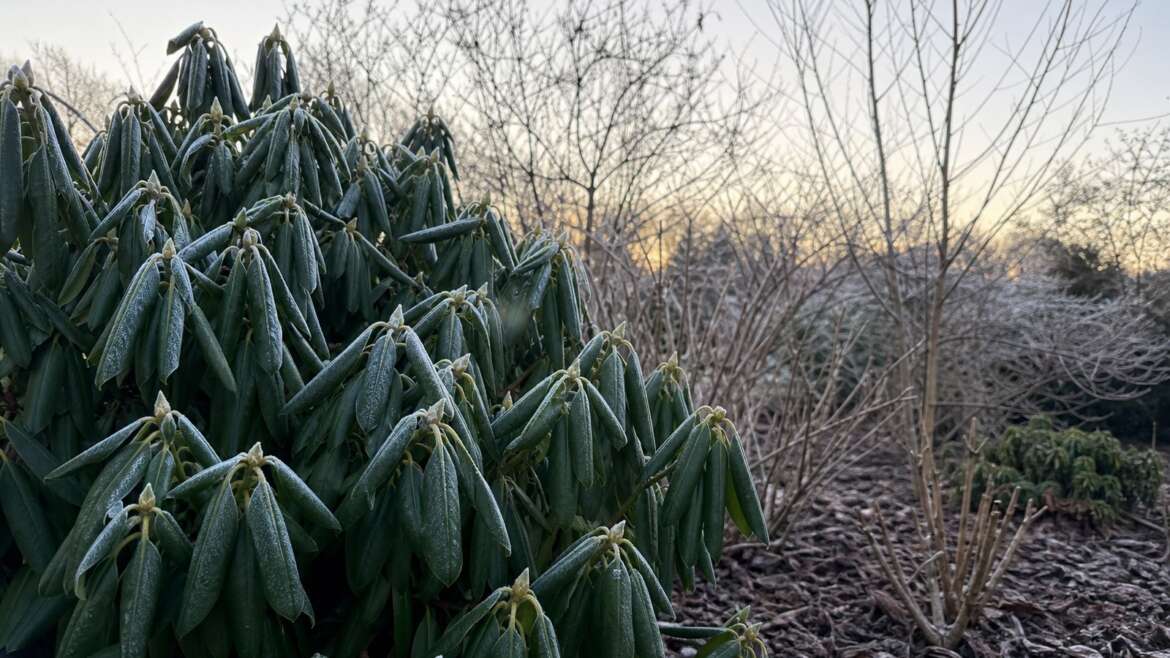
On a January morning, a rhododendron can look as if it has lost its nerve. Yesterday the leaves were broad, glossy, and almost tropical in their confidence. Today they hang like narrow green cigars, each one drooping from the twig and curled along its length as if the whole shrub has tightened itself against the cold.
It is an alarming performance if you do not know the trick. The plant looks thirsty. It looks frozen. It looks as if it might be considering death as a lifestyle. Then the afternoon warms a little, the leaves relax, and by evening the shrub may look ordinary again. Nothing has been watered. Nothing has been saved. The plant has simply changed shape.
Rhododendron leaf curl is one of winter’s most useful garden signals because it is both dramatic and easy to misread. Sometimes it is harmless. Sometimes it points toward a real water problem. The difference matters, especially for newly planted shrubs, exposed sites, and broadleaf evergreens asked to live in bright wind when their roots are sitting in frozen ground.
A cold response, not a collapse
The winter movement of rhododendron leaves is a form of thermonasty, a plant movement triggered by temperature rather than by the direction of light, wind, or touch. A 2014 review by E. T. Nilsen, Rajeev Arora, and M. Upmanyu describes these movements during freeze-thaw events as leaf drooping and rolling, especially in evergreen rhododendrons that keep broad leaves through winter.1
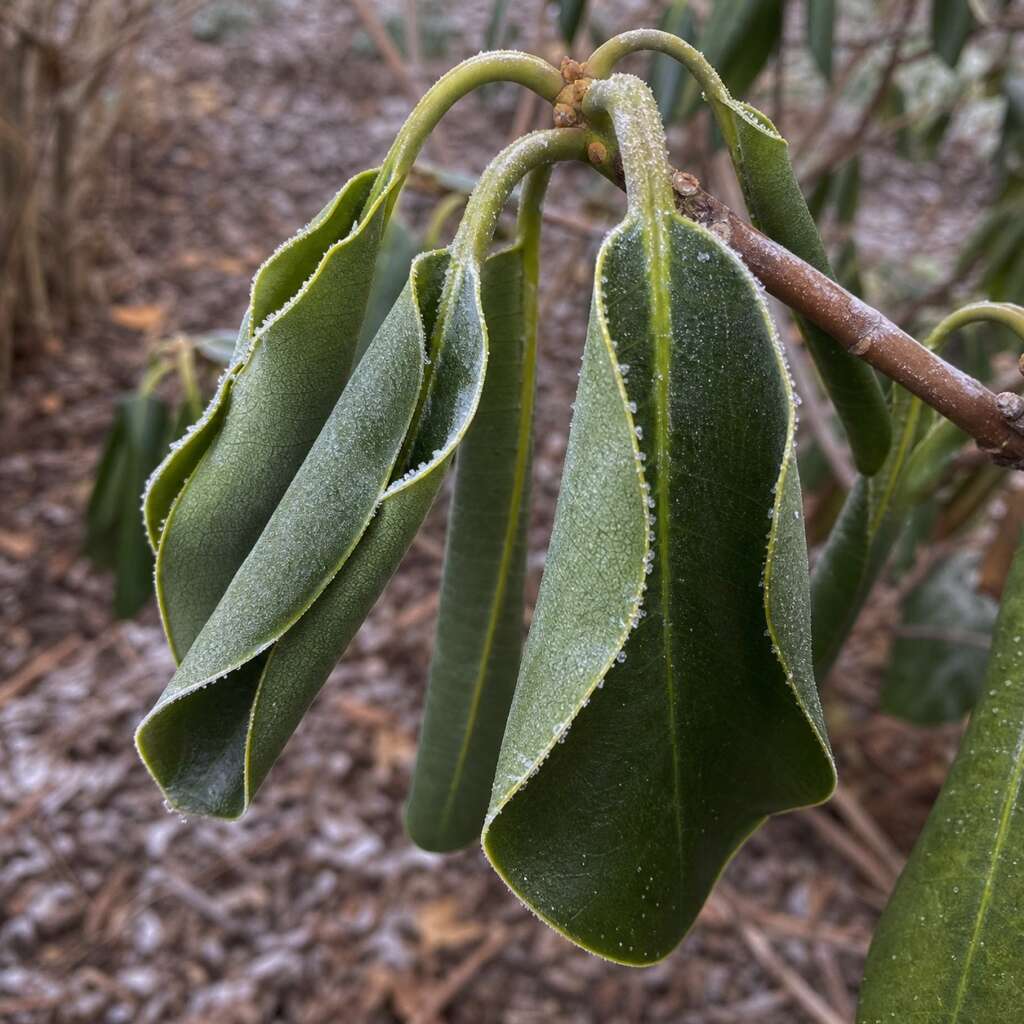
That detail is important. The leaf is not turning away from the sun in the way a sunflower head once did. It is not climbing, twining, or reaching. It is responding to the temperature of its own tissues. In the cold, the leaf blade rolls inward and the leaf angle changes, so the broad paddle becomes a narrower hanging form.
Researchers have been interested in this movement for a long time because it is so visible. Nilsen and Athena Tolbert, writing in the Journal American Rhododendron Society, noted that winter leaf curling in rhododendrons is stimulated by temperature, while summer curling can also be stimulated by water stress.2 In other words, the same curled shape can have different causes depending on season and context.
What the curl may be doing
The honest answer is that rhododendron leaf curl is still more interesting than fully settled. It is probably doing more than one job, and different parts of the movement may matter in different weather. The broad idea is simple enough: a flat evergreen leaf in winter is a risky solar panel. It can intercept bright light when the leaf is too cold to use that energy normally.
When photosynthesis is slowed by low temperature, excess light can become a stress rather than a gift. The 2014 review describes winter broadleaf evergreens as vulnerable to the combination of freezing temperature and high radiation, especially after a deciduous tree canopy has dropped its leaves and the understory is suddenly brighter.1 A leaf that droops and rolls exposes less flat surface to winter light and changes how quickly it gains and loses heat.
Nilsen and Tolbert also found that some hardy species, including Rhododendron maximum and Rhododendron catawbiense, showed intense curling at low temperatures. In their study, the leaf temperature needed to begin curling in several species was around 0 to -2 degrees Celsius, and the most intensely curling species reached 80 percent or greater curling at -6 degrees Celsius.2
That is why the shrub can behave like a living thermometer. You may notice the leaves loosen on a mild gray day, roll on a bright frozen morning, then relax again when the air rises above freezing. The movement is reversible because the leaves are not simply damaged tissue. They are still alive, still hydrated enough to move, and still attached to a winter strategy that has worked for their lineage in cold forests.
A shrub built for cool, sheltered places
Garden rhododendrons are often treated as foundation shrubs, but the plant’s instincts are more woodland than pavement. Rosebay rhododendron, Rhododendron maximum, is native to eastern North America and is especially associated with the southern Appalachian Mountains. NC State Extension describes it as an evergreen shrub that prefers moist, well-drained, richly organic, acidic soil in dappled shade, with protection from afternoon sun that can scorch the leaves.3
The USDA Fire Effects Information System gives the wild plant the same kind of ecological mood: cool, humid climates, shaded conditions, and thickets that can moderate temperature, reduce desiccating winter winds, and hold higher humidity around themselves.4 That does not mean every rhododendron wants to live in a wet cave. It means the plant is often happiest where soil moisture, air humidity, shade, and shelter work together.
This is why the same cultivar can look composed in one garden and miserable in another. A rhododendron tucked under high deciduous branches, mulched over cool soil, and shielded from winter wind may curl dramatically in cold and then recover cleanly. The same plant on a south-facing wall, above compacted soil, beside a salted path, or in a windy corner may curl too, but the curl is no longer just a winter gesture. It may be paired with drying stress.
The water problem hiding inside winter
The trap is that gardeners usually think of winter injury as a cold problem. For broadleaf evergreens, it is often a water problem wearing a cold-weather mask. The leaves remain attached, so they can still lose moisture. On sunny or windy days, that loss can continue even when the ground is frozen and the roots cannot replace water quickly.
University of Minnesota Extension notes that winter sun, wind, and cold can dry evergreen foliage, and that dry conditions going into winter make plant tissues more susceptible to cold damage, especially on evergreens.5 PlantTalk Colorado describes needled and broadleaved evergreens as prone to winter desiccation because they keep leaves and continue to transpire during warm, dry winter periods, while dry soils can leave small absorbing roots unable to keep up.6
Winter burn is the visible aftermath. Margins brown. Tips bronze. The side facing sun or wind looks worse than the protected side. A branch above the snow line may be damaged while leaves that spent the coldest weeks under snow stay green. The curled shape was not the burn. The burn came when the leaf lost more water than the plant could replace.
Normal curl versus real trouble
A normal cold curl is usually even across the plant, or at least across the exposed portions of the plant. The leaves remain green, leathery, and attached. They may droop and roll tightly in the morning, then open again during a thaw or on a milder afternoon. If you gently touch a leaf, it should still feel flexible rather than brittle. The shrub may look theatrical, but it does not look scorched.
Real trouble has a different pattern. Browning along the margins, papery tips, tan blotches on the sunward side, entire leaves that stay curled after the weather moderates, or sections that fail to recover in spring all deserve attention. Missouri Botanical Garden describes desiccation or winter burn as an evergreen problem caused by low soil moisture, freezing temperatures, and blowing wind, with broadleaf evergreens such as rhododendron showing browning along leaf margins.7
Timing helps too. If the shrub curls only during cold spells and relaxes when temperatures rise, the movement itself is probably normal. If leaves remain curled through mild weather, or if browning advances after a dry, windy winter, you are looking at stress rather than ordinary thermonasty. Do not rush to prune in February. Some injured leaves will drop. Some buds will still push. Waiting until growth begins gives you better evidence than a cold-day panic inspection.
How to help without fussing
The best care for winter leaf curl happens before the hard weather, and most of it is plain good gardening. Enter winter with moist soil, not saturated soil. Keep the root zone mulched. Shelter the plant from drying wind. Give it bright shade rather than a reflective furnace. Those choices matter more than hovering over curled leaves with a watering can on a frozen morning.
Rhododendrons have shallow, fibrous roots, so mulch is not decoration. It moderates soil temperature, slows evaporation, and protects the fine roots near the surface. NC State Extension recommends wood chips, bark, or pine needles to help retain moisture and stabilize soil temperatures around Rhododendron maximum.3 Keep the mulch broad and modest, not piled against the stems.
Watering is also about timing. If autumn is dry, water deeply before the ground freezes. University of Minnesota Extension recommends watering heavily before freeze-up in dry falls to reduce frost penetration, and notes that mulch and snow help keep soil temperatures higher.5 In climates with winter thaws and long dry spells, water during mild periods when the soil is not frozen. Do it early enough in the day that water can soak in before night temperatures fall again.
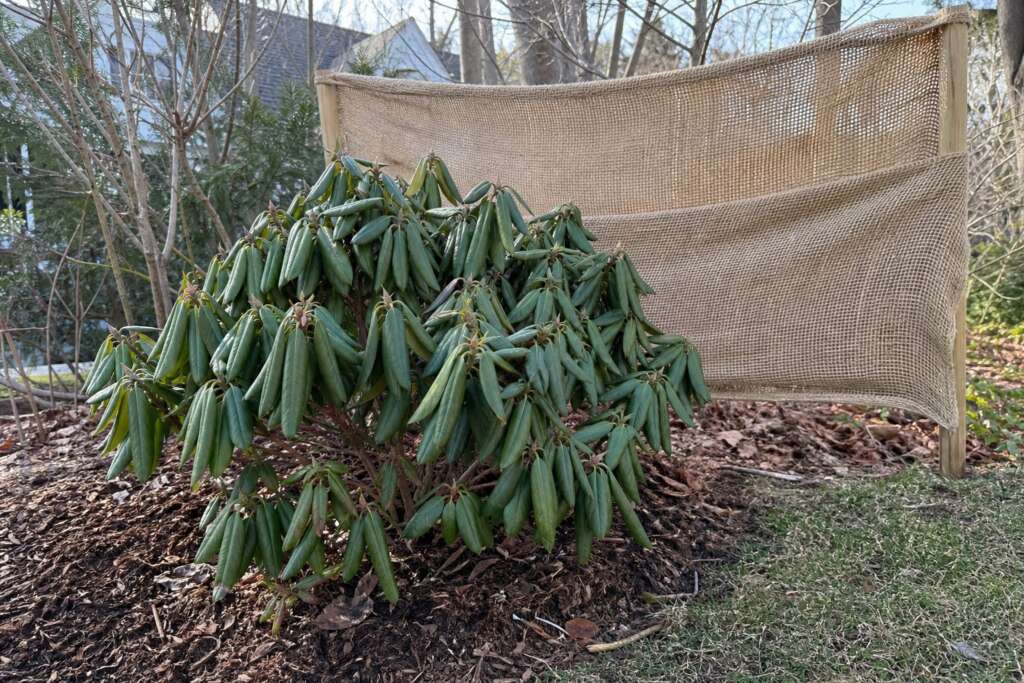
If wind is the main problem, build a screen rather than a cocoon. A burlap barrier on the windward side can deflect drying air while allowing the shrub to breathe. Missouri Botanical Garden includes wind barriers, adequate water, and organic mulch among its strategies for desiccation or winter burn.7 Wrapping foliage tightly can trap moisture, rub leaves, shade the plant too heavily, and create a different set of problems.
Be cautious with fertilizer. A rhododendron entering winter does not need a late push of tender growth. If the plant is struggling, the answer is usually better soil moisture, better drainage, better siting, or less root competition, not more food. Avoid cultivating around the root zone, because the roots are shallow and easy to tear. If the site is fundamentally wrong, moving the shrub after bloom or in early fall may be kinder than repeatedly nursing it through a hostile corner.
Choosing a better place for the next one
Winter leaf curl teaches a design lesson: evergreen does not mean invincible. A rhododendron gives the garden structure in the empty months, but it pays for that gift by keeping living leaf tissue exposed to cold air. The best site lets the plant be evergreen without forcing it to be heroic.
Look for morning light and afternoon protection, especially where winter sun is sharp. Avoid places where reflected heat bounces from pale walls, driveways, stone, or snow into the foliage. Give the shrub room for air, but not a wind tunnel. Improve compacted soil before planting, and do not bury the root ball too deeply. A slightly raised planting in organic, acidic, well-drained soil is often better than a low pocket that stays wet and cold.
Also choose the plant for the place. A cold-hardy species or cultivar still needs roots that function, leaves that do not dry out, and buds that are not roasted by January sun after a frozen night. Hardiness zones are a starting point, not a guarantee. Microclimate is the fine print.
What the shrub is telling you
The curled rhododendron leaf is not a failure of evergreen beauty. It is the machinery behind that beauty briefly made visible. A flat, glossy leaf is a summer face. A rolled, hanging leaf is the winter face, narrower, darker, and less eager to catch light it cannot safely use.
So when the shrub tightens itself on a cold morning, look before you worry. Notice whether the whole plant is moving together. Notice where the wind hits. Notice which leaves relax during a thaw and which ones stay brown at the edges. The plant is not simply asking for rescue. It is reporting the weather, the site, and its own winter physics in green.
That is the pleasure of paying attention in January. The garden seems still, but it is full of small adjustments. Some happen underground. Some happen inside buds. Some are hidden in the chemistry of cold-tolerant cells. And some, like the rhododendron’s curled leaves, are right in front of us, as plain as a thermometer and much more alive.
References
- E. T. Nilsen, R. Arora, and M. Upmanyu: Thermonastic leaf movements in Rhododendron during freeze-thaw events
- E. T. Nilsen and Athena Tolbert: Does Winter Leaf Curling Confer Cold Stress Tolerance in Rhododendron?
- NC State Extension Gardener Plant Toolbox: Rhododendron maximum
- USDA Fire Effects Information System: Rhododendron maximum
- University of Minnesota Extension: Protecting trees and shrubs in winter
- PlantTalk Colorado: Winter Desiccation of Evergreens
- Missouri Botanical Garden: Desiccation or Winter Burn