
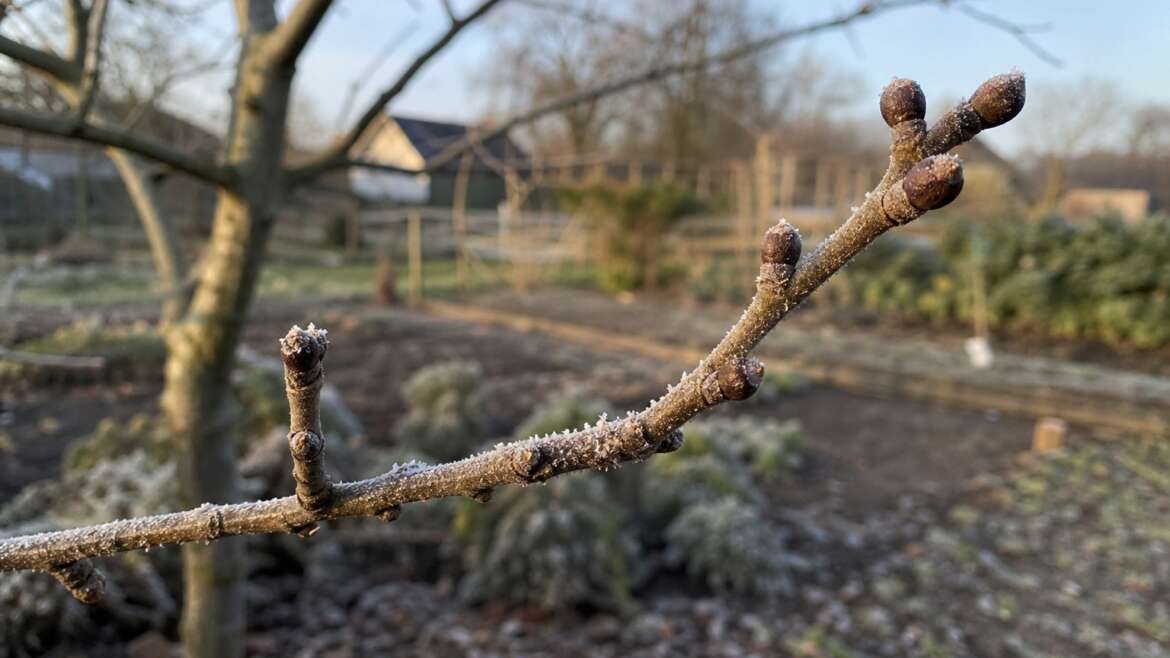
On a cold January morning, a fruit tree can look almost empty. The leaves are gone, the grass is flattened, and the branch tips seem to be holding nothing more interesting than brown dots. It is easy to walk past an apple, peach, plum, cherry, pear, or blueberry and think the garden has become a diagram of waiting.
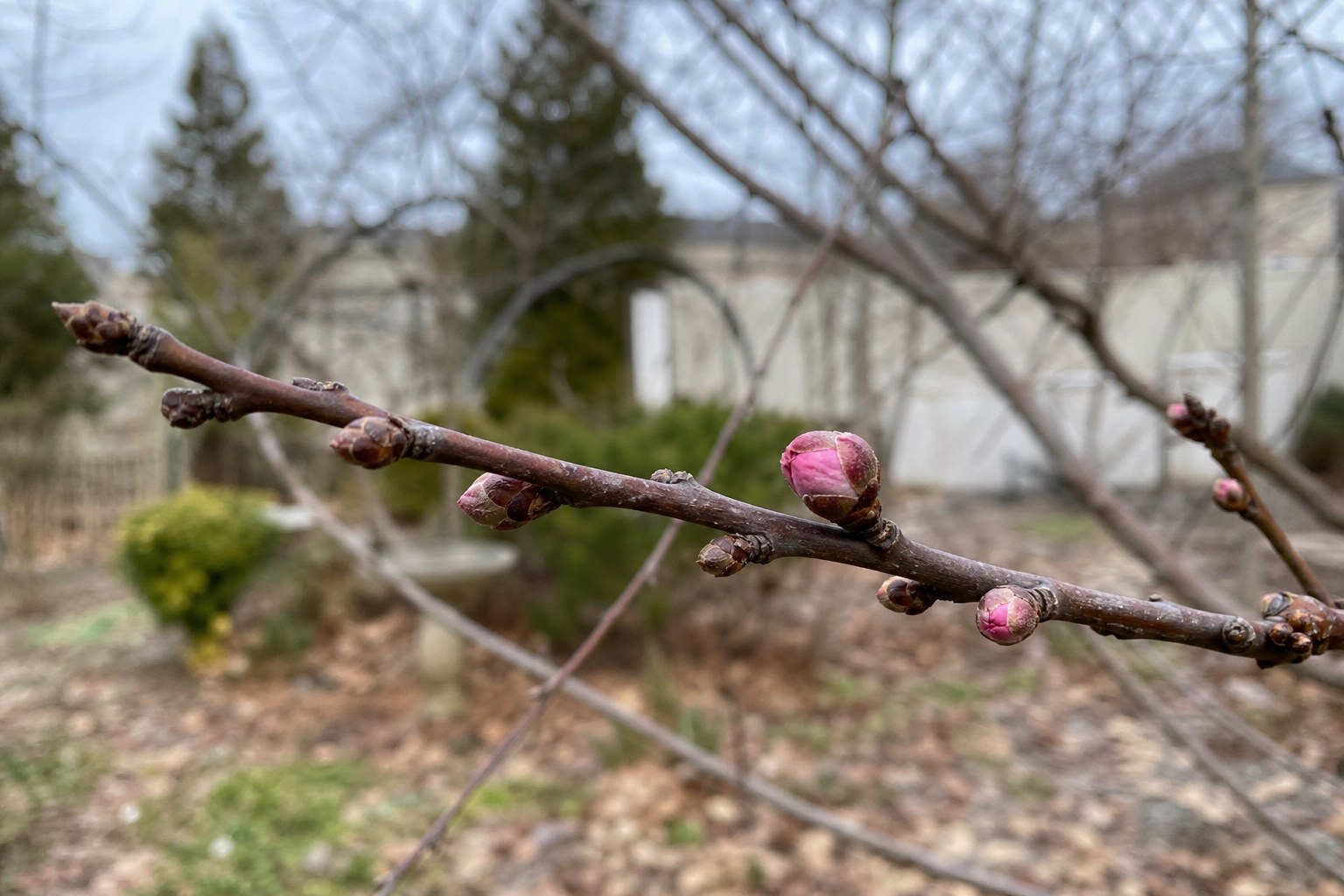
But those dots are not punctuation. They are sealed rooms. Inside many of them are the beginnings of leaves and flowers that were formed months ago, then wrapped in scales and set aside. The tree is not deciding in March whether it would like to bloom. Much of that decision was made the previous summer, refined in autumn, and then held under a winter lock.
That lock is where chill hours enter the story. Many temperate fruiting plants need a period of cold before they can break dormancy, grow normally, and fruit reliably the following season.1 The cold does not simply punish the tree into spring. It gives the buds information. A fruit tree in winter is keeping a quiet account of the weather, adding useful cold to an internal ledger until enough has accumulated for spring growth to become possible.
Dormancy is not one long nap
Gardeners often speak of dormant trees as if they are asleep, which is a useful image until it becomes too soft. Dormancy is more controlled than sleep. It is a set of physiological brakes that keep growth from beginning at the wrong time.
In autumn, as days shorten and temperatures fall, above-ground growth slows, leaves drop, and hormonal changes prepare deciduous fruit plants for cold weather.1 During the deepest part of that rest, buds may remain closed even if a few mild days arrive. Illinois Extension describes this internal block as endodormancy: the bud is not growing because the plant itself is holding it back, even when outside conditions briefly look friendly.2
This is why a warm afternoon in December does not usually make an apple tree burst into bloom. The bud has not yet had the necessary winter experience. The air may feel springlike to us, but the bud’s lock has not opened.
The kind of cold that counts
A chill hour is often explained in the simplest possible way: one hour of cold exposure during winter dormancy. For home gardeners, Clemson Extension notes that tracking hours below 45°F is often sufficient, even though several chill models exist.4 Other models count only hours in a narrower band, such as 32°F to 45°F, or weight different temperatures differently.
The important point is that not all cold is equally useful. The University of Arkansas Extension describes 35°F to 45°F as a good range for chill accumulation, with little or no chilling accumulated below 35°F in that model, and notes that some models subtract chill when temperatures rise above 60°F.3 UC Master Gardeners of Santa Clara County similarly describe the common 32°F to 45°F range and note that warm daytime temperatures above roughly 65°F to 70°F can count against accumulated chill.5
That makes chill hours more interesting than a crude count of freezing nights. A bitter stretch below freezing may preserve dormancy and hardiness, but it is not always the most efficient signal for ending dormancy. The useful cold is closer to refrigerator cold than to deep-freezer cold. It is cool enough to be winter, not so severe that the plant’s metabolism is almost shut down.
Why one mild week does not mean spring
Chill is one side of the spring equation. Warmth is the other. A bud that has not satisfied its chill requirement is still held back by internal dormancy. Once enough chilling has accumulated, the same bud becomes more responsive to warmth. Then, as late winter and early spring temperatures rise, the tree begins accumulating heat that pushes buds toward swelling, leafing, and bloom.
This two-step system is one reason temperate fruit trees survive ordinary winter confusion. A few mild days in midwinter are not enough if the chill requirement has not been met. But after the requirement has been satisfied, the tree is more vulnerable to being hurried by warm spells. Arkansas Extension puts it plainly: once adequate chilling has been reached and temperatures warm, buds begin to grow and the plant flowers.3
That is why low-chill varieties can be risky in places with long, cold winters. If a peach variety needs only 200 chill hours and it is planted where 700 hours is normal, it may satisfy its requirement early. A warm spell can then encourage bloom while much of winter still remains. Arkansas Extension uses exactly this kind of mismatch to explain why cold damage to emerged buds is common when low-chill varieties are planted in medium- to high-chill areas.3
Every fruit has its own winter appetite
Chill requirements vary by species, and then again by cultivar. That is why two peaches can behave differently in the same yard, and why an apple that is sensible in one region can be disappointing in another. Arkansas Extension lists broad average ranges such as 800 to 1,000 chill hours for apple, 700 to more than 1,000 for cherry, 300 to 800 for peach, 400 to 900 for pear, and much lower ranges for some figs and southern highbush blueberries.3
Those numbers are not a secret password. A tree does not count to 799 and fail, then count to 800 and become perfect. Chill listings are estimates tied to models, climates, and observed plant performance. They are still useful because they point you toward varieties that belong in your winter.
This is also where hardiness zones can mislead gardeners. USDA zones describe average annual extreme minimum temperature. They help answer whether a plant is likely to survive winter cold. Chill hours ask a different question: will winter give the buds the kind and amount of cold they need for reliable bloom and fruit? A tree can be hardy enough to live in your garden and still be poorly matched to your winter rhythm.
What too little chill looks like
When a fruit tree does not receive enough useful winter chill, the result is usually not theatrical death. It is disorder. Buds may open late, bloom may stretch out unevenly, leaves may emerge irregularly, and flowers may be fewer or weaker. Mississippi State Extension notes that insufficient chilling can lead to delayed leafing, reduced fruit set, and poor fruit quality.1 USDA Climate Hubs describes reduced chill accumulation in terms of irregular bloom, poor fruit or nut development, and reduced yield and quality.6
In a home garden, that can be hard to diagnose because the symptoms look like several other problems. A peach with poor fruit set may have had frost at bloom, not enough pollinator overlap, weak flower buds from the previous summer, poor pruning, drought stress, or inadequate chill. The tree does not attach a note to the branch explaining which insult mattered most.
Still, the pattern is worth learning. If a variety leafs out patchily after a mild winter, blooms over a long ragged period, and sets little fruit while nearby better-matched trees behave normally, lack of chill moves higher on the list of suspects. Fertilizer will not repair that missing winter. Hard pruning will not add January back into the buds. The useful response is observation, record-keeping, and, next time you plant, a better cultivar choice.
What too much eagerness looks like
The opposite problem is just as important. A low-chill cultivar in a colder region may satisfy its winter requirement too soon, then respond eagerly to a warm late-winter spell. The tree has done exactly what its genetics told it to do. The gardener is the one who planted a fast alarm clock in a place where the night is still long.
Early bloom is not automatically a virtue. It can be beautiful for three days and ruined on the fourth. Many fruit flowers are far less cold-hardy once they begin opening than they were as tight dormant buds. A cultivar that blooms before the local pattern of hard freezes has passed may lose its crop repeatedly, even though the tree itself survives.
This is why the best fruit-tree choice is not always the lowest chill number you can find. In warm-winter areas, low-chill cultivars may be essential. In colder or variable areas, a moderate or higher chill requirement, plus a bloom time that avoids the worst local frosts, may be more useful. The goal is not to make the tree wake as early as possible. The goal is to make it wake at the right time, often enough, for your garden.
Your garden has its own chill map
Regional chill maps are helpful, but they are not the whole garden. A yard is full of small weather. Cold air settles in low pockets. A south-facing brick wall warms early. A slope drains frost differently from a flat lawn. A city garden may hold more winter warmth than a rural orchard outside town. Large bodies of water, elevation, and urban heat can all shift chill accumulation and spring timing.
Clemson Extension emphasizes that chill hours vary by site and microclimate, including factors such as elevation, water, and urban areas.4 UC Master Gardeners note that cold-air pockets and winter shade can increase chill hours within a landscape.5 This is practical information, not trivia. The same cultivar can be slightly more cautious in one corner of a property and slightly more reckless in another.
If you are choosing a new fruit tree, look for local Extension chill data, nearby weather-station tools, and regional nursery experience. Ask for the cultivar’s chill requirement, not only its hardiness zone. Ask when it tends to bloom locally. If it needs a pollination partner, ask whether the partner blooms at the same time in your area, not only whether it is listed as compatible in a catalog.
If you already have a fruit tree, become its historian. Notice when the first buds swell, when bloom begins, how long bloom lasts, whether flowers open evenly, and what the weather did in the weeks before. A few years of notes can teach you whether a tree is behaving like a good citizen of your garden or like a plant forever translating the wrong winter.
The climate wrinkle
Winter chill is also one of the quieter ways climate change enters orchards and backyards. In warm fruit-growing regions, warmer winters can reduce the number of useful chilling hours. USDA Climate Hubs notes that California perennial crops are expected to face fewer hours of chilling temperatures as winters warm, with adaptation becoming important for high-chill crops such as walnuts, pistachios, and cherries.6
The story is not identical everywhere. In very cold regions, some warming can move more winter hours into the range that counts for chill, while also allowing trees to meet chill requirements earlier and become vulnerable to late-winter warm spells. Illinois Extension points out both sides of that concern: some northern areas may see more hours in the effective range, while plants that meet chilling sooner may be more likely to break bud during late-winter warmth.2
For a home gardener, this does not mean every fruit tree choice is suddenly doomed. It means old assumptions deserve checking. A cultivar recommended thirty years ago may still be excellent, or it may now sit closer to the edge of reliability. Local knowledge matters more, not less, when winter becomes less predictable.
A better way to read a bare branch
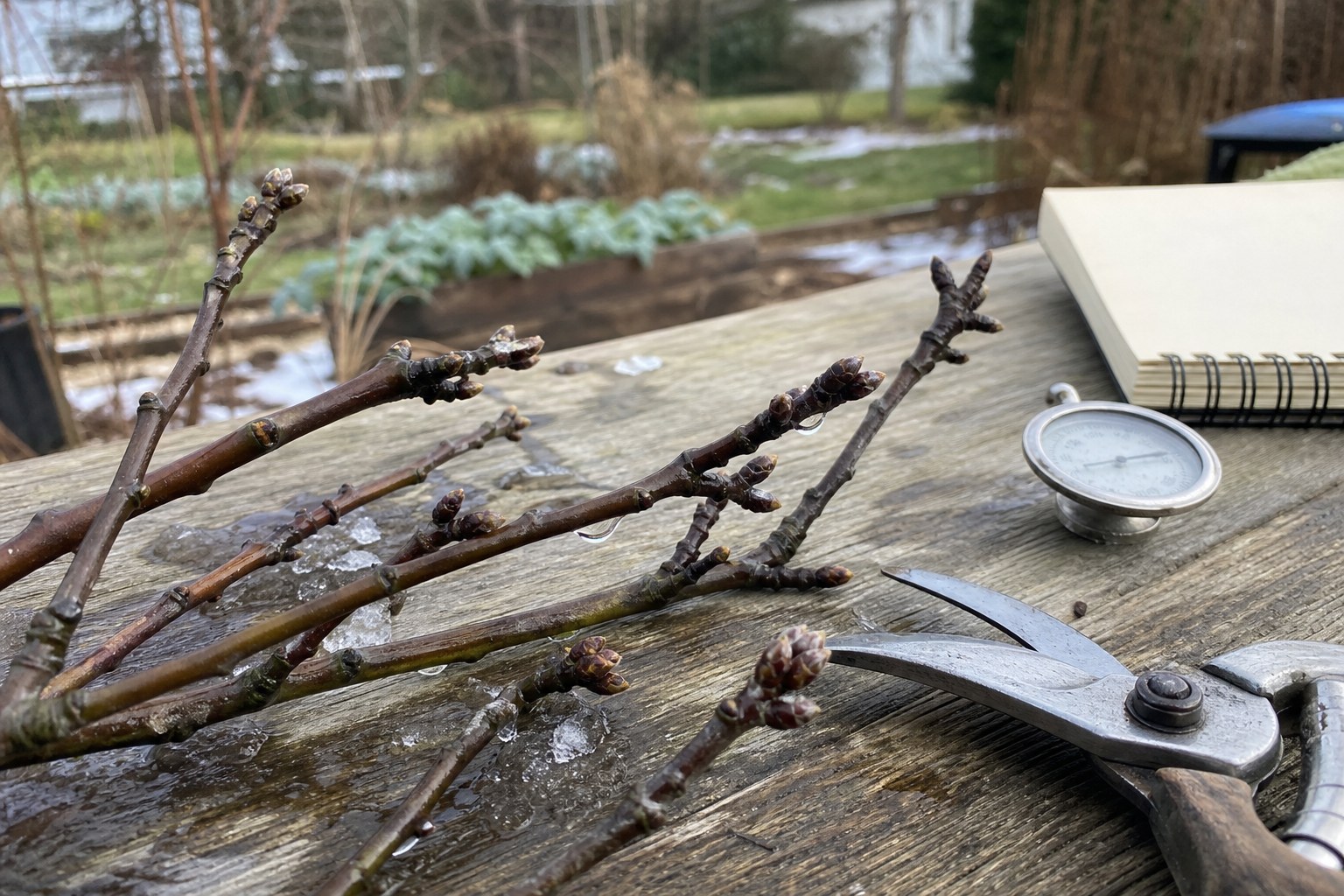
Once you understand chill hours, a January fruit tree stops looking blank. The buds are still closed, but they are not idle. They are locked, counting, waiting for the right sequence of cold and warmth. Some winters hand them a clear instruction. Some winters mumble. The following bloom is often the translation.
That knowledge changes how you shop, plant, and interpret failure. It keeps you from blaming a tree too quickly for a winter it could not read. It keeps you from choosing a cultivar only because the fruit sounds delicious. It reminds you that a successful backyard orchard is not only about sun, soil, pruning, pollination, and water. It is also about whether the buds believe your winter.
The next time you pass a bare apple or peach branch in January, pause for the small brown buds. They are not ornaments on a sleeping stick. They are instruments, measuring the season in cold hours, deciding how spring will be allowed to begin.
References
- Mississippi State University Extension: Chilling Hour Requirements of Fruit Crops
- Illinois Extension: Chilling requirements for plants
- University of Arkansas System Division of Agriculture Extension: Chill Hours and Heat Units for Fruit Production
- Clemson Cooperative Extension HGIC: Understanding Chill Hours for Fruit and Nut Trees in South Carolina
- UC Master Gardeners of Santa Clara County: Chill Hours
- USDA Climate Hubs: Climate Change and Winter Chill